Wednesday, June 25, 2014
Sunday, June 8, 2014
Accidental India, by Shankkar Aiyar
My review of Shankkar Aiyar's book, "Accidental India", was published in the DNA on May 22nd, 2014. Except for the review's title and sub-title - "Should I Be Stupid Just Because the Government Is?"
Funnily enough, in India that was a fact of life and not an absurdity for several decades. - the review was published in its entirety.
This, below, is the review as it appeared in the DNA:
The opportunities that India has squandered, either through indolence or apathy, either individually or collectively, are far too many to be counted. Then there are the quirks of fate that have convinced Indians that perhaps the gods had it in for India – like Lal Bahadur Shastri’s untimely demise just when it seemed India would break free of the socialist straitjacket that had been imposed on the nation, or Sardar Vallabhbhai Patel being asked to make way for Pandit Jawaharlal Nehru as India’s first prime minister despite being the more qualified and better person on every count, or the most unexpected loss of the NDA in the 2004 general elections just when the nation had found a new, confident, and resurgent voice. The list goes on. Perhaps the most public of all humiliations would have been the shipping of Indian gold reserves to England as surety for a paltry loan of $400 million from the Bank of England. But as in every dark cloud, there proved to the silver lining. An accidental silver lining of sorts.
Shankkar Aiyar’s book, Accidental India, has even more relevance in today’s environment, given the trend towards consumption of real-time information in an abbreviated manner (read social media, especially Twitter) which encourages an almost junk-food style of an information diet – quantity without much value. This book looks at seven “accidents” that shaped India’s post-independent socio-economic landscape, for the better, and substantially so.
Funnily enough, in India that was a fact of life and not an absurdity for several decades. - the review was published in its entirety.
This, below, is the review as it appeared in the DNA:
The opportunities that India has squandered, either through indolence or apathy, either individually or collectively, are far too many to be counted. Then there are the quirks of fate that have convinced Indians that perhaps the gods had it in for India – like Lal Bahadur Shastri’s untimely demise just when it seemed India would break free of the socialist straitjacket that had been imposed on the nation, or Sardar Vallabhbhai Patel being asked to make way for Pandit Jawaharlal Nehru as India’s first prime minister despite being the more qualified and better person on every count, or the most unexpected loss of the NDA in the 2004 general elections just when the nation had found a new, confident, and resurgent voice. The list goes on. Perhaps the most public of all humiliations would have been the shipping of Indian gold reserves to England as surety for a paltry loan of $400 million from the Bank of England. But as in every dark cloud, there proved to the silver lining. An accidental silver lining of sorts.
Shankkar Aiyar’s book, Accidental India, has even more relevance in today’s environment, given the trend towards consumption of real-time information in an abbreviated manner (read social media, especially Twitter) which encourages an almost junk-food style of an information diet – quantity without much value. This book looks at seven “accidents” that shaped India’s post-independent socio-economic landscape, for the better, and substantially so.
Sunday, May 11, 2014
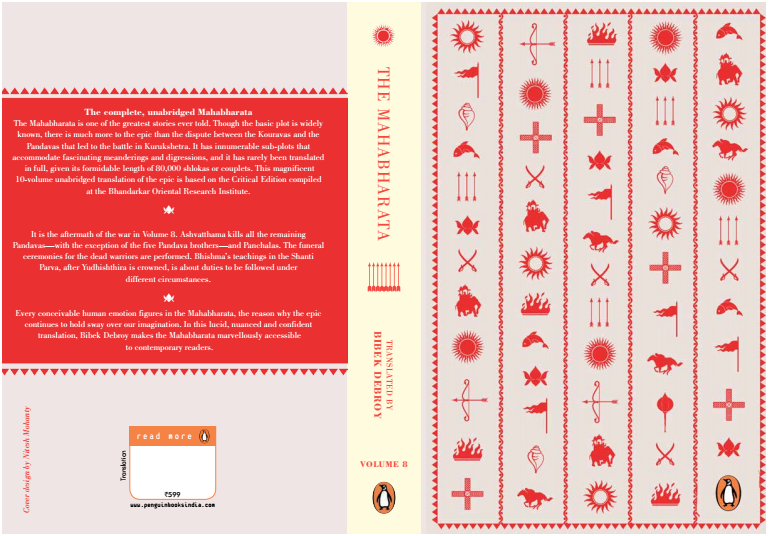
Mahabharata, Vol 8
Mahabharata - Volume 8, Translated by Bibek Debroy

I wrote a short review of Dr. Bibek Debroy's volume 8 of the translation of the Unabridged Mahabharata. It was published in the DNA newspaper's website, at Book Review: 'The Mahabharata' Volume 8 translated by Bibek Debroy | Latest News & Updates at Daily News & Analysis (DNA tweet). My thanks to Harini Calamur.
The full text of the review:
Sunday, February 23, 2014
Indus Valley (Smart Green Civilizations)
Indus Valley: Key stage 2 (Smart Green Civilizations)

Kid-friendly introduction, but marred by selective omissions. Also leaves out the truly spectacular achievements of the people
One-line review: Parents are advised to read out and share this book with children, but are also forewarned that they will need to spend considerable time in correcting the several errors - of commission and omission - in the book.
Longer Review:
The Indus Valley Civilization, more accurately known as the Indus Valley Saraswati Civilization, was the largest and most advanced ancient civilization that existed. This short illustrated book does a good job of introducing the reader - children - to this civilization. It tells us that the Indus people were the first to develop the concept of urban town planning, and were the first to trade with the world. The generous availability of wells meant that people were never far away from access to clean water. Children will like the simple and full-colour illustrations in this book, and the easy style of writing. At the bottom of each page is a short line that has a lesson on environmentalism.
Tuesday, December 31, 2013
Motilal Banarsidas, Bangalore
I had reason to be in Jayanagar a few months back, with 15 odd minutes to spare. I was across the road from the Motilal Banarsidas bookstore, and my feet found their way, along with the rest of me, to the store. I have been to the store a few times before, and every single time have exited the store with a book in tow - that is also the story of my ingress and egress from most other bookstores I frequent, come to think of it. I had posted photos of the store in 2007 (blog post), so I am not going to write about its history or stuff...
Since I have started reading Dr. Bibek Debroy's translation of the unabridged Mahabharata, I have been fascinated more and more by this book, An Index to the Names in Mahabharata by S. Sorensen, 8120820118, 9788120820111 at Mlbd Books. For a book written more than a hundred years ago, it is a stupendous work that has not been rivaled or surpassed. As far as I can tell, there is no other book of its kind attempted since. If you may be wondering why should there be a book on the names in the Mahabharata, then you should take a close look at the unabridged epic.
Since I have started reading Dr. Bibek Debroy's translation of the unabridged Mahabharata, I have been fascinated more and more by this book, An Index to the Names in Mahabharata by S. Sorensen, 8120820118, 9788120820111 at Mlbd Books. For a book written more than a hundred years ago, it is a stupendous work that has not been rivaled or surpassed. As far as I can tell, there is no other book of its kind attempted since. If you may be wondering why should there be a book on the names in the Mahabharata, then you should take a close look at the unabridged epic.Sunday, December 29, 2013
Mahabharata Ch 61-65, Adi Parva, Sambhava Parva
[Ch 59-60 « Ch 61-65 » Ch 66-70]
Parva:Adi; Upa-parva:Sambhava; Chapter:61; Shlokas:102
Janamejaya now wanted to hear from Vaishampayana about the divine origins of the warriors. Vaishampayana told him that the danava Viprachittihad became Jarasandha, Hiranyakashyipu Shishupala, Prahlada's younger brother Samhrada as Shalya, the asura Bashkala as Bhagadatta, the asura Svarbhanu as King Ugrasena, and so on.
Vaishampayana continued, and said that Drona was not born from a womb, and was a part of Brihaspati, while his son Ashvatthama was "born from three parts of Mahadeva that merged into one - yama, kama, and krodha." Kripa was born from the group of rudras, Satyaki, King Drupada, Kritavarma, and rajrishi Virata were born from parts of the divine maruts. Duryodhana was born from Kali's part, while his brothers were born from Pulastya's sons.
Mahabharata Ch 59-60, Adi Parva, Sambhava Parva
[Ch 57-58 « Ch 59-60 » Ch 61-65]
This chapter marks the start of the Sambhava Parva. This parva contains 2394 shlokas and 65 chapters.
"The word sambhava means what can originate or be in existence. Hence, this parva is about the origins of the core story. It is one of the longest parvas."
Parva:Adi; Upa-parva:Sambhava; Chapter:59; Shlokas:54
Janamejaya asked Vaishampayana to recount to him, "from beginning and in detail," accounts of the births of the gods, gandharvas, etc... Vaishampayan said that Brahma had six sons. One of them, Marichi, was the father of Kashyapa. Daksha's daughters were Aditi, Diti, Danu, Kala, Anayu, Simhika, Muni, Krodha, Prava, Arishta, Vinata, Kapila, and Kadru.
"From Aditi were born the twelve adityas... Dhata, Mitra, Aryamana, Shakra, Varuna, Amsha, Bhaga, Vivasvana and Pusha. In the tenth place was Savita, the eleventh was Tvastha and the twelfth was Vishnu."
Mahabharata Ch 57-58, Adi Parva, Adi-vamshavatarana Parva
[Ch 54-56 « Ch 57-58 » Ch 59-60]
Parva:Adi; Upa-parva:Adi-vamshavatarana; Chapter:57; Shlokas:106
In this chapter Vaishampayana primarily describes the birth of Satyavati and her son Dvaipayana. He described Uparichara, also known as Vasu, and a descendant of the Puru lineage, who conquered the kingdom of Chedi, and then retired to practice austerities in a hermitage. This caused a fearful Shakra to try and "wean the king away from his austerities." Indra praised Vasu and offered him many things, including a flying chariot that among mortals only he would be able to fly in, and a garland known as "vaijayanti", and also a "staff made of bamboo to protect the good and the peaceful." Thus Uparichara continued to rule Chedi. Uparichara had five sons - Brihadratha as king of Magadha, Pratyagraha, Kushamba, Macchilla, and Yadu.
Saturday, December 28, 2013
The Blood Telegram, by Gary Bass

The Blood Telegram: Nixon, Kissinger, and a Forgotten Genocide, by Gary Bass
Warning: graphic language. Reader discretion advised.
One-line review: Shines a light and lays bare an ugly passage in American diplomacy.
Short review: The forced exodus of ten million Bangladeshis in 1971 - ninety percent of whom were Hindu, the genocide of an estimated three million Bangladeshis, and the rape of close to half a million women - were all small prices that Henry Kissinger and Richard Nixon paid in exchange for the opening of bilateral ties with China, and in the process getting their names enshrined as visionary statesmen. Henry Kissinger would go on to win a Nobel Peace Prize - a more damning indictment of the elaborate farce that is the Nobel Prize would be hard to find. Archer Blood, consul general in Dacca (as Dhaka was then called) and the "ranking diplomat of the United States in East Pakistan", would protest in the strongest possible diplomatic terms the atrocities perpetrated by the Pakistan army on the citizenry of East Pakistan. He would be ordered to "request home leave and transfer back to the State Department - in other words, unceremoniously sacked" - just one step short of being fired - spend the next decade in a desk job - hiding from an omnipotent Kissinger, his career finished for all practical purposes.Sunday, December 15, 2013
Canada, US, India - Indulging a passion for photography
Three photos, three countries, same year.
The first is from the Canadian city of Fredericton, which also happens to be the capital of the province of New Brunswick. I have a couple of posts on the town, where I spent two months. A most interesting period of time I spent, in what was one of the most eventful years of my life thus far. Spending January and February in Canada means braving lots of cold weather. Cold as in 20 degrees below zero degrees Fahrenheit. Yes, that's close to -30C. Cold as in wind chills of upto -45C. It is a whole different world of cold at those temperatures. Like hell-freezing-over kind of cold. But it makes for gorgeous photographs.
Friday, December 13, 2013
The Best of 2013 - Reading and Reviewing Recap
I list here the ten best books that I read and, or, reviewed in 2013. Along the way, I have also mentioned some other books that I read and, or, reviewed.


Let us start with Indology. I was supremely gratified that I not only got serious - or at least semi-serious - about the topic but also got to read about half a dozen really, really, finger-licking good books. Note to kids: do not try this at home; the finger-licking, that is. Reading? By all means. Not all books were equally awesome, but many were very, very good. Land of the Seven Rivers, by Sanjeev Sanyal was the single best book in this genre that I read this year. I say "this year", because The Lost River: On the Trail of the Sarasvati, by Michel Danino is even better, and by far the best book I reviewed this year. I say "reviewed", because I read this book in January of 2012, but got down to reviewing only this year. And while on the topic of the Saraswati River and the Harappan Civilization, I would be remiss if I didn't mention The City of Dvaraka, by S.R. Rao - perhaps the single most important excavation in the twentieth century, and written by the famed archaeologist who led that excavation - India's first marine excavations to uncover the four thousand year old ancient port city of Dvaraka (modern day Dwarka). Sanjeev Sanyal's Land of the Seven Rivers was on its own a wonderful book, and more so when you compare it with his first book - The Indian Renaissance: India's Rise after a Thousand Years of Decline - that had its heart in the right place, but was dry and unengaging.
Then there was India's Bismarck, Sardar Vallabhbhai Patel, by Balraj Krishna, a short but lucid account of the great Sardar Patel's immeasurably invaluable contributions to a unified India. This book's review was perhaps my most read review of 2013, gathering close to 300 Facebook "Likes" on Centre Right India.

Let us start with Indology. I was supremely gratified that I not only got serious - or at least semi-serious - about the topic but also got to read about half a dozen really, really, finger-licking good books. Note to kids: do not try this at home; the finger-licking, that is. Reading? By all means. Not all books were equally awesome, but many were very, very good. Land of the Seven Rivers, by Sanjeev Sanyal was the single best book in this genre that I read this year. I say "this year", because The Lost River: On the Trail of the Sarasvati, by Michel Danino is even better, and by far the best book I reviewed this year. I say "reviewed", because I read this book in January of 2012, but got down to reviewing only this year. And while on the topic of the Saraswati River and the Harappan Civilization, I would be remiss if I didn't mention The City of Dvaraka, by S.R. Rao - perhaps the single most important excavation in the twentieth century, and written by the famed archaeologist who led that excavation - India's first marine excavations to uncover the four thousand year old ancient port city of Dvaraka (modern day Dwarka). Sanjeev Sanyal's Land of the Seven Rivers was on its own a wonderful book, and more so when you compare it with his first book - The Indian Renaissance: India's Rise after a Thousand Years of Decline - that had its heart in the right place, but was dry and unengaging.
Then there was India's Bismarck, Sardar Vallabhbhai Patel, by Balraj Krishna, a short but lucid account of the great Sardar Patel's immeasurably invaluable contributions to a unified India. This book's review was perhaps my most read review of 2013, gathering close to 300 Facebook "Likes" on Centre Right India.Tuesday, December 3, 2013
Sita: An Illustrated Retelling of the Ramayana, by Devdutt Pattanaik
Note: since I first wrote this and other reviews of Devdutt Pattanaik's books, I have gained a better understanding of Hindu texts and scriptures. I believe Devdutt Pattanaik's writings are influenced heavily by western frameworks and agendas on the one hand, and introduce subtle and sometimes outright distortions in the interpretation of these texts. A small sample of the kinds of outright errors and distortions that would shame any scholar of Hinduism can be found in this blog post.
I therefore do not recommend any of Devdutt Pattanaik's books that I have reviewed on my blog. - Abhinav, Nov 3, 2017.
Review:
In recent times, Devdutt Pattanaik has been the most prolific and successful mythologist-author in India. For almost a decade now, he has explored almost every facet of Hindu mythology, from a rapid-fire look at the spectrum of Hindu mythology in "Myth=Mithya" - that became his most successful book, to gods and goddesses in books like "7 Secrets of Siva", "7 Secrets of Vishnu", "7 Secrets From Hindu Calendar Art", to even dabbling in fiction in "The Pregnant King", and more recently to books targeted specifically at children - "An Identity Card for Krishna", "Shiva Plays Dumb Charades", etc... In 2010, he plunged into a very imaginative and well-researched retelling of the Mahabharata - "Jaya - An Illustrated Retelling of the Mahabharata".
Sunday, November 17, 2013
India's Iron Man - Sardar Vallabhbhai Patel, by Balraj Krishna

Sardar Vallabhabhai Patel: India's Iron Man (India's Bismarck: Sardar Vallabhbhai Patel), by Balraj Krishna
One-line review: His stupendous achievements dwarfed only by the apathy of an ungrateful polity and dishonest historians.Short review: Unless we learn the path we took and who led us down the path, we can never truly hope to correct course and tread towards a brighter future. Blind hero-worship of flawed frauds and idolatry of insidious ideologies cannot ever be the basis of writing history. That is hagiography. This short book on Sardar Vallabhbhai Patel, the iron man of India, is a must-read for anyone interested in understanding what was, what happened, and why we are here. If we today breathe in a united and independent India, we have one person - Sardar Patel - to thank more than anyone else.
Monday, November 11, 2013
Saturday, October 26, 2013
Mahabharata Ch 54-56, Adi Parva, Adi-vamshavatarana Parva
[Ch 51-53 « Ch 54-56 » Ch 57-58]
This parva tells the story of the "partial incarnations" (from "vansha" and "avatarana") of the characters in the Mahabharata.
Parva:Adi; Upa-parva:Adi-vamshavatarana; Chapter:54; Shlokas:24
Upon hearing of Janamejaya's presence at the snake sacrifice, Krishna Dvaipayana, the son of the virgin Kali and Shakti's son Parashara, went there. Krishna Dvaipayana, once born, mastered the Vedas, Vedangas, and Itihasa, and was the first to divide the one Veda into four parts.
When he entered the sacrificial arena, Janamejaya offered a golden seat to Vyasa and paid him his respects. After that Janaejaya asked Krishna Dvaipayana to narrate the story of the Kurus and the Pandavas, the reason behind their quarrel, and the great war. Krishna Dvaipayana asked his disciple, Vaishampayana, to "relate in full, exactly as you had heard it from me, the account of the ancient quarrel between the Kurus and the Pandavas."
This parva tells the story of the "partial incarnations" (from "vansha" and "avatarana") of the characters in the Mahabharata.
Parva:Adi; Upa-parva:Adi-vamshavatarana; Chapter:54; Shlokas:24
Upon hearing of Janamejaya's presence at the snake sacrifice, Krishna Dvaipayana, the son of the virgin Kali and Shakti's son Parashara, went there. Krishna Dvaipayana, once born, mastered the Vedas, Vedangas, and Itihasa, and was the first to divide the one Veda into four parts.
When he entered the sacrificial arena, Janamejaya offered a golden seat to Vyasa and paid him his respects. After that Janaejaya asked Krishna Dvaipayana to narrate the story of the Kurus and the Pandavas, the reason behind their quarrel, and the great war. Krishna Dvaipayana asked his disciple, Vaishampayana, to "relate in full, exactly as you had heard it from me, the account of the ancient quarrel between the Kurus and the Pandavas."
Monday, October 21, 2013
Doctor Sleep, by Stephen King

One-line review: Ghastly ghosts and a Good Old Western Shootout
Review: (minor spoilers)
One of the most anticipated sequels in recent times, Stephen King's "Doctor Sleep", a sequel to "The Shining" thirty years in the making, is one good yarn - better if read on its own merits. If compared with the iconic "The Shining", it will fall short. This one does not match the sheer claustrophobic terror of the original.
"I ain't got any relatives. Unless you count the ex, and if I was on fire she wouldn't piss on me to put me out”Dan Torrance, the boy with the double-edged gift of the "shining" - that allowed him to look into people's minds as well as into the future, though somewhat hazily, had escaped from the Overlook Hotel with his mother, and with help from the Overlook's chef, Dick (Richard) Hallorann.
Sunday, October 13, 2013
Gone Girl, by Gillian Flynn

One-line review: Girl gone, be gone, bygones be bygones?
Review (minor spoilers): Amy goes missing on her fifth marriage anniversary, and as the police start investigating, suspicion begins to zero in on her husband, Nick. There are signs of a struggle in their house, overturned furniture that looks like it was overturned after the fact, broken glass, and later the police even find evidence of a sloppily cleaned-up blood stain in the house. Nick lies to the police, one lie after another, to cover up for the fact that his marriage with Amy had been on the rocks for some time. Things get worse when Nick's sister, Go (Margo), finds that he has also been having an affair with one of his students for over a year. Amy had, it seems, made one last attempt to resuscitate their marriage by leaving several clues in the form of letters, like she used to do, on the eve of their marriage anniversary. Nick figures these clues out, one after the other, but they bring him or the police no closer to cracking the case. Circumstantial evidence mounts and the rising evidence of a motive all point to Nick. Then there is the huge life insurance policy that would accrue to Nick in the event of Amy's death.
Mahabharata Ch 51-53, Adi Parva, Astika Parva
[Ch 41-50 « Ch 51-53 » Ch 54-56]
Parva:Adi; Upa-parva:Astika; Chapter:51; Shlokas:23
Janamejaya was impressed with Astika, who, while still a child, spoke "like a wise old man", and wanted to grant him a boon. The sadasyas agreed with the king, "but not before Takshaka" had been consigned to the sacrificial fire. Janamejaya asked the hotar to speed up the sacrifice so that Takshaka came there without delay. The ritvijas informed Janamejaya that the shastras had revealed, and the fire confirmed it, that Takshaka had taken refuge in Indra's palace. Suta Lohitaksha informed Janamejaya that Takshaka was was protected by Indra and that the fire would not be able to harm him. An angry Janamejaya asked the priests to continue with their sacrifice. Soon enough, Indra himself arrived, with Takshaka hidden in his garments. Janamejaya told his priests to hurl Takshaka along with Indra himself if Takshaka was hiding in Indra's palace. Soon, Takshaka's "terrible roars and fearful cries" could be heard, and the priests informed the king that Takshaka had been abandoned by Indra, his body "disabled through our mantras", and that it was now "proper for you to grant a boon to this best of Brahmanas." Janamejaya agreed.
Parva:Adi; Upa-parva:Astika; Chapter:51; Shlokas:23
Janamejaya was impressed with Astika, who, while still a child, spoke "like a wise old man", and wanted to grant him a boon. The sadasyas agreed with the king, "but not before Takshaka" had been consigned to the sacrificial fire. Janamejaya asked the hotar to speed up the sacrifice so that Takshaka came there without delay. The ritvijas informed Janamejaya that the shastras had revealed, and the fire confirmed it, that Takshaka had taken refuge in Indra's palace. Suta Lohitaksha informed Janamejaya that Takshaka was was protected by Indra and that the fire would not be able to harm him. An angry Janamejaya asked the priests to continue with their sacrifice. Soon enough, Indra himself arrived, with Takshaka hidden in his garments. Janamejaya told his priests to hurl Takshaka along with Indra himself if Takshaka was hiding in Indra's palace. Soon, Takshaka's "terrible roars and fearful cries" could be heard, and the priests informed the king that Takshaka had been abandoned by Indra, his body "disabled through our mantras", and that it was now "proper for you to grant a boon to this best of Brahmanas." Janamejaya agreed.
Mahabharata Ch 41-50, Adi Parva, Astika Parva
[Ch 36-40 « Ch 41-50 » Ch 51-60]
Parva:Adi; Upa-parva:Astika; Chapter:41; Shlokas:30
The story now returned to Jaratkaru. He had been constantly on the move, "having adopted the vow of sleeping at night wherever he happened to find himself in the evening." Thus one day he came upon his ancestors, in a cave, hanging upside down, "hanging on to a single thread of grass" and even "that single strand was being eaten away by a rat that lived in the cave." A distressed Jaratkaru asked these "wretched ones" who they were and if he could help them, by giving a quarter, a half, or even all his austerities. The ancestors replied that they were in this state because of austerities. They "were descending into this hell because of lack of offspring." They said that they were rishis named "yayavaras". The single strand that bound them and prevented them from falling headlong into the cave was the last one in their lineage, someone named Jaratkaru, but who "in his greed for austerities, ... had reduced us to this state."
Parva:Adi; Upa-parva:Astika; Chapter:41; Shlokas:30
The story now returned to Jaratkaru. He had been constantly on the move, "having adopted the vow of sleeping at night wherever he happened to find himself in the evening." Thus one day he came upon his ancestors, in a cave, hanging upside down, "hanging on to a single thread of grass" and even "that single strand was being eaten away by a rat that lived in the cave." A distressed Jaratkaru asked these "wretched ones" who they were and if he could help them, by giving a quarter, a half, or even all his austerities. The ancestors replied that they were in this state because of austerities. They "were descending into this hell because of lack of offspring." They said that they were rishis named "yayavaras". The single strand that bound them and prevented them from falling headlong into the cave was the last one in their lineage, someone named Jaratkaru, but who "in his greed for austerities, ... had reduced us to this state."
Monday, October 7, 2013
Mahabharata Ch 36-40, Adi Parva, Astika Parva
[Ch 31,32,33,34,35 « Ch 36,37,38,39,40 » Ch 41,42,43,44,45]
Parva:Adi; Upa-parva:Astika; Chapter:36; Shlokas:26
Shounaka now wanted to know from Souti why Jaratkaru came to be famous, and what that name meant. Souti replied that "Jara" meant decay and "karu" meant gigantic. "The sage had a gigantic body, but he decayed it slowly through severe austerities." It was for the same reasons that Vasuki's sister also had the same name.
Even though Jaratkaru had promised his ancestors that he would take a wife, even as he placed severe conditions on that promise of his, he continued with his austerities, and "[E]ven in his thoughts, he showed no desire for a wife."
Parva:Adi; Upa-parva:Astika; Chapter:36; Shlokas:26
Shounaka now wanted to know from Souti why Jaratkaru came to be famous, and what that name meant. Souti replied that "Jara" meant decay and "karu" meant gigantic. "The sage had a gigantic body, but he decayed it slowly through severe austerities." It was for the same reasons that Vasuki's sister also had the same name.
Even though Jaratkaru had promised his ancestors that he would take a wife, even as he placed severe conditions on that promise of his, he continued with his austerities, and "[E]ven in his thoughts, he showed no desire for a wife."
Subscribe to:
Comments (Atom)