Showing posts with label technology. Show all posts

Saturday, February 13, 2021

The Curse of Bigness, by Tim Wu - Review


The Curse of Bigness: How Corporate Giants Came to Rule the World, by Ti Wu


Evidence of the power that tech behemoths have come to wield in the world was on display on 7 January 2021, when Google, Facebook, Twitter, Shopify, Snapchat, Discord, and others came together to ban the 45th US President, Donald Trump, from their platforms. It was reminiscent of Stalin’s Great Purge, with a promise of more to come. With even Russian dissident Alexei Navalny and German Chancellor Angel Merkel criticising the ban, back in stark focus are issues of intolerance, accountability, free speech, incitement, and monopoly power.

On 20 October 2020, the US Department of Justice sued internet search giant Google over what it claimed was an unlawfully maintained monopoly. A few weeks later, on 9 December, the Federal Trade Commission and 48 other states and districts sued social media behemoth Facebook, alleging that it had illegally maintained its social networking monopoly through anticompetitive conduct. How companies, especially tech companies, came to wield so much power and become the behemoths they are today is the subject of legal scholar Tim Wu’s short book, The Curse of Bigness.

Monopolies are not new; in fact, have been around for centuries, with the monarchy in England employing what was called the Crown monopoly as political patronage as well as to encourage innovation. The English Parliament banned monopolies in 1624 by enacting the “Statute of Monopolies”, which became the precursor to almost every anti-monopoly law, including the American Sherman Act and the EU’s competition laws. It, however, did not stop the King of England from granting a de-facto monopoly on the sale and export of tea in the British colonies to the British East India Company. This led to what is now known as the Boston Tea Party episode in December 1773, which led to harsh steps taken in retaliation by the British, and eventually sparked the American Revolution.

This anti-monopoly spirit ran deep in some of the founders of the United States, including Thomas Jefferson and James Madison. Jefferson called for a declaration of rights to include a “freedom of commerce against monopolies”. Much of the zeal the American government showed in breaking up what it called “Trusts” of the Gilded Age can probably be attributed to the ideas of American jurist and later justice of the Supreme Court, Louis Brandeis, who came to believe in the dangers of what he called “excessive bigness”. One of the triggers was J.P. Morgan’s attempts to combine more than three-hundred firms into a single entity—the New Haven Railroad, creating a monopoly of the Northeastern transportation infrastructure. Brandeis wrote that “Men are not free if dependent industrially on the arbitrary will of others”. Freedom, in his view, meant freedom not only in a political and individual self, but also freedom from industrial domination and exploitation.

Post World War II Europe was so scarred by the experiences of monopolies, particularly in Nazi Germany, that its anti-monopoly ideology was even stronger than in America and came to be known as Ordoliberalism. Ordoliberals, Wu writes, “wanted a state that was strong enough to break private power, but not so strong as to take over society. They wanted the state to guarantee certain economic securities, but to leave the provisioning of most goods to the market process.”
In 1945, American company Alcoa was broken up, and in the 1960s, anti-monopoly action by the regulators peaked, with the Justice Department going after banks, grocery stores, shoe manufacturers, and others, implementing what it saw as a “broad anti-concentration mandate” given to it by Congress to stop “creeping concentration”.

By 1969, IBM, with annual revenues of $7.2 billion, ranked as the fifth-largest company in America. Only General Motors, Exxon Mobil, Ford Motor, and General Electric were bigger. The same year, it was sued by the Justice Department with “monopoly maintenance”, and the case went to trial in 1975. The trial continued for another six years, and after what many called “a farce of mind-boggling proportions”, the case was dropped shortly after Ronald Reagan became President. The case, however, did result in two major changes. One, even before the case began, IBM made the decision to unbundle its software from its hardware offerings. This effectively birthed the modern software industry as we know it. The other, in 1981, was when IBM entered the personal computer market and chose to make it “open”—with a hard drive from Seagate, printer from Epson, processor from Intel, and the operating system from Microsoft.

Microsoft made the most of IBM’s decision and grew to become the world’s largest software company, pursuing a strategy of bundling applications with its Windows operating system to enter and dominate new markets. This strategy did not go down well with the regulators or competitors and it wound up facing the ire of the government when it was sued by the Justice Department in the 1990s. The case went to trial in 1998 and the government won in both the district court and in appeal, but just when it seemed a breakup of the company was inevitable, regulatory winds changed with the election of a new President in 2000.

The trial did, however, reveal the strong-arm tactics of the company and the ruthlessness of Bill Gates, its co-founder. The after-effects of the trial were to “distract” the company from competing effectively in the booming internet age, with lawyers looking over the executives’ shoulders. This paved the way for companies like Google, Facebook, Amazon, and others to thrive, grow, and grow.
During the George Bush and Obama years, there would be virtually no major anti-trust action by the government. These regulatory shifts in anti-monopoly action over the last four decades can mostly be traced to what Wu calls the victory of “neoliberalism” in American academia. This philosophy argued that the one and only measure of consumer welfare was prices. Lower prices meant that consumers could not be seen as harmed, and therefore, companies could not be penalised for concentrating too much market share and power as long as prices did not go up. Neoliberals were also “opposed to almost all forms of state intervention in the economy”. Aaron Director, “the father of the neo-conservative Chicago School of antitrust,” believed that breaking up larger companies protected weaker companies and reduced efficiency by stopping these larger companies from lowering prices. This thought percolated to the regulators, with the European regulator, in 1997, suggesting the “lowered prices” and “consumer welfare” were its goals.

What have been the consequences of this thinking? The market for glasses and sunglasses, which looks a hotbed of competition with companies such as Armani, Ray-Ban, Tiffany, DKNY, and dozens of others available to choose from. Except it isn’t. All these brands are owned, or exclusively licensed, by just one company—Luxottica. Consumers pay over $200 for a pair of glasses that cost no more than $20 to manufacture. Prescription glasses retail for $400, but cost under $20. Or the beer market, where two companies—InBev and Heineken—own nearly “every single major brewer in the world”. In the technology industry, it allowed Facebook to buy out fast-rising competitor Instagram for $1 billion in 2012, and WhatsApp for $16 billion in 2014. It allowed Google to acquire 270 companies, including competitors like Waze, YouTube, and AdMob. The change in attitudes even in Silicon Valley was captured best by PayPal founder Peter Thiel, who wrote, “only one thing can allow a business to transcend the daily brute struggle for survival: monopoly profits”.

Perhaps the most alarming lesson one may draw from the book is how the growth of cartels and monopolies may foreshadow a coming of totalitarianism. In many ways, the last couple of years showed how tech platforms that now control all social media apps have begun to increasingly exercise censorship on content that they determine to be ideologically contrary to their own beliefs.
Wu writes that “extreme concentration of German industry before the war was an aid to Hitler’s rise to power…” This is lesson we simply cannot afford to ignore. Indeed, German companies like United Steel, Krupp, Siemens, IG Farben and others were major beneficiaries as well as contributors to the Nazi military build-up of the 1930s. IG Farben was perhaps the only company to run its own concentration camp as well as operate a rubber plant in the Auschwitz campus. In case the name IG Farben does not ring a bell, the company was broken up into its original six constituent companies, including BASF, Agfa, Hoechst, and Bayer.

While it is too short to do justice to a subject as complex as antitrust enforcement, Tim Wu’s book nonetheless serves as an accessible primer to some of the thinking that has guided authorities in the US and Europe, and what challenges these authorities face in their enforcement battles against companies that have become larger and more powerful than ever before.

This review first appeared in The Sunday Guardian on the 16th of January, 2021.

Disclaimer: Views expressed are personal.
© 2021, Abhinav Agarwal (अभिनव अग्रवाल). All rights reserved.

Thursday, March 22, 2018

Battle in India for e-commerce market leadership is no longer between just Amazon and Flipkart

Amazon Launches Prime Music in India. What It Means for the Indian e-commerce Market


O
n a day when it was reported that the online streaming music app Gaana was raising $115 million (about ₹750 crores) from Chinese Internet investment company Tencent Holdings Ltd and Times Internet Ltd (Gaana to raise $115 million from Tencent, Times Internet – Livemint), came the news that online retailer Amazon had launched its PrimeMusic streaming music service in India.

According to Amazon, “Prime Music provides unlimited, ad-free access to on-demand streaming of curated playlists and stations, plus millions of songs and albums at no additional cost for eligible Amazon Prime members.”

The Amazon Prime service in India costs ₹999 annually and provides “free One-Day, Two-Day and Standard Delivery on eligible items”, PrimeVideo – Amazon’s video streaming service, and now PrimeMusic. According to Midis Research, Amazon had become the third-largest music subscription service globally, behind Spotify (40%) and Apple Music (19%).

Wednesday, February 28, 2018

Attention Merchants, by Tim Wu - Review

The Attention Merchants - The Epic Scramble to Get Inside Our Heads, by Tim Wu

T
he business of selling requires that the target consumer pay - attention at the very least, for without attention, there is no interest, no sale, and no market. Even, and especially so, with services that are sold and advertised as free, there is still a valuable personal resource that is sold in exchange - your time.

Tim Wu's book is an engrossing, well-researched, and fascinating look into the evolution of the advertising business - the attention merchants, as he calls them. It helps put into perspective many of the advertising practices we see today.

Each one of Brahma's days may well be more than four billion years long, but for humans the time available to each one of us is far limited in comparison. What we do with the time available to us is decided by what we choose to pay attention to. The job of those looking to sell us their wares is to take a bite out of that span of attention and to broker it to the other party in the transaction.

Monday, October 23, 2017

Aadhaar, by Shankkar Aiyar - Review

Aadhaar A Biometric History of India's 12-Digit Revolution

by Shankkar Aiyar

T
his book is perhaps the most detailed and comprehensive biography of Aadhaar and the people who played a role in its birth and evolution. The author, Shankkar Aiyar, is a veteran journalist, and has marshaled his skills and experience in bringing out this short but crisp account of what is the world's largest biometric authentication system. The book is enriched by the access Shankkar had to the people who were central to the schema, at one point or other, including Nandan Nilekani, Rahul Gandhi, Pranab Mukherjee, and even Narendra Modi. The book traces the birth, growing pangs, the creeping at first and then uncontrolled spread of Aadhaar. A long epilogue is dedicated to the issue of privacy, which acquired urgency in the light of a case in the Supreme Court asking the government to clarify whether privacy was a fundamental right. In a most fortuitous turn of events for the book and its author, the Supreme Court, just as the book was released, ruled that privacy was indeed a Fundamental Right, but subject to reasonable restrictions. The book is, on balance, a good place to understand the roots of Aadhaar, the timeline of its evolution, and the contribution of the people involved. It, however, overlooks some of the deficiencies of Aadhaar, but perhaps that is a subject for another book.

The concept of Aadhaar, or a national identity register based on some form of foolproof authentication, is not new. As far back as 2003, a pilot project was launched by the BJP-led NDA government in thirteen states to issue National Identity Cards. In March 2006, the communist-propped Congress-led UPA government "announced a grand plan" to implement a project to provide Unique IDs for BPL (Below Poverty Level) Families within 12 months. Yes, within twelve months. Seventeen months later, "the process committee, which included officials of seven departments, had held seven meetings and put up a proposal for the creation of the UID Authority." Not a single card had been issued, but bureaucrats had kept themselves busy in making themselves look busy.

Sunday, September 10, 2017

Rise of the Robots, by Martin Ford - Review

Rise of the Robots: Technology and the Threat of a Jobless Future, by Martin Ford

"I'm smart; you're dumb. I'm big; you're small. I'm right; you're wrong. And there's nothing you can do about it."

Thus spake Harry Wormwood in the movie "Matilda". This well could be the message that robots will have for us in the not too distant future. The dramatic improvements in the speed, the accuracy, and the areas in which computers have begun to comprehensively outperform humans leads one to believe that while a so-called singularity may well be some ways off, the more immediate effects of this automation are already being felt in permanent job losses. In a country like India, which has used digital technologies quite effectively in the last decade and a half to grow a $150 billion IT-BPM industry, the impact could be devastating - especially where an estimated 10 million people are employed.

Monday, July 31, 2017

Management Mantras for Startups - Waste Not, Vacate Not

Image credit: pexels.com
Waste Not, Vacate Not.

W
hen Jeff Bezos, founder and CEO of Amazon, started out Amazon, he, along with Shel Kaphan, programmer and a founding employee, used sixty-dollar doors from Home Depot as desks. It was the demand of frugality. More than a decade later, when Amazon was a multi-billion dollar behemoth, conference-room tables were still made of door-desks. It reflected its CEO's adamant belief in "frugality." A leadership principle at Amazon states that "Frugality breeds resourcefulness, self-sufficiency and invention." In case you have been living in a world without news, you would know that Amazon's market capitalization, as of July 23rd, was a shade under US$500 billion, its trailing twelve-month revenues in excess of US$140 billion, and has been growing at an annual rate of more than 20%.

All this about Amazon's culture of frugality are captured in Brad Stone's brilliant book on the company, "The Everything Store: Jeff Bezos and the Age of Amazon."
"Bezos met me in an eighth-floor conference room and we sat down at a large table made of half a dozen door-desks, the same kind of blond wood that Bezos used twenty years ago when he was building Amazon from scratch in his garage. The door-desks are often held up as a symbol of the company’s enduring frugality."
...
They set up shop in the converted garage of Bezos’s house, an enclosed space without insulation and with a large, black potbellied stove at its center. Bezos built the first two desks out of sixty-dollar blond-wood doors from Home Depot, an endeavor that later carried almost biblical significance at Amazon, like Noah building the ark.
...
"Door-Desk award, given to an employee who came up with “a well-built idea that helps us to deliver lower prices to customers”—the prize was a door-desk ornament. Bezos was once again looking for ways to reinforce his values within the company."
...
"Conference-room tables are a collection of blond-wood door-desks shoved together side by side. The vending machines take credit cards, and food in the company cafeterias is not subsidized. When a new hire joins the company, he gets a backpack with a power adapter, a laptop dock, and some orientation materials. When someone resigns, he is asked to hand in all that equipment—including the backpack." [The Everything Store, by Brad Stone]

So what does this have to do with Flipkart?

Flipkart has been in business for (almost) ten years now (it was founded in October 2007). It has raised more than $4 billion dollars from investors, the most recent round of funding closing in early 2017. The Indian e-commerce pioneer however has yet to make a single new paisa in profit. In its fiscal year ending March 31st, 2016, its losses doubled to ₹2,306 crores (approximately US$350 million). Keep that in mind as you go through this post.

Friday, June 30, 2017

Usability, Product Management, and LinkedIn - a rant

L
inkedIn began as a professional networking site, has evolved into a social media behemoth, and has yet managed to maintain and sharpen its focus on the professional space. That may, in part, explain why, in 2016, Microsoft chose to put down more than $26 billion Washingtons to buy LinkedIn.
While both LinkedIn's web site and mobile app have undergone substantial changes over the years, and is a far cry from the spartan look both sported just a few years ago, I wanted to call out one peculiarity - call it eccentricity - that the site has. I would call it a glaring UX and product management miss, if you will.
Let me elaborate.
email from LinkedIn in June 2014, announcing the launch of the publish feature.
Sometime in April 2014, LinkedIn introduced a feature that allowed users - by invitation at first, and everyone later - to publish their articles on LinkedIn. This feature is now a great source of user-generated content for LinkedIn, helping drive more traffic to its website. I have written a few over the last couple of years, and it's a great way to my thoughts on relevant topics in front of a relevant audience.

But Where Are My Articles?

From the LinkedIn home page, try finding a way to navigate to your articles - published or in draft mode. Go ahead, I will wait while you wander on the home page.
You can't.
Let me show. See the screenshot below. That is the home page I see when I go to LinkedIn.
  1. The menu at the top contains no links to go to my articles.
  2. I can click the 'Write an article' button and it will take me to the LinkedIn Publishing page, and I can start penning pristine prose there.
  3. I can click the headline and view analytics on my articles or shares.

But I still cannot view a list of my articles. I can't.

  • If I go to the Publishing page, and if I click the 'More' dropdown, then voila, I can see that I have finally found what I was looking for. So will you too.
Why? Why make it so darn tough to find your own articles?
  • By design? Unlikely.
  • Oversight? Likely. A miss, from both product management and UX. Why is an important features such as this so difficult to find? It is not even available from the home page. Why is not anyone talking about discoverability? What about the scent of information? Nielsen, Cooper, Pirolli, anyone?
Solution? Fix it. Fast.

[this post first appeared in LinkedIn on June 29th, 2017]

© 2017, Abhinav Agarwal (अभिनव अग्रवाल). All rights reserved.

Monday, May 22, 2017

The Dark Cloud of the H1-B Fallout for Indian Companies: Layoffs or Reduced Valuations

India's second-largest IT company, Infosys, put out a press release on the 2nd of May, 2017 (link), that it would be hiring "10,000 American Workers Over the Next Two Years and establish four new Technology and Innovation Hubs across the country focusing on cutting-edge technology areas, including artificial intelligence, machine learning, user experience, emerging digital technologies, cloud, and big data."
The first hub, the Infosys press release stated, was expected to open by August in Indiana, which coincidentally is also the home state of the US Vice President, and which would create 2,000 new jobs in the state.
Infosys wasted no time in advertising for jobs in the United States, prominently linking it to its announcement. Nor was there any dearth of tweets on social media site Twitter to give this news more amplification - see this, this, this, this, or this.

While this is certainly good news for the United States and for its President Donald Trump's goal of making American "Great Again", the impact on outsourcing companies like Infosys is likely to be less positive.

Tuesday, April 18, 2017

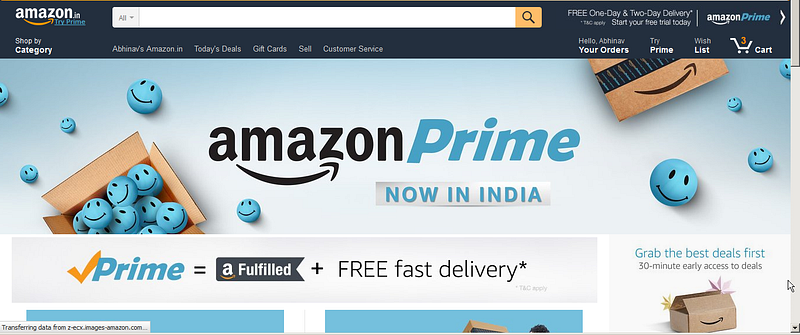
Amazon Launches Prime in India. Can Flipkart Stay ‘First’?

O
n the 27th of June, 2016, Amazon launched the first of its first AWS (Amazon Web Services) data centers in India, in Mumbai.

Amazon India announcing the launch of Prime (July 26, 2016) 
Less than a month later, on the 26th of July, 2016, Amazon launched Amazon Prime in India. After a free, trial period of 60 days, customers would be able to sign up for what it calls a “special, introductory price” of ₹499 a year. Prime Video was not included in Prime at the time of launch.


Friday, April 7, 2017

Oracle Looking to Buy Accenture? Stranger Things Have Happened

Image credit: pixels.com
The Register reported that Oracle may be exploring the "feasibility of buying multi-billion dollar consultancy Accenture."

To summarize the numbers involved here, Oracle had FY16 revenues of $37 billion, net income of $8.9 billion, and a market cap of $180 billion.

On the other hand, Accenture had FY16 revenues of US$34.8 billion, net income of $4.1 billion, and a market cap of $77 billion.

Some questions that come to mind:
  1. Why? Oracle buying NetSuite in 2016 made sense. Oracle buying Salesforce would make even more sense. Oracle buying a management consulting and professional services company, and that too one with more than a quarter million employees, on the face of it, makes little sense. Would it help Oracle leapfrog Amazon's AWS cloud business? Would it help Oracle go after a new market segment? The answers are not clear, at all.

Monday, February 20, 2017

Flipkart and the Revolving Door

T
he contrast could not have been more striking, or poignant.
2017 began on a sombre note for Flipkart, when it announced on the 9th of Jan that Kalyan Krishnamurthy had been named CEO, and its current CEO Binny Bansal would become group CEO. It was the Indian e-commerce startup's third CEO in less than one year.
Three days later, on the 12th, Amazon let it be known via a press release that it intended "to grow its full-time U.S.-based workforce from 180,000 in 2016 to over 280,000 by mid-2018." To let that sink in, Amazon, already a company with a 180,000 employees in the US, would add another hundred-thousand full-time employees in eighteen months. Media was all over the news.

The battle for dominance of the Indian e-commerce market continues well into its third year. For all practical purposes this battle began in earnest only after Amazon entered India in 2013, and since then it has transformed into a brutal, no-holds barred, fifteen-round slugfest between Flipkart and Amazon. Yes, there is SnapDeal that is entering its end-game (there are talks of a merger between Paytm's marketplace and SnapDeal and of senior-level exits amidst rumours of a cash-crunch), there is ShopClues that has had to defer its IPO plans, and an e-commerce tragedy by the name of IndiaPlaza that was among the earliest e-commerce entities, which survived the dot-com bust of 2001, and yet folded up in a most ignominious manner. Ever since Amazon entered India in 2013, it notched up one success after another against the Indian behemoth, Flipkart. Flipkart went from strength to strength when it came to valuations even as it reeled from one blow to another in the market. Flipkart's party finally entered its long-expected yet still-painful endgame in 2016. For Amazon the costs have been equally staggering - billions of dollars sunk into its Indian operations, promises of billions more to be spent, break-even years and years away, and almost every last penny of profits from its parent company being shoveled into its Indian outpost.

Saturday, July 9, 2016

InMobi, Privacy, and Penalties

image credit: WDnet Agency, pexels.com
In 2015 I had written a series of articles on the e-commerce battle between Flipkart and Amazon, one of which focused on why companies are so obsessed with apps Mobile Apps: There’s Something (Profitable) About Your Privacy. Now it turns out that InMobi has agreed to pay a US$950,000 in civil penalties to "settle charges it violated federal law." InMobi is described by the US Federal Trade Commission complaint thus: "describes itself as the “world’s largest independent mobile advertising company.” In February 2015, Defendant reported its advertising network had reached over one billion unique mobile devices, with 19% of those devices located in North America, and had served 6 billion ad requests per day." According to the FTC complaint [bold emphasis mine], "Even if the consumer had restricted an application’s access to the location API, until December 2015, Defendant still tracked the consumer’s location and, in many instances, served geo-targeted ads, by collecting information about the WiFi networks that the consumer’s device connected to or that were in-range of the consumer’s device. "

Saturday, April 30, 2016

Flipkart: Million-Dollar Hiring Mistakes Translate Into Billion-Dollar Valuation Erosions

As the week drew to a close, a story that broke headlines in the world of Indian e-commerce was the departure of Flipkart’s Chief Product Officer, Punit Soni. Rumours had started swirling about Punit Soni’s impending exit since the beginning of the year (link), almost immediately after Mukesh Bansal had taken over from Binny Bansal as Flipkart’s CEO (link).

Punit Soni's LinkedIn profile
Punit Soni was among a clutch of high-profile hires made by Flipkart in 2015, rumoured to have been paid a million dollar salary (amounting to 6.2 crores at then prevailing currency exchange rates — see this and this). This was in addition to any stock options he and other similar high-profile hires earned.
One decision that Punit Soni was most closely associated with was the neutering of Flipkart’s mobile-web execution, where he killed Flipkart’s mobile site, forcing users to download the app on smartphones. The mobile app itself was poorly designed, had a mostly unusable interface, and was riddled with bugs to the point of crashing every few minutes. I had written in detail on its mobile app’s state in 2015 (see this article in dna, or from my blog). At the time I had expressed my astonishment that Myntra, the fashion e-tailer that Flipkart acquired and which had gone app-only, had a mobile app that was NOT optimized for the iPad. The same was the story with the Flipkart app — no iPad-optimized app, but a “universal” app that ran on both the iPhone and iPad devices. Even today, the Flipkart iPad app does not support landscape-mode orientation, even as Amazon’s iPad app has grown from strength to strength.

Friday, December 18, 2015

E-Commerce in India - A tide lifting many boats

India, with an estimated population of 1.2 billion, had more than 900 million mobile subscribers in 2014. Of these, about 150 million were smartphone subscribers. As more and more people get connected to high-speed Internet, mostly via smartphones, it is estimated that there will be more than 400 million smartphone subscribers in India by 2018. India has already gained the attention of the world's leading Internet companies. India is Facebook's second largest market in terms of monthly active users, the largest market for WhatsApp, the fastest growing market for Twitter, and so on. The implications on e-commerce are even more significant. The e-commerce market in India, which is expected to cross $25 billion in 2015, has attracted billions of dollars in venture capital funding, giving rise to a second e-commerce boom in the country. Unlike the dot-com boom at the turn of the century, that was driven almost wholly on the illusory metrics of and "page-views", with little to no real revenue behind those "clicks", the story this time is different. The e-commerce boom in India is a tide that is lifting many boats.

Wednesday, November 25, 2015

Rise of the Robots - 3

Rise of the Robots: Technology and the Threat of a Jobless Future
Martin Ford

Part 3 of 3 (part 1, part 2)

As 2014 drew to a close, the Indian IT industry was rocked by rumours that TCS (the largest Indian IT company by annual revenues) had completed an internal review and had initiated lay offs of thousands of employees - mostly in middle management. Some stories talked about a number as high as 30,000. The saga finally ended with a round of clarifications and denials by TCS and some well-deserved opprobrium over its inept handling of the needless controversy. What the fracas however served to highlight was a stark truth that's been staring at the Indian IT industry for some time now - the skills that the typical Indian IT worker possesses are mostly undifferentiated and prime candidates for automation.
What is worse, from at least one perspective, is the fact that (smart) humans have built technology that has becoming adept at "engineering the labor out of the product." One will need to be particularly myopic to not also recognize that "the machines are coming for the higher-skill jobs as well." This much should have been clear in part two of this series, through the examples I cited from Martin Ford's book.

Tuesday, November 24, 2015

Rise of the Robots - 2

Rise of the Robots: Technology and the Threat of a Jobless Future
Martin Ford

Part 2 of 3 (part 1)

Machines have been able to do mechanical jobs faster than humans, with greater precision, and for longer periods of time - the cotton gin invented in the eighteenth century for example. The inevitable loss of jobs called for a re-skilling of the people affected, and the mantra went that you had to pull yourself up by your socks, learn a new skill, and get productive again. Martin Ford's book shatters that illusion. There is not a single profession left - whether unskilled or skilled, whether in technology or medicine or liberal arts, whether one that can be performed remotely or requires direct human interaction - that is not at threat from the machines. Whichever way you slice and dice it, you are left facing one or the other variation of a dystopian future, with stark income inequalities, a substantial population that will require doles on a permanent doles, and the concomitant social upheavals.

Monday, November 23, 2015

Rise of the Robots - 1

Rise of the Robots: Technology and the Threat of a Jobless Future
Martin Ford

Part 1 of 3

"I'm smart; you're dumb. I'm big; you're small. I'm right; you're wrong. And there's nothing you can do about it."

Thus spake Harry Wormwood in the movie "Matilda". This well could be the message that robots will have for us in the not too distant future. The dramatic improvements in the speed, the accuracy, and the areas in which computers have begun to comprehensively outperform humans leads one to believe that while a so-called singularity may well be some ways off, the more immediate effects of this automation are already being felt in permanent job losses. In a country like India, which has used digital technologies quite effectively in the last decade and a half to grow a $150 billion IT-BPM industry, the impact could be devastating - especially where an estimated 10 million people are employed.

Tuesday, June 30, 2015

Flipkart - 5 - Focus and Free Advice

I wrote about the obsession of Flipkart (and Myntra) with "mobile-only" without even having an iPad-optimized app! I also talked about the stunning advances being made in voice-search by using machine learning, cognitive learning, natural language processing, even as voice-based search capabilities of e-commerce companies - including Amazon - remain abysmal. Finally, I also included several use-cases that these companies need to work on incorporating into their capabilities.

That piece, Flipkart, Focus and Free Advice, appeared in DNA on June 27th, 2015.


My earlier pieces on the same topic:

  1. Flipkart vs Amazon: Beware the Whispering Death - 20th April '15 (blog, dna)
  2. Mobile Apps: There’s Something (Profitable) About Your Privacy - 18th April '15  (blog, dna)
  3. Mobile advertising and how the numbers game can be misleading - 14th April '15  (blog, dna)
  4. Is Flipkart losing focus - 12th April '15  (blog, dna)

Flipkart, Focus, and Free Advice – Shipping Charges Also Waived!


What is one to make of a statement like this - “India is not mobile-first, but mobile-only country[1]”? Especially so if it is from the co-founder of the largest ecommerce company in India, and it turns out the company does not even have an app for the Apple iPad?

I have written at length on the distractions that seem to have been plaguing Flipkart and why it cannot afford to drop its guard in this fiercely contested space[2] - especially in light of all the noise surrounding its mobile ambitions. Somewhat paradoxically, this post is about offering advice to Flipkart that calls for some diversification!

As a logical next step, I wanted to take a look at Flipkart’s mobile apps – both on the iOS and Android platforms – to see how well they were executing on their very bold ambitions. As an aside, I also wanted to see if these (and competitive) mobile apps were leveraging all the computing power now available on tap inside these tiny devices. After all, apart from the recent – and amazing – advances Google has made in its voice-based search capabilities[3], there was this stunning demo from Hound[4] that gave a glimpse into the huge advances that voice-recognition, search, and machine-learning technologies have made in the last decade.


Monday, June 8, 2015

Creepy Dolls - A Technology and Privacy Nightmare!

This post was first published on LinkedIn on 20th May, 2015.

"Hi, I'm Chucky. Wanna play?"[1]  Fans of the horror film genre will surely recall these lines - innocent-sounding on their own, yet bone-chilling in the context of the scene in the movie - that Chucky, the possessed demonic doll, utters in the cult classic, "Child's Play". Called a "cheerfully energetic horror film" by Roger Ebert [2], the movie was released to more than a thousand screens on its debut in November 1988 [3]. It went on to spawn at least five sequels and developed a cult following of sorts over the next two decades [4].

Chucky the doll
(image credit: http://www.shocktillyoudrop.com/)
In "Child's Play", Chucky the killer doll stays quiet around the adults - at least initially - but carries on secret conversations with Andy, and is persuasive enough to convince him to skip school and travel to downtown Chicago. Chucky understands how children think, and can evidently manipulate - or convince, depending on how you frame it - Andy into doing little favours for him. A doll that could speak, hear, see, understand, and have a conversation with a human in the eighties was the stuff out of science fiction, or in the case of "Child's Play" - out of a horror movie.

Saturday, May 30, 2015

Flipkart and Focus 4 - Beware the Whispering Death

The fourth part of my series on Flipkart and its apparent loss of Focus and its battle with Amazon appeared in DNA on April 20th, 2015.

Part 4 – Beware the Whispering Death
Monopolies may have the luxury of getting distracted. If you were a Microsoft in the 1990s, you could force computer manufacturers to pay you a MS-DOS royalty for every computer they sold, irrespective of whether the computer had a Microsoft operating system installed on it or not[1]. You dared not go against Microsoft, because if you did, it could snuff you out – “cut off the oxygen supply[2]”, to put it more evocatively. But if you are a monopoly, you do have to keep one eye on the regulator[3], which distracts you. If you are not a monopoly, you have to keep one eye on the competition (despite what Amazon may keep saying to the contrary, that they “just ignore the competition”[4]).