
Showing posts with label Hinduism. Show all posts
Showing posts with label Hinduism. Show all posts
Wednesday, March 7, 2018
Sunday, April 30, 2017
Rama and Ayodhya and The Battle for Rama - Review


"Rama and Ayodhya" and "The Battle for Rama", by Meenakshi Jain
Circumstantial Evidence Preceded Archaeological Evidence
(see my earlier review of Rama and Ayodhya and a part-review of The Battle for RamaThis review incorporates material from both reviews as well)
The diffusion of propaganda requires repetition. In the words of someone many leftists have secretly admired for long, repetition is what makes propaganda successful (the full quote is (bold-emphasis mine), "The most brilliant propagandist technique will yield no success unless one fundamental principle is borne in mind constantly and with unflagging attention. It must confine itself to a few points and repeat them over and over".
This was a strategy used to brilliant success by militant Islamists, communist historians, and Indologists of dubious integrity in the west during the Ayodhya movement in the 1980s and 90s.

Monday, March 6, 2017
The Battle for Rama - 1. Babur's Mosques

Her 2017 book, "The Battle for Rama: Case of the Temple at Ayodhya", builds upon "Rama and Ayodhya" with new information and evidence that has come to light in the last few years. While it is a short book, at 160 pages, it is nonetheless lavishly produced, with 61 illustrations and full-colour photographs printed on glossy paper.
Thursday, January 26, 2017
Diwali, Hinduphobia and the Great Indian Derangement Syndrome
D
iwali (or Deepavali) is a time for celebration.
Diwali is a time for celebrating the return of Rama, Sita, and Lakshmana back to Ayodhya after fourteen years in exile.
Diwali is a time for bursting firecrackers to welcome the return of the Prince of Ayodhya.
Diwali is a time for celebrating the victory of Krishna over Narakasura.
Diwali is a time for happiness, joy, prosperity.
Diwali is a time for lighting lamps to welcome Goddess Lakshmi into our lives.
Diwali is also a time for welcoming the return of the annual Great Indian Derangement Syndrome. It is a rabid affliction which is marked by the apogee of a ritual that many Indians punctuate with long, haunting howls of dirges, for several nights at a stretch, every night, their penned faces pointed towards the west, the words contorted into a grotesque visage that seems to beg forgiveness for collective sins unknown. The climax of this annual ritual is a long, unbroken shriek of guilt that is somewhat quaintly reminiscent of the atavistic call of dogs to their savage masters out on their hunts. So powerful is this ritual that several people who have witnessed this ritual have lost their sanity. Let us take a look at once such recent example.
It all began with a tweet on the 27th of October by @padhalikha that I was pointed to:
The screenshot embedded in @padhalikha's tweet was of a tweet by the controversial news channel, @NDTV, of a five-day awareness campaign on child sexual abuse launched by the The National Commission for Protection of Child Rights (@NCPCR_), and which was jointly launched in Delhi by the Delhi government and the Childline Foundation (@CHILDLINE1098). The Delhi government is run by the AAP Party (@AAP).Yes, Eid and Christmas are festivities that do not entail large gatherings. Hindus, you and your dirty mind festivals! pic.twitter.com/S9RqSHER9O— Eminent Intellectual (@padhalikha) October 27, 2016
 |
| Screenshot of tweet from NDTV |
Friday, December 9, 2016
Harivamsha, by Bibek Debroy - Review

 T
he Harivamsha is the final, final part of the Mahabharata. Not quite a part of itihaasa - which the Mahabharata and Ramayana are - nor quite a Purana, the Harivamsha nonetheless gets by by being called a "kheel" (appendix) to the Mahabharata. The Bhandarkar Oriental Research Institute in Pune, over several decades, compiled a Critical Edition of the Mahabharata. The Harivamsha also forms part of this Critical Edition. The critical edition of the Harivamsha contains a shade less than 6000 shlokas - thus bringing the total length of the Critical Edition of the epic to just under 79,000 shlokas. An English translation of this version is what Dr. Bibek Debroy has come out with (he came out with translations of the Critical Edition between 2010 and 2015). He informs us that "Non-Critical versions will often have double this number, reflective of the slashing."
Saturday, November 12, 2016
Sati, Evangelicals, and Atrocity Literature

Sati: Evangelicals, Baptist Missionaries, and the Changing Colonial Discourse, by Meenakshi Jain
(Amazon India, Amazon)I
n many ways this book documents the birth of atrocity literature and its first application in India on Hindus. The successful template of manufacturing atrocities, hyping them, and then using the resulting public opinion to further an evangelical agenda may appear new, but it is one that was honed more than two centuries ago. This is yet another stunning book from Meenakshi Jain, coming after her 2013 tour-de-force, "Rama and Ayodhya."
What was the evidence and prevalence of Sati in ancient and medieval India? Did it have religious sanction? Was it mandatory? Was there coercion? Was it confined to certain regions and castes or widespread? Did it change over time? Did it increase or reduce over time? Did the English or the East India Company ban it? Did they want to ban it? What were their motivations in banning it? Were they driven by the need to put a stop to a widespread evil? How did Indians react to the ban? When talking of Sati, these are some of the questions that should spring to mind. These are the questions that the book asks, and answers.
Tuesday, November 1, 2016
Diwali 2016 Photos
D
eepavali (Diwali) 2016 is over. It is time therefore to post the photos.
And here they are.

eepavali (Diwali) 2016 is over. It is time therefore to post the photos.
And here they are.

Sunday, May 29, 2016
Rama and Ayodhya, by Meenakshi Jain
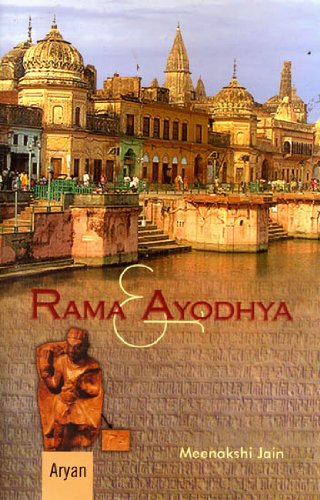 |
| Rama and Ayodhya, by Meenakshi Jain Aryan Books International; 2013 edition (ISBN: 8173054517, 978-8173054518) |
Rama and Ayodhya, by Meenakshi Jain
An indispensable, though brief, compendium to understand the past and present of Ayodhya.The diffusion of propaganda requires repetition. In the words of someone many leftists have secretly admired for long, repetition is what makes propaganda successful (the full quote is (bold-emphasis mine), "The most brilliant propagandist technique will yield no success unless one fundamental principle is borne in mind constantly and with unflagging attention. It must confine itself to a few points and repeat them over and over".
This was a strategy used to brilliant success by militant Islamists, communist historians, and Indologists of dubious integrity in the west during the Ayodhya movement in the 1980s and 90s.
Diana Eck is a faculty member of The Prince Alwaleed Bin Talal Islamic Studies Program at Harvard University (which was established as a result of a $20 million grant by the Saudi prince, Alwaleed Bin Talal). In her 2012 book, "India: A Sacred Geography" (my review), she had very bluntly and pointedly argued against the evidence of a temple at the disputed site, citing "Indian historians and archaeologists, both Hindu and Muslim." The sole archaeologist she cited in her section on Ayodhya had this to say in her book - "There is not a single piece of evidence for the existence of a temple of brick, stone, or both." For reasons that should become clear very soon, Diana Eck chose to bury the archaeologist's name in the references section of her book. That archaeologist's name is D. Mandal, from the University of Allahabad.
Wednesday, March 23, 2016
Female Infanticide and Western Institutions
The Ford Foundation’s Quest to Fix the World - this New Yorker piece in the January, 2016 issue of the magazine, by someone named Larissa MacFarquhar caught my eye. The Ford Foundation is a highly controversial organization with an unsavory past in India (and I suspect in many other third-world countries), and I was therefore keen to know what the insufferably long and at-times rambling piece had to say about the Ford Foundation and India. To be honest, I suspected at the onset this was a puff piece done to massage the egos of the high-and-mighty at the Ford Foundation, and by the time I had read through it, my suspicions had been confirmed, and worse.
 |
| New Yorker piece on the Ford Foundation |
There were two bits that caught my attention in particular.
The first was the following sentence - "In April, the government froze the bank accounts of Greenpeace India, and in the same month cancelled the registration of nearly nine thousand N.G.O.s that received money from abroad."
While true in itself, this sentence failed the basic smell-test of journalistic ethics. Why? Because the sentence presented facts selectively to present a manifestly one-sided version of what actually transpired.
Thursday, February 18, 2016
Being Hindu, by Hindol Sengupta - Review

Being Hindu: Old Faith, New World and You, by Hindol Sengupta
A thought-provoking and breezy account. Hindol hits the right points and notes. Informs and provokes in equal measure. Add this one to your year-end holiday reading list.Being Hindu can be an amalgamation of many different things to many different people, at different times. Whatever being Hindu may be, it however - we need to be clear - cannot be about "discussing for years whether we should drink a glass of water with the right hand or the left, whether the hand should be washed three times or four times, whether we should gargle five or six times." But this was what discourse on Hinduism had been reduced to in the nineteenth century, in the words of none other than a young, thirty-something ascetic, Vivekananda, speaking to "an inherently orthodox populace in nineteenth-century, British-ruled India."
Sunday, January 3, 2016
India A Sacred Geography, by Diana Eck - Review

India: A Sacred Geography, by Diana L Eck
Diana L. Eck "is professor of comparative religion and Indian studies at Harvard University and is Master of Lowell House and Director of the Pluralism Project." She has written an atlas of sorts of the connectedness and shared mythology that binds the people of the Indian subcontinent with Hinduism.While I have not yet completed reading the book, I did want to pen down and share my thoughts based on what she has written about two sacred places that are associated with Lord Krishna and Lord Rama. These are Dwarka and Ayodhya.
Friday, December 4, 2015
Rearming Hinduism, by Vamsee Juluri - Review

Who controls the history of a people controls the people. Colonization of the land is easier to fight than colonization of the mind. Who gets to define Hinduism today? Should they? For those who have, what's their agenda, their motives? For those who support, what drives them?
Academia in the United States has a well-deserved reputation for independence, and exercises far greater intellectual honesty - for the most part - than compared to, say, many of the leftist-controlled institutions in India. This streak of honesty breaks down, however, when it comes to Indology, and especially Hinduism studies. Almost without exception, Hinduism as a subject in US academia has for decades been in the control of the racists, the xenophobes, the bigots, the supremacists, and at times the outright insane! Like the person who insisted in an "acclaimed" book that "most of India" lay in the Northern Hemisphere (for the record, and this is not a matter of opinion - all of India is entirely within the Northern Hemisphere; not "most", but every square-inch. In fact, the southernmost tip of India - Kanyakumari - is a good 800 kilometers north of the Equator, and has been that way for at least the last 15 million years)!!!
Tuesday, October 27, 2015
Vamsee Juluri - Hinduism and Its Culture Wars
 Hinduism and its culture wars
Vamsee Juluri's essay in 2012 has been published as an e-book, "Hinduism and its culture wars", and I would recommend it whole-heartedly for all. In some ways, it can also serve as a short primer for his longer, and more recent, book - "Rearming Hinduism".
For those unaware, there has been a raging battle being fought for more than two decades for the soul of Hindu academia. On one side have been the liberals, the orientalist academia, the Hinduphobes - all of whom have had a stranglehold on the mainstream narrative of Hinduism. On the other side have been a section of Hindus who have risen up to challenge this bigoted and jaundiced view of their faith.
Monday, September 7, 2015
Gita for Children, by Roopa Pai

The Gita for Children, by Roopa Pai
Yes, there is a need for one more book on the Gita. This one fits a particular niche quite well.On the one hand you have over-simplified adaptations of the Bhagavad Gita that throw in a sentence or two from the text but fail to either capture the essence or its substance, leaving the young reader none the wiser at the end. On the other hand you have scholarly translations with detailed commentaries that bring a life's worth of study to bear on the subject, are a joy to read, but are ipso-facto mostly out of reach of most children, unless assisted by an adult. Then there are books that seek to bridge this gap, like Swami Chinmayananda's "Gita For Children" - but even that is more a parent's reading companion than a book meant to be read by children.
Roopa Pai's book, "The Gita For Children", therefore fills a much-needed gap. It's a book written for children, makes even the difficult sections of the Gita accessible to children, and which patiently explores some of the knottier questions that arise when reading the profound work. Actual shlokas from Gita are also present - the most obvious ones are all there - but used sparingly.
Sunday, May 11, 2014
Mahabharata, Vol 8
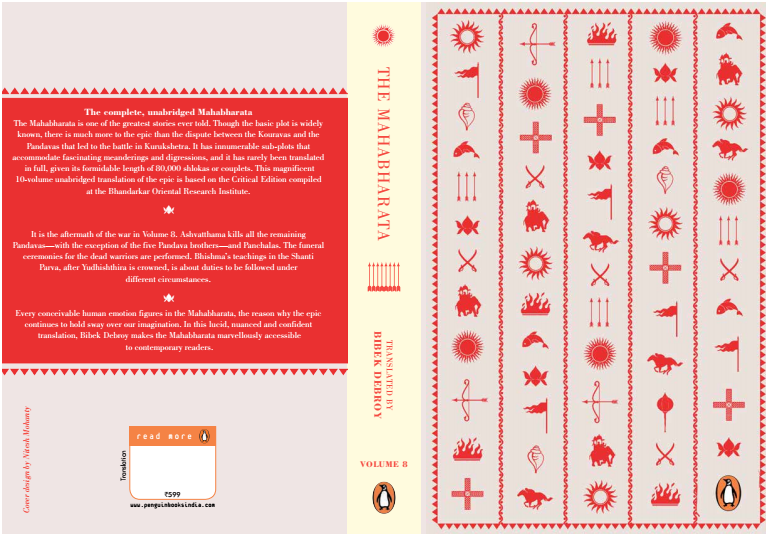
Mahabharata - Volume 8, Translated by Bibek Debroy

I wrote a short review of Dr. Bibek Debroy's volume 8 of the translation of the Unabridged Mahabharata. It was published in the DNA newspaper's website, at Book Review: 'The Mahabharata' Volume 8 translated by Bibek Debroy | Latest News & Updates at Daily News & Analysis (DNA tweet). My thanks to Harini Calamur.

The full text of the review:
Sunday, February 23, 2014
Indus Valley (Smart Green Civilizations)

Indus Valley: Key stage 2 (Smart Green Civilizations)

Kid-friendly introduction, but marred by selective omissions. Also leaves out the truly spectacular achievements of the people
One-line review: Parents are advised to read out and share this book with children, but are also forewarned that they will need to spend considerable time in correcting the several errors - of commission and omission - in the book.
Longer Review:
The Indus Valley Civilization, more accurately known as the Indus Valley Saraswati Civilization, was the largest and most advanced ancient civilization that existed. This short illustrated book does a good job of introducing the reader - children - to this civilization. It tells us that the Indus people were the first to develop the concept of urban town planning, and were the first to trade with the world. The generous availability of wells meant that people were never far away from access to clean water. Children will like the simple and full-colour illustrations in this book, and the easy style of writing. At the bottom of each page is a short line that has a lesson on environmentalism.
Tuesday, December 3, 2013
Sita: An Illustrated Retelling of the Ramayana, by Devdutt Pattanaik

Sita: An Illustrated Retelling of the Ramayana, by Devdutt Pattanaik
Note: since I first wrote this and other reviews of Devdutt Pattanaik's books, I have gained a better understanding of Hindu texts and scriptures. I believe Devdutt Pattanaik's writings are influenced heavily by western frameworks and agendas on the one hand, and introduce subtle and sometimes outright distortions in the interpretation of these texts. A small sample of the kinds of outright errors and distortions that would shame any scholar of Hinduism can be found in this blog post.
I therefore do not recommend any of Devdutt Pattanaik's books that I have reviewed on my blog. - Abhinav, Nov 3, 2017.
Review:
In recent times, Devdutt Pattanaik has been the most prolific and successful mythologist-author in India. For almost a decade now, he has explored almost every facet of Hindu mythology, from a rapid-fire look at the spectrum of Hindu mythology in "Myth=Mithya" - that became his most successful book, to gods and goddesses in books like "7 Secrets of Siva", "7 Secrets of Vishnu", "7 Secrets From Hindu Calendar Art", to even dabbling in fiction in "The Pregnant King", and more recently to books targeted specifically at children - "An Identity Card for Krishna", "Shiva Plays Dumb Charades", etc... In 2010, he plunged into a very imaginative and well-researched retelling of the Mahabharata - "Jaya - An Illustrated Retelling of the Mahabharata".
Monday, September 30, 2013
Lost City of Dvaraka, SR Rao

Lost City of Dvaraka, S.R. Rao
One-line review: Mythology excavated, history re-incarnated.Short review: Arguably the single most important archaeological excavation of the twentieth century, the offshore marine excavations off Dvaraka began with a humble eighty thousand rupee grant. It helped plug in a thousand-year hole in India's ancient history - of what happened after the decline of the Harappan civilization and before the advent of the Buddha in the fifth century BCE. In the process was also established the historicity of a certain gentleman named Krishna Devakiputra - also known as the eighth incarnation of Narayana, Lord Vishnu. These two stunning implications of the excavations have not yet been fully appreciated, thanks to a benign neglect of archaeology by the government, the warped revisionism practiced by Marxist historiographers in India, and the Indian's general apathy to history.
Sunday, September 1, 2013
The Lost River: On The Trail of the Sarasvati, Michel Danino

The Lost River: On The Trail of the Sarasvati, by Michel Danino
Kindle IN, Amazon US, Amazon IN, Kindle US, FlipkartOne-line review: Remarkable book that tells the remarkable history of a remarkable river that sustained a remarkable civilization!
Short review: It is rare that a book flows with the same ease and felicity as the river it seeks to describe. This is that rare book. The river Saraswati, when it flowed some five thousand years ago, gave birth to the most massive and advanced ancient civilization that existed. The almost million square kilometers of land that formed the Indus Saraswati Civilization saw the development of the most advanced urban planning in the ancient world, a system of standardized weights and measures that boggles the mind, a social order that was more egalitarian than has ever existed anywhere since. When the river stopped flowing - severely depleted by the "double desertion" of the Sutlej and Yamuna - it caused a massive abandonment of the Indus Saraswati sites, with its residents migrating to the Gangetic plains and elsewhere, giving birth to a new phase in the evolution of the Vedic dharma which saw its birth amidst the fertile plains of the Indus Saraswati. That the existence of this once mighty river is in dispute is itself a sordid tale of ideologies polluting academics. Michel Danino writes fluidly, engagingly - makes this book a page-turner.
Long review:
Sunday, July 7, 2013
Nageshwar Jyotirling, Dwarka, Gujarat

On our trip to Gujarat a couple of years back, we knew we would not be able to cover even half the spots we wanted to. Making it a mad dash from one place to the other was not exactly our goal either. Therefore we decided to cover the southern coast of the state of Gujarat, which meant starting from Bhavnagar, where some of our extended family is. We landed at Ahmedabad and took the road to Bhavnagar. Enroute we stopped at the Harappan town of Lothal. There we got a personal guided tour from a dock owner at the shipbreaking port of Alang. From there we got on the road, and made a dash to Dwarka, passing the oil refinery town of Jamnagar. From there we drove down to Sasan Gir, the last preserve of the Asiatic lion. While in Dwarka we also stopped by the Nageshwara Jyotirlinga, one of the twelve jyotirlinga shrines mentioned in the Shiv Purana (see Wikipedia excerpt below).
Subscribe to:
Posts (Atom)