Thursday, December 18, 2008

Web 2.0: A Strategy Guide

Web 2.0: A Strategy Guide (Kindle link, Flipkart.com, my user review on Amazon.com)

2 stars

Desperate Miasma of Buzzwords
Web 2.0 - the moniker given to the combination of technology enabled rich internet applications, collaborative user experiences like wikis, folksonomies, and more - has changed the way most people experience and expect the web to be. Google, Facebook, Twitter, Flickr, Wikipedia, blogs are all examples of Web 2.0 based companies.

What is less understood is whether Web 2.0, despite all its newness, hype, and substance, is only an incremental step in the path of the continual evolution of the web, or whether it represents a substantially, and fundamentally, different way of doing business on the internet.

Web 2.0: A Strategy Guide: Business thinking and strategies behind successful Web 2.0 implementations.
(the book page on the OReilly web site - http://oreilly.com/catalog/9780596529963/)- this book is an attempt to try and make sense of Web 2.0. The book is short enough that it can be read in a couple of hours, is written for the average user and does not get into technical details or intimidating equations at any point. It has a very long list of references, which do add a lot of value to the book.

However, upon reading the book, you are faced with a constant barrage of disappointment, irritation, and finally a feeling of having wasted a good two hours of your time.

Tim O'Reilly has written the Foreword, and the best he has to say about the book is that (added stars mine) "It's the first book that really does justice to **my** ideas". The author makes sure to reciprocate in kind, thanking O'Reilly 'for championing this project and seeing **its breakthrough potential**'.

The purpose of the book is not to educate or inform, but to equip the reader with an arsenal of buzzwords. It is not what you know, but what you can pretend to know.
Sample these snippets:
  • "If you feel like .... or that you somehow walked into the middle of the conversation, you're not alone"....
  • "Second, even recent M.B.A.s have a hard time pulling together all the necessary pieces of the Web 2.0 business model" - many a Web 1.0 company went down the tube because MBAs decided that they were the experts in running technology startups.
  • "...how a shift as small as XML separating content from form..." - smalllll??? The move from HTML to XML based HTML is small????
  • "Web 2.0 companies have figured out a profitable path to growth" - really???? No evidence cited, no names, no revenue or financial statements. Just the evidence of an opinion is offered.
  • F, sample this: "You will learn about how to make money by monetizing the network effects..." - all in two hours of lightweight reading.
Assertions are made throughout the book, but without much by way of explanation, reasoning, or substantiation. Take the example of Flickr, which is the first Web 2.0 company described in some detail in the first chapter itself:
  • Flickr's business model is described as "freemium", but no details or numbers.
  • In the section on 'Calcuating Company Value', there is utter confusion: a number of $20 per user over a 3-5 year period for Flickr is arrived at by estimating the price that Yahoo paid to acquire Flickr in 2005. But that is distinct from how much real money was actually coming into the company. Valuation is NOT the same as revenue - a point painfully lost on the author. Look at it this way: Google has a valuation of $100+ billion. But it does NOT make $100b in revenues, or profits, or cash flow. In any case, this 'method' of valuation is no different than what was practiced during the Web 1.0 dot-com bubble.
  • And before the discussion on valuation can get complicated, the focus quickly shifts to Netflix.
The chapter on network effects is an improvement, with a short but reasonably acceptable description of network effects and the marginal/average/total cost function.
But here again, what is not explained is why the classic aggregate adoption 'S-curve' should be labeled differently for Web 2.0, nor why the product adoption bell curve should have a closed chasm (Geoffrey Moore - Crossing the Chasm) in the world of Web 2.0, except by stating that "free viral closes the gap". How does it close the gap? No explanation. Shoot and scoot.
There is further confusion when the author states in the paragraph titled "Avoiding the chasm" that "Product cost is a classic adoption barrier" - Moore certainly did NOT list cost as a major adoption barrier.

Chapter 3, "People Build Consensus" covers social networking, specifically Facebook and LinkedIn - two companies targeting different, but slightly overlapping parts of the social network demographic spectrum. The description of the 'six degrees' effect is described well enough. Other very pertinent and useful concepts and theories are mentioned, like 'Diffusion of Innovation' and the 'Bass model'.
What is, again, irritating is the needless repetition of sentences. "By mid-2005, requests for introductions had reached 25,000, and acceptance rates had increased slightly to 87%.", and in the very next section, the same is repeated, almost ad verbatim, "In mid-2005, LinkedIn announced that monthly requests were 25,000 and acceptance rates were at 87%." Why? Why?? Why??! Wouldn't the reader remember what he had read just a paragraph or two back?
How exactly does "frequent interaction builds community, trust..."? Take the author's word.

A profligate plethora of acronyms litters the book. Long tail. Network effects. Collaborative innovation. Web to wealth. Fremium. Collective user value. Leapfrog link. Competence syndication. Competence capitalization.Online recombinant innovation. And the list goes on and on.

Disjointed, rambling paragraphs interspersed with 'back-of-the-napkin' style charts, authoritative-looking links, economic terms interspersed with catchphrases are thrown in, and then on to the next topic. Scoot and shoot. Rinse and repeat.

A desperate miasma of buzzwords pervades the entire book. The best part of the book is its list of references, but here again, quantity trumps quality. The really good references are buried among the more than 280 references.

Save your money for something actually useful. I would suggest you read these books instead.

Tuesday, December 16, 2008

Leadership, Followership, and Evolution

From Bob Sutton's blog post - "Bob Sutton: Insights About Leaders and Followers from an Evolutionary Perspective":
I just finished read a wonderful article in the American Psychologist called Leaders, Followership, and Evolution, by Mark Van Vugt and his colleagues. You can get a pdf from Van Gut's website here. They take an evolutionary perspective, showing -- among other things -- that leaders in the groups that we evolved from led small face to face groups, which (my interpretation) may help explain why leaders of large organizations fail so often -- it isn't something that humans as a species have much experience doing. The authors also make a compelling case that people who rose to leadership positions in such groups did so because of their ability to serve the needs of followers rather than their ability to intimidate and bully. Along related lines, they point out that another implication of an evolutionary perspective,is that people who study leaders typically devote too much attention to leaders and not enough to followers.

I especially like this quote from page 190, which they show is bolstered by quite a bit of research on leadership in modern organizations:

“[G]ood leaders should be perceived as both competent and benevolent because followers want leaders who can acquire resources and then are willing to share them.”

This post just scratches the surface. This is a carefully researched and unusually creative piece on leadership. If you are interested, I suggest diving in deeper.

The PDF referenced is available here.
Bob Sutton is a professor of Management Science and Engineering in the Stanford Engineering School.
He is the author and co-author of several books. The only book that I have read to date is The No Asshole Rule: Building a Civilized Workplace and Surviving One That Isn't , which was a wonderful book on the benefits of recognizing, and then dealing, with assholes (or call them jerks, bullies, kiss-up-kick-down, self-centered dolts, etc...) in the workplace.
He promoted the book very heavily, and very effectively, on his blog (you can read posts on the book and its topic at The No Asshole Rule), that seems to have more than a hundred posts labeled such. and even after close to two years after being released, still ranks #2423 in the overall books category.

Thursday, December 11, 2008

Confessions of a Swadeshi Reformer


Confessions of a Swadeshi Reformer: My Years as Finance Minister, by Yashwant Sinha 

(Amazon, Flipkart.com)
4 stars
Firstly, there is little by way of confessions in this book. None of the kind that would create front page headlines. However, Yashwant Sinha, former finance minister and then external affairs minister for India under the short-lived Chandrashekhar government in 1990-1991 and later in the Vajpayee NDA government between 1998 and 2004, does write eloquently about his swadeshi reforms. He comes across as honest and candid about his days in politics, with frank statements on issues that you would not expect from a career politician. Yashwant Sinha is in many ways not a career politician. He spent some two decades in the Indian Administrative Service, before joining politics in 1984.

It is also clear that Yashwant Sinha is disappointed, and mostly justifiably so, that while Manmohan Singh and then P Chidambaram are seen as the architects of India's economic reforms, his contributions and to some extent pathbreaking steps towards opening up and reforming the Indian economy have not been given their due attention and credit. Hopefully, when the history of the Indian economic reforms that started in 1991 is written, Yashwant Sinha will no longer remain the 'unsung hero of India's reforms' but be recognized as its pioneer and major architect.

The book is divided into three sections, "The Finance Minister Presents", "Policy and Reforms", and "Confessions of a Swadeshi Reformer". The first section is mostly a chronological account of his years as India's finance minister, the second section takes a look at some specific areas of policy in areas like the insurance sector, telecom, banking sector, etc... The third section is where he talks about some of the controversies and allegations levelled against him, including allegations of corruption, the labelling of Yashwant Sinha as "rollback Sinha", his thoughts on capitalism vs socialism, and more.

All in all, this is an engrossing read, well written, with a refreshing amount of candour, short enough (261 pages) to be read in a single sitting. It could have done with more references and details, and some of the characters in the book could do with more context for not intimately familiar with the political landscape in India. One minor quibble is that Yashwant Sinha makes copious use of the 'perpedicular pronoun', excessive usage of the word 'I'.

Excerpts:
  • "we were mortgaging our most precious asset, gold, which Indians are sentimental about, to save something even more precious - our honour and prestige." Prologue, page xii, talking about the events when India had to mortgage its gold reserves to obtain a loan from the Bank of Scotland to meet its balance of payments obligations in 1991.

  • "... the Bank of Scotland, however, insisted on the gold being shipped to England.". Page 23. Maybe the bank was only being prudent and responsible at a time when India's foreign exchange reserves had fallen to about one billion dollars, enough to cover less than one month's worth of imports, but one wishes the bank had displayed a little more grace.

  • "Giridhar Gomango, who was the chief minister of Orissa, was technically still a member of the Lok Sabha. He was asked by the Congress party to come to the House that day and vote against us. Many felt it was morally not correct for him to do so. But politics and morality do not often go together." Page 70. I think he is referring to the no-confidence motion of 1999 that brought down the NDA government by one vote. Yes, one vote. You do not get any closer than this as far as margins go.

  • "In 1998 my son Jayant introduced me to his friend from IIT Delhi, Raghuram Rajan.... He suggested to me that, as in the United States, if we encouraged housing in India, it could become a major multiplier of economic prosperity. ... " this advice was taken to heart by Yashwant Sinha, who then implemented changes in successive budgets, that led to an "increase in deduction for interest on borrowed capital from Rs 15,000 to Rs 30,000 for self-occupied property. In subsequent years, I raised it to Rs 1,50,000". Page 100. Notwithstanding the current global financial crisis, the bursting of the housing bubble in the US, and the massive correction in the Indian real estate sector also, it remains undisputed that this income tax exemption granted to interest on housing loans has been a major factor contributing to the growth of home ownership in India.

  • "People hate to be brought within the tax net." Page 118

  • "The propensity in India is not to pay taxes. People want everyone else to be taxed but not them." Page 123. True. Ask politicians, businessmen, and everyone who cheats on his taxes.

  • "Intra-cadre rivalry was its worst in the Central Board of Excise and Customs. The officers here did not mind cutting each other's throats to reach their senior positions. They filed anonymous petitions against each other (unfortunately many were often true)." Page 125

  • "The first was to reduce T & D - Transmission and Distribution - losses, which the Prime Minister described as theft and dacoity losses." Page 140. It's no wonder that politicians across parties, regions, and ideologies are all, almost without exception, against privatization of any part of the electricity sector - generation, transmission, distribution, etc... There is a lot of talk about reform, but little by way of concrete, specific action.

  • "Fiscal deficit, apart from the economic malaise that it represents, also raises the serious question of inter-generational equity." Page 144. This statement becomes even more important in the light of the massive amounts of money being committed to the oil bonds floated by the government. The current generation is using oil at subsidized prices, the full cost of which will have to be paid by future generations. As economists have said, high oil prices work on the one hand to drive investment towards drilling and refining activities, but also on the commercialization and R&D into alternate forms of energy on the other hand. The opposite is true when prices are depressed. Think of the explosion of gas guzzling SUVs from Detroit, Europe, and Japan during the second half of the 1990s when oil prices were as low as $10 a barrel.

  • "I had expected opposition to this move (FRBM) in the cabinet but, surprisingly, it went through without much discussion. I used to make such a fuss about the fiscal deficit in cabinet meetings that I suppose my colleagues decided to spare themselves further agony of having to listen to me one more time." Page 149. A candid confession by Yashwant Sinha, and a subtle dig at the intellectual level and appetite for any serious discussion among our politicians.

  • "... but I could not understand how the quantity of steel required could go up over the years." Page 154. Yashwant Sinha here is referring to cost escalations that are rampant in almost any construction activity undertaken by almost any arm of the government. The cost of steel can go up, but how can the amount of steel needed to construct a bridge go up??!!

  • "... how once a colleague rang me up and said that we should not privatize a particular PSU since it was the only PSU under his charge." Page 159. No public sector undertaking, no ministry, no minister. Therefore, self-interest rules supreme.

  • "PSUs of the Government of India have long been milch cows for politicians, trade unions, and bureucrats. They must be privatized for this reason alone, if for no other reason." Page 159. Yashwant Sinha is perhaps the most passionate when talking about the malaise in the public sector undertakings, the wastage of money and resoures, and the resistance to their privatization from all quarters. Little ideological underpinnings to the arguments made by communists, labor union leaders, and politicians - but for the most part it's self-interest, often at considerable cost to the nation, that is at work here.

  • "... I had referred to the large investment made by the UTI in the shares of Reliance Industries earlier in an off-market transaction in one day. This was done when Manmohan Singh was finance minister." Page 217

  • "As I was about to leave, Jayalalitha handed me an envelope. Later, when I opened it, I found it was a note about her income tax cases." Page 226. For those familiar with the people here, Jayalaliths is generally recognized as one of the more corrupt politicians.

On socialism, excessive controls, pernicious system of quotas and licenses, Yashwant Sinha is positively livid with rage.
  • "Everyone flourished under the this system. Officials and ministers of the government weilded enormous powers."
  • "Losses were worn as a badge of honour."
  • "competition became anathema"
  • "... and the common man suffered the most because for him everything was scarce, expensive, and of poor quality."
  • "... we distributed poverty in the name of equity and social justice." Page 243-
  • "... we must distribute wealth in the future. There are many who believe that equity lies in the country remaining poor. We shall have to get rid of the mindset that creating wealth is sinful."
More information:
Publisher's book page: http://www.penguinbooksindia.com/Bookdetail.aspx?bookId=6573

Published by : Penguin Books India
Published : June 2007
Imprint : Viking
Cover Price : Rs 450.00
ISBN : 0670999520
Edition : Hardback
Format : Demy
Extent : 272 pp
Classification : Non Fiction
Rights : World


Available from:
Landmark
Rediff
Flipkart.com

Wednesday, December 3, 2008

Makers of India's Foreign Policy, by JN Dixit

Makers of India's Foreign Policy - by JN Dixit (Amazon, Flipkart)


The blurb from the book reads thus:
"
In this brilliant, insightful book, J.N.Dixit chronicles the role of those who have played an important role in fashioning and implementing India's foreign policy since and before independence -- right up to the 12th SAARC summit in Islamabad in January 2004. In doing so he fulfils a major gap in the study of Indian foreign policy, for he focuses not just on the Nehru-Gandhis but also on those who are less well-known, including diplomats and policy advisers. ... Apart from the central role played by Jawaharlal Nehru, Lal Bahadur Shastri and Indira Gandhi, the book highlights the contributions of other prime ministers such as Narasimha Rao, I.K.Gujral, and Atal Behari Vajpayee. Also portrayed are ministers such as V.K. Krishna Menon, Sardar Swaran Singh, Y.B. Chavan, Jaswant Singh and Yashwant Sinha. The role of behind-the-scenes operators like Girija Shankar Bajpai, Badruddin Tyabji, D.P.Dhar, P.N.Haksar and Brajesh Mishra is also recalled.

"

The book's major achievements, in my opinion, are:
  1. JN Dixit attempts to classify India's foreign policy influencers and architects into two philosophical camps - the Buddhist/pacifists, and the real-politik/Chanakya followers (Patel, Bose for e.g.).
  2. it collects in one place brief accounts of the people who were involved with and contributed to India's foreign policy, and
  3. the chapters on Sardar Patel and Lal Bahadur Shastri are very, very good. Sardar Patel's letter to Nehru on the coming threat from China is reproduced in its entirety, and is the gem of the book. Shastri's contributions are duly recognized.
Regarding Dixit's theory on the "two broad strands in terms of attitudes and reactions towards other countries and foreign societies", he states that the "first orientation was that of a feeling of inferiority and inadequacy via-a-vis foreign countries, particularly those of the west..... the second orientation was that of asserting the relevance and importance of India's ancient culture and civilization..." Most of the early Indians who had an impact on India's perspectives on the world are then clubbed into the first or second group. Unsurprisingly, Swami Vivekanand, Lokmanya Tilak, Badruddin Tyabji and others fall in the second group.

However, I am not sure the book can be called "brilliant". It's a decent effort to be sure, and certainly does a good job of collecting in one place all the contributors to India's foreign policy.

The drawbacks to the book are:
  1. It lacks any references to background, supporting, or more detailed material that the reader may be interested in. No references, appendix, or footnotes.
  2. there are lots of statements made, that in the absence of supporting material come off sounding as opinions... (contrast this with Arun Shourie's style for example where there are copious footnotes and references - which may also be reflective of his academic background - he is a PhD).
  3. the book is too politically correct; the author does not take a firm stand against anyone. Many of the statements in the book seem to be manufactured for the sole purpose of being used as blurbs...
Of particular interest to me was Sardar Patel's letter to Jawaharlal Nehru on November 7, 1950. This letter was written to warn Nehru about the impending danger that the annexation of Tibet by the Chinese would pose to India. A little more than a decade later these words proved prophetic as the Chinese army marched into India and overran much of Indian territory, and still hold parts of Jammu & Kashmir.

Here are snippets from that letter...

"
-- even though we regard ourselves as the friends of the Chinese, the Chinese do not regard as as their friends. With the communist mentality of 'whoever is not with them being against them'..."
-- Chinese irredentism and communist imperialism are different from the expansionism or imperialism of the Western Powers. The former has an ideological cloak, which makes it ten times worse.
-- Thus, for the first time after centuries, India's defense has to concentrate on two fronts simultaneously.
-- Hitherto, the Communist Party of India has found some difficulty in contacting communists abroad, or in getting supplies of arms, literature, etc... from them. .... They shall now have a comparatively easy means of access to Chinese communists, and through them to other foreign communists. Infiltration of spies, fifth columnists, and communists would now be easier.

"
Some other related books:
- Inside Story of Sardar Patel
- Lal Bahadur Shastri, Prime Minister of India 1964-1966: A Life of Truth in Politics
- Indira Gandhi: A Biography
- Will the Iron Fence Save a Tree Hollowed by Termites? ; Defence Imperatives Beyond the Military

Book Details:
ISBN: 9788172235925
Cover Price: Rs. 500.00
Format: Hardback
Extent: 328 pages

Buy Makers Of India's Foreign Policy: Raja Ram Mohan Roy To Yashwant Sinha from Flipkart.com
Makers of India's Foreign Policy (Amazon)


Monday, December 1, 2008

Chikmagalur, Belur, Halebid

Chikmagalur ('town of the younger daughter') is a town and district in western Karnataka (just as Bangalore is a city as well as a district, though Bangalore the city is part of Bangalore the district - you knew that already, but it never hurts to repeat the obvious). Its political claim to fame is that Indira Gandhi had contested and won a parliamentary seat here in 1978, after she had been defeated in the elections of 1977. After winning from here she pretty much forgot about the constituency, or so our guide told us. Forgetting about the constituency and its constituents is pretty much the 'done thing' when it comes to politics, so one way or the other it didn't raise any eyebrows, and is seen as par for the course. Other than that, it is famous for primarily two other things. Well, lots of things, but let's stick with two things for the sake of simplicity and focus.

The first is that Chikmagalur is the place where coffee first came to India. Legend or folklore has it that a saint by the name Baba Budan Giri, whose real name was Hazrat Shah Jamer Allah Mazarab, smuggled some six or seven coffee beans from Yemen in the early seventeenth century into India and planted them here. Several decades later the British took upon the task of extending coffee cultivation to other areas in the country like the Nilgiris, Coorg (now called Kodagu), Darjeeling, etc... According to government statistics, the district of Chikamagalur grows some 17% of all Robusta coffee and 38% of all Arabica coffee grown in India. In case you wondered what Robusta and Arabica mean, Robusta is the cheaper of the two, is usually used for making instant coffee, and has twice the caffeine content of Arabica. Arabica, therefore, as you would have figured out, is costlier, and is used in making the 'traditional' filter coffee. There are thousands upon thousands of acres of land under coffee cultivation in Chikmagalur. Interspersed between these coffee estates are even more coffee estates. When you go visit Chikmagalur, a sine-qua-non is a visit to a coffee plantation. If you are fascinated with coffee plantations, it may be a good idea to find a homestay or accomodation in a plantation itself. Many plantations have large houses that have been converted to serve as decent accomodations for tourists. We stayed at one such place in Coorg, where the rooms had all the amenities that an urban dweller would expect, but no television in the rooms. It stands to reason that if you crave a television when in the midst of such lush greenery and nature, then maybe the lush greenery and nature is not for you. Rush back to the city where the concrete and the television awaits. I may be a bit harsh here, since you are quite likely to find a television in the dining area or the common area of the hotel, just not in the rooms. With a complement of a hundred channels, replete with the cacophony of loud newscasters. Whereas a few years back you would have to remain content with the national television of Doordarshan, thanks to the wonders of satellite television, and the manic saturated advertising of Tata Sky ('isko laga dala to life jhinga lala'), Dish TV ('thoda aur wish karo, dish karo'), Big TV, or Airtel Digital TV (which is a case of very confused branding - is it IPTV or dish TV, or both, or none???), you can actually sit in the middle of thousands of acres of forest and greenery and yet be able to watch the exact same channels as in your living room in the city. Technology is wonderful - you can now never truly escape it. Even your cell phone works, so if not the television, you can watch videos at YouTube.

Coffee plantation owners can be rich dudes. Maybe not as rich as the mining magnates of Bellary, but check out the mansion in the middle of the plantation below. The photograph is admittedly not as rich, but I blame that on my laziness in composition and exposure primarily, and also on the fact that I did not have a sharp enough lens... Then there is the lighting to be considered, the time of day, the absence of a tripod, the time at hand that can be spent in composing and shooting the photo, and you get this photo. Not quite bad, but not quite good either.

These are examples of the coffee beans look like when in bloom. Now imagine tens of thousands of acres of plantations like this in December and January when all these plants bloom. Blooming awesome!

Ignore the mosquitoes and other insects out to feast on your city slicker blood, and you can have the most relaxing of walks among these plantations. Early mornings are possibly the best since the sun has not been up long enough in the sky to make it very warm, the light is quite amazing, and the dew on the leaves and plants very, very pretty. If you are the poetic kind, Robert Frost should make for a good companion (Miles to Go Before I Sleep). Closer home, Ghalib and 'dil dhoondta hai, phir wahi, fursat ke raat din' (दिल ढूँढता है, फिर वही, फुर्सत के रात दिन) should strike a chord.


Having digressed enough, to return to the aromatic world of coffee plantations, what come as a surprise, or more as a revelation is the fact that alongside the coffee plants, there are silver oak trees also planted, that serve to provide shade to the coffee plants. Further, to make the most of these trees and to improve the returns per acre of land, pepper plants/creepers are grown on these trees. While it is possible to grow coffee plants even under the direct gaze of the sun using newer techniques, in India you will generally find shade grown coffee plants.

You will find that all along the drive, and especially as you start approaching Halebid, Belur, Shravanbelagola on the highway, there are ample signs put up by the government. They all look similar - black text on a yellow board - that they are easy to spot.
Near chikmagalur are the small historical towns of Belur and Halebid, which were the capitals of the Hoysala rulers. Belur is actually in the district of Hasan, but quite near Chikmagalur also. These temples are approximately 900 years old, with spectacular carvings and statues. The Belur temple is the larger of the two, but the Halebid temples are no less admirable. Some of the carvings are so intricate that you would be forgiven for forgetting that these carvings have been done on stone and not wood. There do not seem to be any two carvings that are similar, anywhere in the temple. To get a good appreciation of these temples, you would need to spend a lot of time there, several days or even weeks. But if you have a few hours, or less, then engaging the services of a guide is well advised.

There are several depictions from Hindu mythology that can be observed. The Mahabharata, Dasha-avtar, life of Krishna are some of the favorite themes.

If you are upto speed on your Hindu mythology, here are some to pique your interest:
This below is a depiction of Krishna and Putna. Putna, as we well know, is one of the better known rakshasis from Puranic lore, and who was sent by Kamsa to kill Krishna. Krishna was still an infant when Putna tried to do away with the Lord.


This is Bheeshma lying on a bed of arrows after he was felled by Arjun's arrows.


Going back a little bit in Hindu mythology, according to the Dashavtaar, Hirayanksha and Hirayankashyap were brothers cursed to die at the hands of Lord Vishnu. They were born again as Ravana and Kumbhakaran, where they were slain by Ram, incarnation of Lord Vishnu. And were born for the third and last time during Krishna's time as Sishupala and another character whose name I forget. Anyway, here below is a depiction of Prahalad as he is attacked by elephants. Of course, nothing happened to Prahalad, protected as he was by the Lord.


Messing around with the lord has its consequences, as Prahalad's father, Hirayanakashyap, found out to his dismay as he is slain by the Narsimha avtar of Lord Vishnu. Not by man or beast, by any weapon, in day or night, indoors or outdoors, on earth or in heaven - this is what he had asked of Lord Brahma as a boon. Well, he had first asked for immortality. When told that one who is born must die, this is the next best he could manage. According to Wikipedia, this is what he asked for:
O my lord, O best of the givers of benediction, if you will kindly grant me the benediction I desire, please let me not meet death from any of the living entities created by you. Grant me that I not die within any residence or outside any residence, during the daytime or at night, nor on the ground or in the sky. Grant me that my death not be brought about by any weapon, nor by any human being or animal. Grant me that I not meet death from any entity, living or nonliving. Grant me, further, that I not be killed by any demigod or demon or by any great snake from the lower planets. Since no one can kill you in the battlefield, you have no competitor. Therefore, grant me the benediction that I too may have no rival. Give me sole lordship over all the living entities and presiding deities, and give me all the glories obtained by that position. Furthermore, give me all the mystic powers attained by long austerities and the practice of yoga, for these cannot be lost at any time.
One wonders whether immortality is a boon or a curse - Ashwatthama is a case in point, but to each his own. The good Lord took it upon himself to take care of all provisions of the boon when disposing of Hiranyakaship. He was neither man nor beast, it was the twilight hour, his hands were no weapons, his lap was neither earth nor the skies, and the deed was done at the threshold of the palace, which was neither indoor nor outdoor... The significance of this episode from the Dashavtar is that the lord is omnipresent, that devotion is a matter of character and not birth, given that Prahalad was born to one of the most evil of asuras.


Hebbe Falls
Hebbe falls are about 10 kms from the hill station of Kemmangundi. From there you take a ride in a jeep to reach a spot that is, still, a couple of kilometers from the base of the falls. The jeep ride is about 8kms long. The reason you have to take a jeep is because there is no road. Not only is there no road, but the path that is used as a road is the worst road you can hope not to travel on, ever. Sometimes the jeep goes over boulders, sometimes over rocks, the vehicle tilting 15, 20 degrees or more. The entire ride is bumpy, extremely so, and takes an interminable 45 minutes. At the end of the ride you reach a private plantation. From there you have to trek down to a stream, over which there is no bridge. Immediately after the monsoons and for a few months after, the stream is full of water, and needs to be waded through. Which does not sound like a difficult task. Till you step in the water and realize that the bed is not smooth or easy to walk on. It has rocks underneath, some of which are jagged, slippery, tilted, and which make walking a challenge. Our driver told us cautionary tales of several college youths who had been washed away in this stream because they under-estimated the strength of the current, the slipperiness of the rocks in the bed, and, most importantly, they were drunk. So there you have the moral of the story - drinking and crossing shallow streams with rocky beds leads to a watery grave. After this you have to wade through two more streams. If it has rained the night before, and the soil is moist, then be prepared for leeches. Since you would have taken off your shoes to wade through the stream, chances are almost better than 100% that a couple of leeches will pick you your leg to feast on. Not that you will notice it, because you will not feel their prick on your skin, nor will you notice or feel them sucking your blood. It is only when they have gorged on enough blood and fall off do you notice it.


The hotel itself had some very nice views of the Sahyadri range in the Western Ghats. It is just off the main road, a small, short, winding road leading upto the hotel. It used to be known as the Taj Garden Retreat till a few months back, but in a stroke of branding madness, it has been renamed as the 'Gateway' hotel. The reasons are probably not too difficult to fathom. The 'Taj' brand is a marquee brand, and as a brand it is most useful if it offers a sense of exclusivity, comforts, and a price to match. If there are too many hotels associated with the 'Taj' brand, then brand dilution occurs, and that's not good. Also, it is probabaly considered a good idea to build a new brand rather than risk overextending and diluting an existing brand. Hence the 'Gateway' brand. In case you wondered and did not yet figure it out, the most famous Taj hotel is in Bombay (now Mumbai), besides the Gateway of India. That is where the 'Gateway' name was inspired from. What the brand managers probably missed is to add a small subline to the 'Gateway' brand indicating it was a Taj property. This way you have some sense of continuity and not scare off people who may not immediately or initially associate 'Gateway' with 'Taj'. After a few years you could do away with the Taj tagline completely. Anyway...

Monday, November 17, 2008

Weekend reading - Nov 10 2008

  • Excel Web Application Announced at PDC - someone at Microsoft has finally woken up and realized that they cannot find the move towards the web. What will be interesting is how they monetize this, whether they get creative about this, even risking reducing their huge margins on this in exchange for crushing competition from Google and other entrants in this space.
  • Go Phish - why it is so difficult for people to avoid falling a prey to online scams and phishing attacks, EVEN when forewarned. The attached email in the post makes for some hilarious reading.
  • Status, Please - you will never attend 'status' meetings the same way.
  • Can Oracle’s former Fusion chief rescue SAP’s on-demand strategy? - John Wookey was one of two people that Larry Ellison, CEO of Oracle, had noted as being capable of running Oracle. This is in the book Softwar: An Intimate Portrait of Larry Ellison and Oracle
    , published sometime in 2003. Thomas Kurian, the other executive Larry names, has since moved within Oracle to build out Fusion Middleware development into a very successful middleware platform, and also head Fusion Apps development.
  • An interesting study on iPhone usability - not just to the iPhone, but I think illustrates how people invariably end up trying to use almost any product's interface in ways that the designers would probably never have imagined. Truly great products are probably those that anticipate these quirks well.
  • The Economist reduced to reblogging Wired [Great Moments In Journalism] - yes, even venerable media companies like the 'Economist' also plagiarize.

Sunday, November 9, 2008

Weekend reading

American Auto Industry

Edited this post to add more content at the bottom.
Reading about these dramatic headlines, GM reports $2.5B 3Q loss, says it's running out of cash - San Jose Mercury News, , GM, Ford Post Losses as Liquidity Worsens - WSJ.com, GM: Huge loss leaves it almost out of cash - Nov. 7, 2008, and several more, it struck me that I do not really know of any good, comprehensive, and well written books on the American auto industry. There are several books on niche topics I am sure, like on the American fascination with muscle cars, or the cultural impact of the car, or even lots of books on the personalities that shaped the auto industry, especially Henry Ford. Then there are scores of books on the Toyota way, of the Japanese way of building cars, of incorporating feedback from everyone on the shop floor, and a miasma of books detailing management fads. But what I am looking for is more an analysis on when and where the American auto industry started to go wrong. I remember having a conversation with a colleague in Milwaukee in 1998. We were talking about Japanese and German cars, and how my American friend was stating that the Japanese just did not know how to build trucks, or that the minivan had been invented by the American industry, and that there would always be innovations that would happen that would keep the industry ahead of the imports. And my response was, that the American industry had retreated from one segment after another, and what was to prevent the Japanese or others from encroaching into more and more segments till there was nowhere left to hide. The Japanese started with small cars, the hatchbacks, and became good at making them. Detroit - GM, Ford, Chrysler - left that segment since it was too low margin, not profitable enough, and Honda and Toyota and Datsun were free to make these toy cars anyway. Every American would anyway buy a car made by Detroit eventually when they grew up. Then the Japanese entered the sedan market, till they were good at making these cars. Then the minivans (Odyssey, Sienna), the SUVs (Lexus RX, RAV4, Passport, CRV, etc...), the luxury cars (Lexus, Infinity, Acura), the trucks - till imports were everywhere, and beating Detroit on almost every parameter that counted: resale value, quality, reliability, comfort, drive quality, safety.

What is also evident, or at least should be, is that Detroit could not have NOT seen this coming. To be sure, you read about Saturn and GM's attempt to redefine the market in terms of how autos were sold. That was successful, for some time, but never on a scale that could make a tangible difference, nor successful enough to attract more followers. Issues of quality are easy enough to spot, and one could argue that quality is a matter of process and discipline. Quality is not about technology - almost everyone has access to the same technology. It is the processes that define how you go about quality, and with how much discipline that determines who builds the better car. Yet Detroit continued to lag behind imports on initial build quality metrics.

When it came to attacking international markets, it is illustrative to look at the Indian market. When the Indian market was opened up, while the Koreans came to India with new models, and with cars built for the Indian market, which were small, fuel efficient, Detroit chose to come with large, outdated models. The result is that Detroit has a minuscule share of the market, with no realistic expectations of any improvement there.

Even on designs, Detroit cars were seen as sometimes downright ugly, as with some Pontiac models, or just not good looking, as with the Ford Taurus that came out in 1995-96. They were either too huge, or simply not aesthetic looking. Design is of course a very subjective matter, but German designs were seen as consistently better (the Audi A4 for example), the Japanese imports as boring but never ugly.

Even when Detroit was losing market share, consistently, year after year, to imports, analysts and the industry was incredibly sanguine about it, looking at the financing arms of these companies that were hugely profitable on the back of the huge interest in leasing among consumers.

Anyway - looking for books on the American auto industry, that in particular looks at the last thirty odd years, leading upto the death spiral that it seems to be struggling with in 2008.

Search for books on the American automobile industry on Amazon.com


Adding a couple of more thoughts after publishing this post.
Firstly, also consider what Toyota did to compete even better with Detroit. They opened plants in the US. They spent hundreds of millions of dollars, even billions, to build plants in the US. They trained American workers to work in these plants. States were eager to court Toyota because these plants represented an investment as well as jobs for hundreds of manufacturing jobs. These were blue collar jobs at a time when manufacturing had been on the wane for years and decades in the US, the shift towards a services oriented economy, outsourcing, and the move towards lower cost countries had laid low the manufacturing sector in the US. The point of this point is that Toyota was showing, and even proving that it was possible to build cars, in the US, with US workers, that were better than what Detroit had been able to come up with. Toyota also had other considerations to be sure; making a point to the Americans was not what they had at the top of their minds for sure. To hedge against and to protect against a strengthening yen (an expensive yen meant that cars exported to the US would be costlier, and therefore less competitive), and to help ward off the political fallout. Toyota creating jobs in the US would always make good copy in advertisements, which it did.

Secondly, consider the issue of fuel efficiency - Detroit had an attitude towards fuel efficiency that basically equated it with a lack of masculinity, of acting like a sissy if you even talked about fuel efficiency. Yes - oil in 1998 was close to $10 a barrel, and it never looked like it would touch even $20, let alone $140, as it did this summer in 2008. So you had Ford come out with an SUV named Excursion in 1999, which was much, much bigger than the Ford Expedition, which in turn was much bigger than the Ford Explorer, which itself was much bigger than any car you would reasonably expect to need. This behemoth weighed more than 8500 pounds, and even though Ford did not have to specify fuel economy for the monster, it gave no more than 10 miles to a gallon - about 4kms to a liter. When gas prices started to rise, well, guess what - these cars were simply too costly to run. Even with thousands of dollars in rebates, Ford just could not get them moving. Production finally stopped in 2005. The same story was to be repeated when Toyota and Honda started to work on making hybrid and electric cars; Detroit's response was one of denial, ignorance, arrogance. Till oil hit $100 a barrel, and then $110, $120, and more. Even though oil is today back to $60, people recognize that it is more because of the slowing economy and the global financial crisis. Once the US and world economy picks up, so will demand, and countries like India and China, ever hungry for oil to fuel their industries and factories, will likely push prices of oil to near $200. At that price, one can well imagine that most of the world's cars will be uneconomical.

Thirdly, it has been documented, but not received as much publicity as one would have liked. The US auto industry paid local governments to dismantle city rail transport networks so that people would have no choice but to buy cars. It worked - there is more than one car per person, man, woman, and child, in the US today. In other words, there are more cars than people in the country.

A book that covers all these topics and more with authority, depth, and intelligence, would be greatly useful.

Tuesday, November 4, 2008

HBR Case Study - Nov 2008

When Your Colleague Is a Saboteur (HBR Case Study and Commentary) (from the November 2008 issue of HBR) is a case-study that I found quite engrossing. You can read the entire case, at least at the time of writing this post, at the HBR site above. I have reproduced some snippets from the case below:
“Bit of a blur, actually. I spent forever working up some new slides. I looked high and low for that file you said Patrick kept on Millhouse—and ultimately couldn’t find it. So I just cobbled something together.”
“Oh, that’s harsh,” Nicole replied empathetically, pulling open a desk drawer. She produced a box of Swiss chocolates and offered him one, which he accepted. “I know that file is somewhere,” Nicole added. “Patrick never seemed to save anything in its proper place. The file’s probably on the hard drive of a junked laptop. Don’t you just love living with the consequences of someone else’s nasty habits?” She took a sip of tea, winked at Mark, and peeked at her computer monitor.
“Listen, Nicole, I know you must be inundated, but would you mind looking over the slide deck as soon as you can? I sent it to you last night. I want to make sure it looks all right from your standpoint before we present it.”

Mark knew he should interject, but his mind was in a whirl. This was exactly the kind of information that was supposed to be in the file he had been looking for. Why did Nicole have it, and why hadn’t she shared it with him?

Nicole looked up quickly from her desk. Her cheeks reddened. “There’s no way you’re going to meet with Ian if I’m not there!” She stood up confidently. “I’ve been working in this sector, and on Millhouse, for a long time. If you think you’re going to take that away from me, you’ve got another think coming!”

Mark decided to be direct. “Ah, I see. So it’s about grabbing most of the credit, is it?”

“Most of the credit? Ha!” She laughed as if mocking a schoolyard playmate. “I’m trying to grab all of the credit!”

Mark was visibly stunned. “Relax, Mark, you look stressed,” she said breezily as she strode past. Tilting her head at him, she opened the door and walked out.


Irrespective of the industry, and almost irrespective of geography, it is likely that we have encountered variations of this case study in our professional lives. The threat of being upstaged, back-stabbed, or being wrongfully deprived of credit is something that all of us deal with at some or the other point in our careers. This threat can be real at times, or imagined and exaggerated at others.
The three commentaries attached at the end of this case try to analyze and provide some suggestions. One thing that seems to come out is that the effective and lasting solution to this problem is to go back wit a renewed focus on execution and delivering on your job. Complaining to the boss is one of the easiest yet least desirable solutions, especially when the boss is likely to view you as a complaining kindergarten kid running off to the teacher, tears in eyes, asking for the saboteur to be spanked and proscribed from any future bullying. This is especially so if you do not have much capital built with your boss.
What may really be happening here? Nicole may actually be a very good and effective though slightly aggressive executive who has just happened to brush Mark off the wrong way, and Mark fails to respond in a mature way. Of, Nicole may in fact be a person who is used to getting her way, the end justifying the results, and this particular episode is only one representative example of that philosophy. A third explanation, could well be that Nicole's behavior is actually encouraged, implicitly so, by the organizational culture, where people are expected to behave so. In any case, one solution may well be to, so to say, let your work do the talking.

This also reminded me of a very good book, The No Asshole Rule: Building a Civilized Workplace and Surviving One That Isn't, which I strongly recommend.

Monday, November 3, 2008

Weekend reading list

Azure Blues - Robert Cringely argues, persuasively, that Moore's law will bring the same sort of disruptive enablement to the world of solar energy as it has to other spheres in the technology world. Interesting reading for sure.

Wisdom From Steve Jobs: The Importance of Killing Good Ideas - the title says it all. If you do not know what is good, then you do not know what is bad. What is probably left unsaid is that you have to have the right people in the first place, who are able to come up with good ideas. Mediocre people will come up with mediocre ideas. Sifting through mediocre ideas and mistaking them for good ones does not help.

Are visual analysis tools poised to become pervasive? - Stephen Few argues, using Tableau as an example.

Scrabble - if you follow the xkcd.com cartoons, then this one is entirely in character with the strip.

Gary Hamel: All Bankers Who Get Federal Funds Should Be Required To Tattoo "Stupidity is Contagious" On Their Foreheads - Gary Hamel is a professor of strategy, and a past collaborator with Prof CK Prahalad.

Friday, October 24, 2008

Seth Godin on Not Settling

Seth Godin is a prolific blogger and a marketing guru with several bestsellers to his credit. While reading the Acknowledgments section of "Designing for the Social Web" by Joshua Porter, there is a Seth Godin post referenced there. Worth reading - The Dip by Seth Godin: Not settling

Wednesday, October 22, 2008

First post

The first post.
Shall post photographs, since that is what I like doing, taking photographs, i.e.
And shall also post reviews on books I read as well as posts on topics concerning books and reading.

Thursday, August 16, 2007

Indian Summers - John Wright


John Wright's Indian Summers with Sharda Ugra and Paul Thomas 

Heart warming, funny, and down-to-earth

I finished reading John Wright's Indian Summers last weekend. John Wright was the coach of the Indian cricket team for five years. The book is neatly divided into chapters that correspond to a tour or season of the Indian team. So, there is one chapter each on the Australian team's visit of 2001 (who can forget that!), India's tour of Pakistan in 2004, the England tour of 2002, the West Indies tour of 2002, the Australian tour of 2003-04, etc... Then there is a chapter on Wright's experiences with the selection system, its regional quota system, another one on the struggles that the aspiring Indian cricketer has to go through to make it, or not. Srinath, Kaif, Kumble, Yuvraj, Harbhajan and many more are covered...

A couple of points about the book - Wright almost never drops names, he writes about controversial topics without resorting to being sensationalistic (the Dravid declaration in the Multan test when Tendulkar was on 194* for example). The second point is that Wright ultimately comes across as a very decent man with a genuine love for India - which is very heartwarming indeed (contrast it with the rather disgusting 'In Spite of the Gods' by Ed Luce).

Saturday, July 28, 2007

Free enterprise near VT


Mumbai (formerly called Bombay) is a city of enterprise.
This is an image that has stayed with me... this person has found a need, namely, of cleaning people's ears, and has a mobile enterprise running out of a small pouch.
Consider this: VT (Victoria Terminus, now known as Chattrapati Shivaji Terminus and a UN World Heritage Site) is one of the busiest places on Earth: a few million people pass through this square every single day. More than twenty lakh people alight or board trains at VT. So this dude has got the location funda figured out pat. As have thousands of people who ply some trade or the other here.

© 2007, Abhinav Agarwal. All rights reserved. Reposted to this blog 2011.

Motilal Banarsidas

Motilal Banarsidas Publishers, MLBD as they are also known, are the oldest publishing house in India, established in 1903. They identify themselves as 'Indological publishers', with books on such categories as Advaita Vedanta, Ancient Indian history, Bhakti, Buddhism, and more. According to this article, MLBD was incorporated with a capital of Rs 27, in (then part of pre-partition India) Lahore. Motilal was the father, and Banarsidas the son (link). "When Banarsi Dass also died shortly after that in 1915, the responsibility for running the bookstore went to his younger brother, Sundar Lal Jain. Sundar Lal was soon joined by Shanti Lal, the only son of Banarsi Dass."
They moved to Patna initially, and then to Delhi: "The first branch of the business was established in Patna (Bihar) in 1937. After Partition in 1948, when the Jain family home and publishing house were burned to the ground during the riots, the Jains moved their headquarters to their branch office in Patna. Three years after that, they relocated to Varanasi. In 1958, they moved one final time to New Delhi."
 According to their managing director, they are the world's largest publisher of books on Buddhist teachings.
The point of this post is I discovered that they have a store in Bangalore, in Jayanagar! A month or two back I visited it for the first time, and then a couple of times more. On my last visit there I got permission to take some photos...

© 2011, Abhinav Agarwal. All rights reserved.

Sunday, April 15, 2007

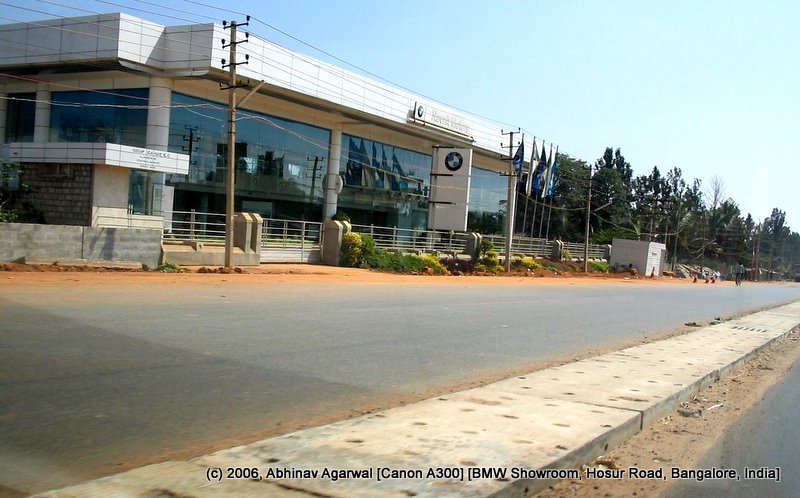
Widening of Hosur Road, Bangalore

 This below is a photo I took in November 2003 - at the time this BMW showroom was under construction.

And this below is a photo I took in December 2006 - you can see that the road widening project on Hosur Road has taken over the space at the side of the road.


© 2007, Abhinav Agarwal. All rights reserved. Reposted to this blog, 2011

Friday, December 22, 2006

Mt St Helens

Mt St Helens is an active volcano. It last erupted more than 20 years back, in 1980, and blew off more than a thousand feet off its top, and killed more than 50 people. I visited that place about three or four times over a two year period. From interstate 5 you take an exit and travel some 50 miles before reaching the Johnston Ridge observatory. This below is one of many bridges on the way to the volcano. And if i remember correctly, this bridge is new - it was blown away by the volcanic eruption of 1982.

During summer, when all the snow has melted away, even at the peak, you can see the starkness of the volcano. It is clear which way the eruption took place, and which direction the lava flowed. Everything in its path was burnt, destroyed, and buried under millions of tonnes of molten lava.

This photo taken many miles from the base of the volcano shows you the extent of the damage the volcanic eruption caused.

And this photo, taken from even further away, you can almost see the river of molten lava flowing at more than 200 kilometers an hour... burning everything in its path, raising temparatures to hundreds of degrees around it...

And, if you look closely at the upper right corner of the photo, you can see another mountain in the background. I think that is Mt Rainier, another volcano, albeit a dormant one. Or is that Mt Hood? Don't remember for sure.


And look at this photo - taken in November 2000 I think (or it may have been December). I like this photo and almost always think of two things when I see it: the first is that you can make out very clearly the onset of winter; the peak of the mountain is obviously the first to be covered with snow, and as it keeps getting colder as winter advances, the snow line keeps descending, from 10000 feet, to 9000, to 8000, and lower. By January all that is brown below would be white, covered in snow. The second thought is that this photo could have used a 2 stop neutral density filter (see this link). I had to expose for either the snow or the base - had I exposed for the base, the snow and the peak would have simply been washed out totally. Exposing for the peak meant that the base is very dark, most of the details are lost.


Some links:
- the US Forest service site.
- The NPS (National Park Service) has a short PDF brochure here.
- A totally gorgeous photos of the volcano is available here, or visit the page here.
- More information about the volcano is available here from the USGS site.

Reposted to this blog, Nov 2012
© 1999, 2000, Abhinav Agarwal (अभिनव अग्रवाल). All rights reserved.

Thursday, December 21, 2006

Undercover Economist by Tim Harford

The Undercover Economist

I finished reading "The Undercover Economist: Exposing Why the Rich Are Rich, the Poor Are Poor--and Why You Can Never Buy a Decent Used Car! by Tim Harford". A brilliant book, excellently written, lucidly explained, and it is simply unputdownable (if that indeed is a word).
If you have read Freakonomics : A Rogue Economist Explores the Hidden Side of Everything, make sure to read this. If you haven't, read this book first. The book takes simple everyday things, like buying coffee, at a railway station, or just outside it, or from Starbucks, or selling telecom bandwidth, or buying vegetables from your local store, and explains the economic concepts that go behind many decisions made here, by the customer as well as the seller. Lots of basic and not so basic microeconomic concepts are introduced and blended into everyday examples from life: price discrimination, demand and supply, revealed preferences, externalities, game theory, marginal pricing, and many more. While the first chapter is titled "Who Pays for your coffee", it takes a few chapters before the mechanics and economics are fully explained.
For my money, a very useful theory that while applied to Cameroon to explain why it is so poor, and its rulers corrupt, could just as easily be applied to India, its politicians, and its endemic corruption. Without going into too much detail, or any detail at all for that matter, the theories of Mancur Olson are invoked many times in this context.
The last chapter of the book is about China and how it grew rich. Towards the end Tim Harford tends to get a bit moralistic and preachy, but given the overall excellence of the book, it can be ignored and excused.

© 2006, Abhinav Agarwal. All rights reserved. Reposted to this blog Nov 2011