Friday, November 25, 2011

Idiots On Roads - 12

I present to you an idiot on a pavement. The motorcyclist at the left of the photo, sir, is an idiot.
For several reasons.
Let's examine those reasons.
Firstly, he is on the wrong side of the road. Actually he is more than just on the wrong side of the road, but let's at least establish that he is on the wrong side of the road, to begin with.

Secondly, there is not much traffic on either side of the road, is there? Not that traffic congestion should be a reason to break traffic rules, but at least you could that out as a mitigating factor in those conditions. Understandable, if still not acceptable.

Thirdly, because he has chosen to use the pavement for driving. Not the road. Not even the wrong side of the road. He is driving on the pavement, on the wrong side of the road.

Fourthly, because he is on the pavement, the lady in the yellow sari has to walk on the road. It is a testament to the infinite patience and fortitude of the forlorn pavement trodder who has to keep his or her eyes on not only the pavement to watch out for uncovered manholes and potholes and gaps in the pavement, but also on vehicles on the pavement. All in a day's work. Inconsiderate idiot.

Why is he on the pavement? Well, he did not want to go to the other side of the road, drive up, then take a U-turn to come back on to this road. So much easier to simply take a turn on to the wrong side of the road, and the ride up the pavement for convenience.

Fifthly, he is driving without a helmet. It should not matter, since the helmet would be on a head that has long since stopped working to figure out what is right and what is wrong.

It only makes you wonder in what else walks of life he has internalized the philosophy of such shortcuts. At his job? In his friendships? In his relationships?

To say it using the words from the greatest movie of all time - Sholay: "khota sikka to dono taraf se hi khota hota hai." (खोटा सिक्का तो दोनो  तरफ़ से ही खोटा होता है )

© 2011, Abhinav Agarwal. All rights reserved.

Monday, November 21, 2011

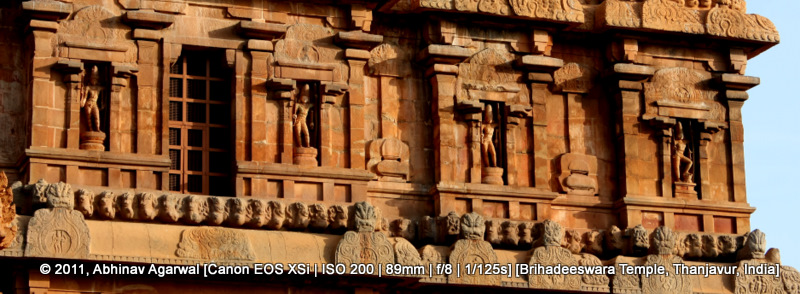
Brihadeeswara Temple at Thanjavur (Tanjore)

The Big Temple at Tanjore - correctly and properly known as the Brihadeeswara Temple at Thanjavur, is one of the most famous of all temples devoted to Lord Siva - the great Lord (brihad = great; eeswara = lord). It is also recognized as a World Heritage site by the United Nations. It therefore tends to attract a fair number of foreign tourists from around the world.

This temple completed 1000 years of completion. Yes, that is 1 followed by three zeroes. The temple was completed in 1010 CE - imagine the fanfare with which people would have tweeted the symmetry of the year, and there would have been polls on Facebook to debate whether the temple should be inaugurated by the King on the 10th of October, so that the date would read 10.10.1010.

Sometimes temple history is clouded in confusion and doubt. Not so in the case of the Thanjavur Big Temple. Thanks to extant inscriptions carved on the walls, we know the temple was completed exactly 25 years and 275 days after Raja Raja's ascension in 985 CE. [Temples Of South India by Ambujam Anantharaman]

From the UNESCO site, the following is listed as the justification for the inclusion of the temple in the World Heritage List:
Justification for Inscription
Criterion (i): The three Chola temples of Southern India represent an outstanding creative achievement in the architectural conception of the pure form of the dravida type of temple.
Criterion (ii): The Brihadisvara Temple at Thanjavur became the first great example of the Chola temples, followed by a development of which the other two properties also bear witness.
Criterion (iii): The three Great Chola Temples are an exceptional and the most outstanding testimony to the development of the architecture of the Chola Empire and the Tamil civilisation in Southern India.
Criterion (iv): The Great Chola temples at Thanjavur, at Gangaikondacholapuram and Darasuram are outstanding examples of the architecture and the representation of the Chola ideology.


The placque at the temple entrance in available in English, Hindi, and Tamil.


Temples tend to have the obligatory elephant and throng of devotees waiting to get blessed by the elephant's trunk. All for a nominal payment of a rupee or two to the mahout. Or deposited to the elephant's trunk, which then makes it way to the mahout.


The vimanam marks out this temple as unique from the architectural point of view. In most temples in south India, for that matter in India, the temple gopuram (pyramidal tower at the entrance to the temple) is bigger than the vimanam. At the Srirangam Ranganatha temple and the Srivillputhur Vatapatrasayee temples, for instance, the gopuram is magnifient, while at Thanjavur and in three other temples built by Chola kings, the vimanam dominates.
The dimensions of the vimaanam in Thanjavur clearly indicate the ingenuity and skill of Chola architects. Its 13 tiers are totally 58 m tall. The square base of 29  supports the octagon-shaped shikara (cupolic dome). This dome that weighs 81 tonnes rests on a single block of granite, which is a square of 7.8m.  [Temples Of South India by Ambujam Anantharaman]

The best time to visit the temple is in the early hours of the morning or after 4PM, when the sun is shining a little less intensely, the light is softer, and the ground walkable with your bare feet.


What is fascinating, among so many other aspects of this temple, is that the Chola dynasty, that built this temple, ruled over South India and large parts of India and South East Asia, and held sway for over a thousand years, making it surely one of the longest lasting dynasties in the world. Even the vaunted Mughals could not hold on to power for more than a few hundred years. By the time the eighteenth century dawned, the empire was a pale shadow of itself.


Chola dynasty - Wikipedia, the free encyclopedia
The Chola dynasty (Tamil: சோழர் [ˈt͡ʃoːɻə]) was a Tamil dynasty which was one of the longest-ruling in some parts of southern India. The earliest datable references to this Tamil dynasty are in inscriptions from the 3rd century BC left by Asoka, of Maurya Empire; the dynasty continued to govern over varying territory until the 13th century AD.
...
During the period 1010–1200, the Chola territories stretched from the islands of the Maldives in the south to as far north as the banks of the Godavari River in Andhra Pradesh.[6] Rajaraja Chola conquered peninsular South India, annexed parts of what is now Sri Lanka and occupied the islands of the Maldives.[4] Rajendra Chola sent a victorious expedition to North India that touched the river Ganges and defeated the Pala ruler of Pataliputra, Mahipala. He also successfully invaded kingdoms of the Malay Archipelago.[7][8] The Chola dynasty went into decline at the beginning of the 13th century with the rise of the Pandyas, who ultimately caused their downfall.[9][10][11]


You will find a fair number of foreign tourists at this temple. This is not surprising, considering its World Heritage Site tag. However, despite this, the infrastructure for tourists - domestic as well as foreign - is not upto the mark. The hotels are mostly old and of the three-star variety. The staff is courteous and helpful, and the rooms themselves were clean - in the hotel we stayed at - but not where you would want to stay back for a day and lounge in the hotel. No. These hotels are strictly utilitarian. Not luxury.


The second is the pretty dismal state of parking facilities at the temple itself. There is but one small parking lot opposite the temple's entrance, which has one entry that also serves as the exit. It is not asphalted, and no parking slots are marked, leading to cars and other vehicles parking in a fairly haphazard manner. Furthermore, there is no guarantee that someone will not park their vehicle in a manner that makes it impossible for you to get your car out. That can happen - take a look at the parking lot to decide for yourself. These are small amenities that would make it a lot less stressful to the visitor and make it easier to take in and enjoy the magnificence of this edifice itself.

On the other hand, the road from Trichy to Tanjore - NH 67 - is now a dream to drive on (also see this post). It is four-laned, and makes the drive from Trichy a short 45 minute breeze.


© 2011, Abhinav Agarwal. All rights reserved.

Saturday, November 12, 2011

RK Laxman on Interviews


This is one of the funniest RK Laxman cartoons I have read. Truly timeless. Isn't this the way, though not exactly so, that several companies still prefer to conduct interviews?
I don't know which collection this is available in however.


© 2011, Abhinav Agarwal. All rights reserved.

The Lincoln Lawyer by Michael Connelly


The Lincoln Lawyer, by Michael Connelly 

(Amazon.com, my review on Amazon.com, Streaming, DVD, BluRay, Kindle, Flipkart.com)
5 stars
This is a first-rate legal thriller. The courtroom drama is high quality. All the threads weave into a thrilling finish.
Michael (Mickey) Haller is a street-smart lawyer who runs most of his business out of his Lincoln Town Car (hence the title), with a driver who uses an iPod and its earphones to not hear conversations he is not supposed to hear (privileged conversations and all that). Haller has been a lawyer long enough to know it is not so much about the guilt or innocence as much about representing the other side of justice. He does however worry about coming across an innocent client and not recognizing that. The prosecution sees him as lower than scum, and there is a running joke about fish and lawyers that is funny, especially as it travels from one person to the other in the book. Haller is a likable cynic, who is on good terms with his two ex-wives. Imagine. Only a lawyer could manage that you would think.

The plot starts to form, and almost immediately thicken, when Haller is picked to defend Louis Roulet, a rich real estate agent accused of assault and worse. Haller is looking at this as a "franchise case" - "A franchise client is a defendant who wants to go to trial and has the money to pay his lawyer's schedule A rates. From first appearance to arraignment to preliminary hearing and on to trial and then appeal, the franchise client demands hundreds if not thousands of billable hours. ... From where I hunt, they are the rarest and most highly sought beast in the jungle." The case seems to crack wide open early on, and then starts to cracks back shut, trapping Haller in a life-and-death pincer grip as it does so. After that, there are a series of turns that leave Haller desperately trying to save his own life, his family's, defend Roulet, who has a darker past than he led on initially, and save himself from being disbarred.

There are several other threads that run through the book, all of which are handled very well by the author. The trial itself covers a lot of ink in the book and is basically forms the climax of the novel, and is paced excellently.

Haller may or may not have a franchise case on his hands in the novel, but Connelly, the author, certainly penned a franchise novel. There have been three more Haller novels since, the latest one being The Fifth Witness.

An outstanding thriller.

The Michael Haller series:


Kindle Excerpt


-->
© 2011, Abhinav Agarwal. All rights reserved.

Sunday, November 6, 2011

GS Books, Incheon Airport, South Korea

This is a lone photo of GS Books, a bookseller in the international terminal at Incheon International Airport in South Korea (Republic of Korea).
The person manning the bookstore did not want any photos taken, so I stopped after the first.


© 2011, Abhinav Agarwal. All rights reserved.

Saturday, November 5, 2011

The Psychopath Test by Jon Ronson


The Psychopath Test: A Journey Through the Madness Industry 

 (Amazon.com, Kindle, Kindle IN, Flipkart.com, Flipkart ebook, my user review)
4 stars
The world is ruled by psychopaths. Breezy but slightly scattered look at the world of psychopaths

This is a book about the author's self-confessed attraction to the study of psychopaths, its sometimes dangerous consequences, and of course, a look at some psychopaths. This is certainly not a tour or journey through the madness industry - it is too diffused a travel to qualify as such. This book is however a look at the world of psychopaths as seen through the author's interviews and the time he spent with people who may or may not have been psychopaths. The evidence certainly suggests they are, but you never know with the really good psychopaths, do you? After with such an array of impressive skills as pathological lying, ability to con and manipulate people, and superficial charm, how could you ever be sure?

The author is a self-confessed nervous person. I first saw him on Jon Stewart's The Daily Show, and his demeanor matches his writing. Writing about psychopaths, interviewing them, and meeting them, sometimes in asylums, can ignite an overwhelming wave of anxiety in most of us. The author is no exception.
I began to yawn uncontrollably around Kempton Park. This tends to happen to me in the face of stress. Apparently dogs do it, too. They yawn when anxious.
While spotting the true psychopath can be difficult, some psychopaths are easy enough to spot, especially when you have this kind of an exchange as evidence.
WOODCOCK: I just wanted to know what it would feel like to kill somebody.
INTERVIEWER: But you’d already killed three people.
WOODCOCK: Yes, but that was years and years and years and years ago.
Perhaps the single most identifying hallmark of a psychopath is lack of empathy. They look at suffering and they feel nothing. If they do observe emotions and people exhibiting human emotions, it is nothing more for them than an opportunity to observe how people react, so they can then be better manipulated.
All those chats about empathy were like an empathy-faking finishing school for him: “I did learn how to manipulate better,” he said, “and keep the more outrageous feelings under wraps better.”
The generally accepted authority on psychopaths, who has studied psychopathy extensively, and who authored the medical profession's generally accepted checklist for diagnosing psychopathy in a person - Psychopathy Checklist (PCL) and Psychopathy Checklist Revised (PCL-R) - is Bob Hare.
Bob knew we tend to jump a lot higher when startled if we’re on the edge of our seats anyway. If we’re watching a scary movie and someone makes an unexpected noise, we leap in terror. But if we’re engrossed by something, a crossword puzzle, say, and someone startles us, our leap is less pronounced. From this Bob deduced that when psychopaths see grotesque images of blown-apart faces, they aren’t horrified. They’re absorbed.
Rob Hare's Psychopathy Checklist  is a twenty point checklist. A trained practioner is supposed to spend time with a subject, try to evaluate him (or her) on these twenty traits, and assign points.
Item 1: Glibness/superficial charm
Item 2: Grandiose sense of self-worth
Item 3: Need for stimulation/proneness to boredom
Item 4: Pathological lying
Item 5: Conning/manipulative
Item 6: Lack of remorse or guilt
Item 7: Shallow affect
Item 8: Callous/lack of empathy
Item 9: Parasitic lifestyle
Item 10: Poor behavioral controls
Item 11: Promiscuous sexual behavior
Item 12: Early behavior problems
Item 13: Lack of realistic long-term goals
Item 14: Impulsivity
Item 15: Irresponsibility
Item 16: Failure to accept responsibility for own actions
Item 17: Many short-term marital relationships
Item 18: Juvenile delinquency
Item 19: Revocation of conditional release
Item 20: Criminal versatility

    Psychopaths, Bob said, will invariably argue that their victims had no right to complain. They had insurance. Or they learned a valuable life lesson getting beaten up like that. Or it was their own fault anyway. One time Bob interviewed a man who had impulsively killed another man over a bar tab. “He only had himself to blame,” the killer told Bob. “Anybody could have seen I was in a rotten mood that night.”
    They’re the spouse who marries to look socially normal but inside the marriage shows no love after the initial charm wears off.”
    Perhaps the boldest assertion is where the author states that Bob Hare seems to think the corporate world is over-represented by psychopaths at the upper echelons of power. Lack of empathy, pathological lying, superficial charm, manipulativeness - these are all attributes that can contribute to a ruthlessness that can drive psychopaths to success in the workplace. As opposed to the estimate of 1% of the general population and 25% of the prison inmates being psychopaths, it is estimated that 4% of leaders in the corporate world may be psychopaths.
    “Sociopaths love power. They love winning. If you take loving kindness out of the human brain, there’s not much left except the will to win.” “Which means you’ll find a preponderance of them at the top of the tree?” I said. “Yes,” she said. “The higher you go up the ladder, the greater the number of sociopaths you’ll find there.”
    a big study he’d coauthored, “Corporate Psychopathy,” had just been published. In it, 203 “corporate professionals” were assessed with his checklist—“including CEOs, directors, supervisors,” Bob said—and the results showed that while the majority weren’t at all psychopathic, “3.9% had a score of at least 30, which is extremely high, even for a prison population, at least 4 or 5 times the prevalence in the general population.” [Highlight on Page 162 | Loc. 2214-17]
    I was more interested in Bob’s theory about corporate psychopaths. He blamed psychopaths for the brutal excesses of capitalism itself, that the system at its cruelest was a manifestation of a few people’s anomalous amygdalae. He had written a book about it—Snakes in Suits: When Psychopaths Go to Work— coauthored with a psychologist named Paul Babiak. [Highlight on Page 137 | Loc. 1874-76]
    And when it comes to psychopath CEOs, the one name most thrown up is the former CEO of Sunbeam, Al Dunlap. The author goes to meet Dunlap in his Florida home, and spends a most interesting day there. Dunlap seems to have shed more tears for his dog than for the tens of thousands of employees he fired and the utter ruination he wrought upon the town where Sunbeam's factory was located. A high-scoring psychopath for sure.

    This book is short and breezy. There are three of four other persons that the author writes about in some detail; that were suspected of being psychopaths, or were in prison or in mental health institutions because they had been diagnosed as such. There is a particularly interesting account of a person who entered a mental institution, to escape a jail term for assault, by pretending to be a mentally ill person. Once in however, he found it difficult to get out. Catch-22 if you will. These accounts are interspersed with the author's meetings with Robert Hare, Douglas Hofstadter (the bestselling author of Gödel, Escher, Bach, and I Am a Strange Loop), and others. The book will likely leave you wanting more, and I think some of the books listed below would help provide more details and information.

    Buy The Psychopath Test from Flipkart.com


    Kindle Excerpt:


    The Daily Show With Jon StewartMon - Thurs 11p / 10c
    Jon Ronson
    www.thedailyshow.com
    Daily Show Full EpisodesPolitical Humor & Satire BlogThe Daily Show on Facebook

    -->
    © 2011, Abhinav Agarwal. All rights reserved.

    Sunday, October 30, 2011

    Diwali 2011

    These are photos of firecrackers burst on Diwali night, Oct 26 2011, at our apartment complex in Bangalore.


    Saturday, October 29, 2011

    Sapna Book House, Koramangala, Bangalore

    This is the Koramangala branch of Sapna Book House in Bangalore, located on the Raheja Arcade Road. Sapna Book House advertises this as the larges book store/mall in India. I have no way of verifying that claim, but the store is large, spread across four floors. While it sells toys and other items besides books, the two floors dedicated to books do contain many books.

    The store is well lighted, and new releases are stocked in neat arrangements throughout the floor. As far as aesthetics go, for some reason or reasons I prefer Landmark. The tiled floor, the harsh white light, and the white shelves all combine to give a very antiseptic feel to the environs. When browsing books you want the store to exude a more homely, comfortable, and inviting feel.


    As most bookstores go, Sapna Book House also does not offer discounts on most books. Some fiction bestsellers are available at 20% or more off the list price, but most other books sell at the published price. As a physical retailer it is understandable that they need to to recover their costs and also make a profit decent enough to justify staying in the business and not turn their store into a multiplex or a mall. However, with the advent of online retailers like Flipkart.com or the older IndiaPlaza.com that offer steep 40% discounts on several bestsellers, it is difficult to see how traditional booksellers like Sapna will survive in this rapidly evolving market.

    Recent events in the US, where brick-and-mortar bookstores like Borders (Borders Group - Wikipedia, the free encyclopedia, The death and life of a great American bookstore - CNN), that filed for bankruptcy and then closed down all 400 or so of its stores, or the iconic Barnes and Noble (Barnes & Noble - Wikipedia, the free encyclopedia), that put itself up for sale, and is now relying mostly on its Nook e-book reader and ebooks to revive its fortunes, indicate that Indian booksellers will find it difficult to survive, let alone thrive, as more online retailers start to expand operations in India.


    2011, Abhinav Agarwal. All rights reserved.

    Tuesday, October 25, 2011

    Power by Jeffrey Pfeffer: Why Some People Have It and Others Don't

    Power: Why Some People Have It and Others Don't, by Jeffrey Pfeffer (Kindle Edition, Flipkart, my user review on Amazon)
    4 stars
    Do as the world does; not as you think it should.
    This book is an urgent wake-up call to the nice, smart, but otherwise powerless people in the workplace. Secondly, it is a guide to understanding how mediocre people rise to and stay in power. Thirdly, well... aren't the first two enough? A riff though; the book almost drowns out its message in anecdotes. Stay focused through the innumerable accounts, and you will see the considerable merits in the book.

    The premise of this book is simple. The world is not as nice a place as you think it should be. In fact, the world may actually be run mostly by psychopaths (The Psychopath Test). If bad people do bad things to good people, it is not because the good people deserve it. That's a fallacy. That's the "just-world hypothesis." If you buy into this hypothesis it hurts you in two ways. More on that in a bit. The acquisition of power in the business world does not necessarily flow to the good people. By good people I mean the people that good people would call good people. People who acquire power do so by understanding how the world works, and understand they need to work as the world does, and not force the world to work they way they want it to, notable exceptions notwithstanding.

    By knowing these rules, and understanding how they work, and reading about them in the context of examples from the real world, the author hopes to level the playing field.
    The belief in a just world has two big negative effects on the ability to acquire power. First, it hinders people’s ability to learn from all situations and all people, even those whom they don’t like or respect.
    Second, this belief that the world is a just place anesthetizes people to the need to be proactive in building a power base.
    Books on leadership, and books on leadership by leaders are your worst enemy. Because they have been written to fool people into thinking that good, kind-hearted, do-gooders are what leaders are. Leaders writing about themselves seldom write about what it really took for them to get to the top. Churchill called Stalin trustworthy in 1945. You won't read about that in Churchill's writings. Jack Welch did not talk about the accounting jugglery that GE indulged in to make its earnings look more predictable than they were. Why leaders, even rank-and-file people lie about themselves. They lie about verifiable facts. They exaggerate achievements. And this has been documented in studies over and over again.
    People distort reality. One study found that out of 1,000 resumés, there were substantial misstatements on more than 40 percent.18 If people make up educational qualifications and previous job experience—stuff that can actually be verified—do you think everyone is completely honest when they describe aspects of their behavior and character that are more difficult to discover?
    If that were not good enough, know that performance does not matter. Good performance is not likely to get you promoted. Bad performance will not get you fired, if you are a leader. Being nice may make your neighborhood kids like you, but it won't make your coworkers respect you. Unless there are consequences to disagreeing with you, people will not fear you. Between love and fear, always choose fear. Because fear gets you results. Love gets you, well, a big wet kiss from a puppy. Maybe.

    So enough with the cynicism. What does it take to get to the top? Well, like any good book, there is a list. There is a list of attributes.
    The three three personal qualities embodied in will are ambition, energy, and focus. The four skills useful in acquiring power are self-knowledge and a reflective mind-set, confidence and the ability to project self-assurance, the ability to read others and empathize with their point of view, and a capacity to tolerate conflict.

    The fact that status hierarchies are stable means not only that it is difficult to move up but also that it is difficult to move down. Once you have achieved power and status through the network of your relationships, you will be able to maintain your influence without expending as much time and effort.

    This is a very engaging book that is well-organized and takes the reader through the topic of power. However, the anecdotes accounts of people tend to drown out the substantive stuff at times. The author, you realize, is making the point that the real world exists, despite our denials. The accounts reinforce the reality of power in the world. However, you wish they were a little less in-your-face and in-every-paragraph.

    University of California–Berkeley professor Morten Hansen has studied what types of social networks are most useful given different types of product development efforts. When you need to access tacit knowledge, a smaller network of close ties is important because it takes close relationships to get people to spend the time to explain their tacit expertise. When the project requires locating explicit knowledge that can be readily transferred once you find it, a large network of weak ties provides greater benefit.
    This is a list of the chapters in the book. This will help you understand the lay of the land, so to say, in the book.
    1. It Takes More Than Performance 
    2. The Personal Qualities That Bring Influence 
    3. Choosing Where to Start 
    4. Getting In: Standing Out and Breaking Some Rules 
    5. Making Something out of Nothing: Creating Resources 
    6. Building Efficient and Effective Social Networks 
    7. Acting and Speaking with 
    8. Building a Reputation: Perception Is Reality 
    9. Overcoming Opposition and 
    10. The Price of Power 
    11. How-and Why--People Lose Power 
    12. Dynamics: Good for Organizations, Good for You? 
    13. It's Easier Than You Think


    Kindle Excerpt:


    © 2011, Abhinav Agarwal. All rights reserved.

    Monday, October 24, 2011

    Bisterey hi bisterey

    The photo above is from the holy city of Kurukshetra. The shop sign at the top reads "bistery hi bistery and light house", i.e., "beds and beds and light house". Go figure that one out.


    © 2011, Abhinav Agarwal. All rights reserved.

    Kindle Million Club

    Amazon announced that George R R Martin (Official Website, Wikipedia) is the latest author to join the Kindle Million Club - i.e. he has sold more than one million books in the Kindle format in the Kindle store. 
    George R.R. Martin is the Newest Author to Join the Kindle Million Club
    Amazon.com, Inc., today announced that best-selling author George R.R. Martin is the latest author to sell more than 1 million Kindle books in the Kindle Store (www.amazon.com/kindlestore). Martin's most recent novel in his A Song of Ice and Fire series, "A Dance with Dragons," debuted in the #2 spot on the Kindle Best Seller list and has remained in the Top 50 for more than 100 days. Martin joins Stieg Larsson, James Patterson, Nora Roberts, Charlaine Harris, Lee Child, Suzanne Collins, Michael Connelly, John Locke, Janet Evanovich and Kathryn Stockett in the Kindle Million Club.
    This reminds me of the million club in 1998 and 1999 when DVDs first came out. This was a time when not all Hollywood studios had embraced the DVD format, and thus a significant collection of blockbusters was not available on this new format. 20th Century Fox and Disney were two prominent holdouts. This meant that the stupendously successful trilogy of Start Wars was not available on DVD. This was of course before George Lucas did a slow burn-of-death of his franchise with the newer "prequels" to the trilogy.
    The Titanic DVD, released in 1999, was the first to sell a million copies, and it took a long time, by comparison, to reach that seven-figure mark.
    Things are a little different now, with the Twilight DVD selling more than 3 million copies on the first day of its release, or Avatar selling more than six million copies in DVD and BluRay formats in the first week of their release.
    Game of Thrones Author Enters Amazon's 'Kindle Million Club' | News & Opinion | PCMag.com lists all the authors thus far in this club:

    The Kindle Million Club


    © 2011, Abhinav Agarwal. All rights reserved.

    Saturday, October 22, 2011

    Halloween Reads from Amazon at $3.99 or less

    Amazon has brought out a targeted list of discounted e-books for Halloween - Chilling Halloween Reads. I don't do a whole lot of fiction reading, and certainly even less of the horror genre. However, there are a few books that are familiar and famous, including one that I had read almost 20 years ago.

    I know these books because these have been turned into iconic movies...
    Rosemary's Baby - I watched this movie with my brother almost 15 years ago. Some parts are scary, yes.

    The Exorcist: 40th Anniversary Edition - when growing up, the movie based on this book was often referred to as the scariest movie ever, and dozens of urban legends grew around it. As an adult, the movie seems much less scarier. Nonetheless.

    Again, I haven't read the book, The Shining, but who can forget the "here's johnny!!!" line by Jack Nicholson in the movie.

    I saw this book's movie, featuring Will Smith, and that's one cracker of a scary movie. I do plan on reading the e-book shortly. I Am Legend (Richard Matheson Series)

    Now, this is one book I did read, but the movie I haven't seen. Maybe I should. Carrie

    The Silence of the Lambs - Anthony Hopkins made Hannibal Lecter immortal in the movie. The movie seems to have lost a little bit of its edge over the past 20+ years, but is still well worth a watch.


    © 2011, Abhinav Agarwal. All rights reserved.