Sunday, November 21, 2010

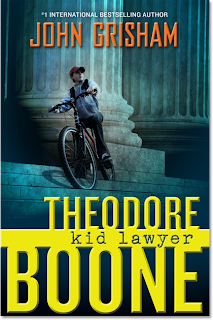
Theodore Boone

Theodore Boone: Kid Lawyer
But Where Is The Climax?

Like Grisham stopped typing and decided to finish the novel (almost) mid-sentence. If you accept and believe this to be a novel meant for pre-teens or tweens, even then this is still weak.

Theodore Boone, Theo for short, is a 13 year old teenager, is the son of lawyer parents, has a more than keen interest in law, sees himself as a trial lawyer when he grows up, often helps out his school mates with legal troubles. When a murder trial starts in his town, he is obviously interested in following it. Which he does, even arranging with the trial judge to have his class attend the first day of the trial. When Theo is introduced to a cousin of a low income student that he teaches, and who may be a crucial witness to the murder, Theo is caught up in a dilemma as to what to do. To tell his parents, or his Uncle Ike, or the judge, or the police. What complicates matters is that the trial is about to come to an end in a matter of a few days, and more importantly, the witness is in the United States as an illegal immigrant, and is therefore not willing to go to the police for fear of deportation.

The premise is interesting, and promises lots of thrills, suspense, and action mixed with the innocence of youth. Except the premise remains a premise. The plot never goes anywhere. There are no surprises. No twists. No suspense. Nothing at all. The novel JUST ENDS. I actually turned over the last page more than a few times, expecting to read more. There was nothing. I checked online on Amazon.com to see if a page or more had bee torn from my copy. No. That's it.

Hugely disappointing. From any author this would have deserved 3 stars at best. Coming from Grisham this deserves a low 2 star rating, if not a lone star. This book reeks of an assembly line mentality, shoddy workmanship laden writing.

Book website
Search Amazon.com Kindle Store for John Grisham
Theodore Boone: Kid Lawyer
The Confession: A Novel
The Rainmaker
A Time to Kill: A Novel
The Last Juror: A Novel


© 2010, Abhinav Agarwal. All rights reserved.

Yelagiri-1

Yelagiri is a small nondescript hill station off the Bangalore - Chennai NH46 national highway. It ranks second to the other hill station near Bangalore, Yercaud (see my posts on Yercaud). If you want a short, relaxing weekend away from Bangalore, either of these two hill-stations will do. Yelagiri offers even less than Yercaud, but this is not to say that there is nothing to do there. There is the lake, a garden, and some short treks. There is also a musical fountain, which is sort of unique as you don't generally find musical fountains at hill stations. The musical fountain is a recent addition. Speaking to the people there, it seems it was mostly the result of an enterprising bureaucrat who made sure that the funds allocated towards the development of Yelagiri as a viable tourist attraction were put to good use, and in good time.

Yelagiri - Wikipedia, the free encyclopedia
Yelagiri (Tamil: ஏலகிரி) is a hill station / village in Vellore district of Tamil Nadu, India, situated off the Vaniyambadi-Tirupattur road.[1] Located at an altitude of 1,410 metres above Mean Sea Level and spread across 30 km2, the Yelagiri village (also spelt Elagiri at times) is surrounded by orchards, rose-gardens, and green valleys.[2][3]

Also see yelagiri - Google Search
The road from Bangalore to Yelagiri is excellent. With the completion of the last remaining flyovers on NH7, the drive from the Bangalore Silk Board is uninterrupted by diversions that existed hitherto. From NH7 you need to take a left at Krishnagiri on to NH46, the tolled highway that takes you to Chennai. At Bargur you take the state highway that takes you to Yelagiri.

The drive up to Yelagiri is pretty good, with 14 hairpin bends to be navigated. How do I know there are 14 hair pin bends? Because these are very neatly numbered such. While the temperatures are only marginally lower than the plains, the abundance of trees and the green cover makes the heat much more tolerable than in the open, where the sun beats down upon you, mercilessly.
As you enter proper Yelagiri, you are greeted by good pavements, proper lane markings on the road, and lots of signs to give a first-time visitor information on the things to do at the place. Very thoughtful, and to be much appreciated by travelers.


View Larger Map

As I wrote above, this is one of the 14 hairpin bends when going up to Yelagiri.


This is the intersection on NH46 where you need to take a right onto SH131. The flyover you see in the background is NH46.

© 2010, Abhinav Agarwal. All rights reserved.

Sunday, November 14, 2010

Bangalore Book Festival 2010 Photos

Photos from the Bangalore Book Festival. The festival is open till Sunday, Nov 21 2010. If you take your car there, you need to pay Rs 20 for parking. Entry costs Rs 20 per adult.
See my earlier post, Books, Photos, and Travels: Bangalore Book Festival 2010, for more details.

One thing's for sure. If you want to do justice to the book festival, you need to budget at least half a day. That's right. Six hours or more. Maybe even a full day. You may not end up stopping at every single stall, but there will be a dozen or so where you will want to spend some time.

And yes, one more thing. A few thousand rupees in your pocket may not be a bad idea. At these book festivals, the chances of stumbling upon a book that you had been searching for, or one that had recessed into some long, forgotten crevice of your mind are high. With the advent of the internet, powerful search engines, book previews that can show you snippets of books, and shipping options that can land that desperately sought book at your doorstep in a matter of days or a week or two, the lure of these book festivals is not as great as it was, say, a decade or two ago. But there is something about being in the midst of tens of thousands of physical books that still holds an attraction.


© 2010, Abhinav Agarwal. All rights reserved.

Friday, November 12, 2010

Bangalore Book Festival 2010

The Bangalore Book Festival, 2010, kicks off from Friday, November 12, 2010, and continues till the following weekend, closing on Sunday, Nov 21 2010. The organizers expect to have more than a million (ten lakh) titles on display, and more than 3.5 lakh (3,50,000) visitors attend the festival over the 10 days it is held.
The book festival is open to the public from 11 a.m. to 9 p.m. and the entry fee is Rs 20. Entry is free for school and college students, a press note said.
Books on medicine, engineering, indology, architecture, ayurveda, astrology and various other subjects will be on display catering to the interests of all - from six-year old to sixty-year old.
Devaru Bhat, secratory  BBPA, "To conduct the Book festival in a systematic and hassle free manner, we are ensuring that every detail is taken into account."  He further said that, "The event is spread over 75,000 sq.ft is jointly organised by the Bangalore Booksellers and Publishers Association and Klub Class. The Kannada Book Authority has extended its financial support to the fair."


View Larger Map of Bangalore Palace Grounds

© 2010, Abhinav Agarwal. All rights reserved.

When embedding a Kindle Web Sample

If you have a blog where you want to embed Kindle books, here is a tip.

When you copy the HTML to place on your web page or blog post, note that div id used. It reads "kindleReaderDiv" and is later referenced by this name in the JavaScript as KindleReader.LoadSample({containerID: 'kindleReaderDiv', ....

If you have more than one post that appears on the same page with such content embedded, it is going to be bunched together in the same place rather than in their respective posts. This is because of the div id.
A simple fix is to give each such div its unique id.
If I am embedding Michael Crichton's "Pirate Latitudes", all I do is add the word "Pirate" to the end of the div id, so that the whole thing now reads as:


© 2010, Abhinav Agarwal. All rights reserved.

Saturday, November 6, 2010

Diwali firecrackers

The Hindu festival of Diwali, the festival of lights, is incomplete without the bursting of firecrackers. Which means that you want to be handy with a camera in hand. Here are some photos from the celebrations.


Tuesday, November 2, 2010

Coopetition, by Adam Brandenburger, Nalebuff

Co-Opetition : A Revolution Mindset That Combines Competition and Cooperation : The Game Theory Strategy That's Changing the Game of Business

Co-Opetition 

by Adam M. Brandenburger, Barry J. Nalebuff

(my Amazon.com review)
Amazing book, and a classic that still retains its relevance and power to educate. You won't find much game-theory theory in this book, and certainly no math, but as a book on business strategy, this is one of the very best. Think Competitive Strategy: Techniques for Analyzing Industries and Competitors and The Innovator's Dilemma.

It is a bit surprising to give a book on game theory strategy 5 stars that really does not talk much about the theory of game theory, and contains not a single formula, and no math - not a single formula. Leave that little lacuna aside, and you will find this is, even 15 years after its publication, one of the best business books on strategy there are.

Kindle To Enable Lending Soon

Interesting. You will be able to lend or read loaned books on your Kindle soon. With lots of restrictions for sure, but a welcome step nonetheless. This also introduces a way for Amazon to build more knowledge about its customers, specifically around their social networks. From the Kindle Community, Coming Soon for Kindle - kindle Discussion Forum 

"...we will be introducing lending for Kindle, a new feature that lets you loan your Kindle books to other Kindle device or Kindle app users. Each book can be lent once for a loan period of 14-days and the lender cannot read the book during the loan period. Additionally, not all e-books will be lendable - this is solely up to the publisher or rights holder, who determines which titles are enabled for lending. "
Kindle 3G Wireless Reading Device, Free 3G + Wi-Fi, 6" Display, Graphite, 3G Works Globally - Latest Generation 
Kindle Wireless Reading Device, Wi-Fi, 6" Display, Graphite - Latest Generation 
 

© 2010, Abhinav Agarwal. All rights reserved.

Monday, November 1, 2010

The Girl With The Dragon Tattoo

The Girl with the Dragon Tattoo

The Girl with the Dragon Tattoo 

Amazing thriller, with a dark side, some sickening violence, and with a slightly weak ending.

Carl Mikael Blomkvist is a financial journalist who has been accused of and found guilty of libel against a business tycoon. He has been handed a hefty fine and three months in jail. Lisbeth Salander is a 25 year old hacker who does PI (private investigative) work for a security firm, but someone who has also been deemed as legally "incompetent", is regarded as a "retard", has a mostly undisclosed history of abuse, and who may also be suffering from Asperger's Syndrome (hinted at but not stated definitively). And then there is Henrik Vanger, the octagenarian patriarch in retirement of Vanger industries. He has been obsessed with the disappearance of his grand-niece almost forty years ago. Vanger proposes to Blomkvist that he write a history of the Vanger family and also try and find out what happened to his grand-nience, Harriet Vanger, who he suspects was murdered. No body was found, no one was suspected, and no one charged. Yet, a grim and smug reminder of her disappearance makes an annual appearance at Henrick Vanger's house.

As Blomkvist starts his work, first alone, and then with the help of Salander, things start to go horribly wrong. A sadistic murderer may in fact be on the loose. Blomkvist's life may be in danger, in mortal danger, Salander herself has to deal with abuse, Blomkvist's newspaper may be in danger of going down in the wake of the libel suit, and the Vanger family is no gathering of saints.

This is by far the best fiction book I have read in almost ten years. The pace is measured, even slow at times, but never slackens. Enough detail is included to keep you involved. The central characters are thoughtfully etched out. There is substantial dialog between the characters; important if you are to build empathy, or antipathy, towards the characters, and yet given short shrift in so many works of fiction.


© 2010, Abhinav Agarwal. All rights reserved.

HBR - Envy at work

Three Stars
"Envy At Work", from the April 2010 issue of HBR.

Why is envy a bad thing? For one it is considered one of the seven deadly sins. It damages your self-respect. It makes you obsess with the other person's success, when you should really be focused on your own success. That causes you stop working towards your own performance, your success.
Envy damages relationships, disrupts teams, and undermines organizational performance.
And the bloody feeling is so difficult to admit, isn't it? When the other person gets promoted, or recognized, or praised, or a bigger salary hike, or stock options, or a bonus, or a bigger cubicle, or a bigger office, how many people go and congratulate the person, "Congratulations Bob. You sure worked hard as hell in sucking up to the boss. I would have fired you and your sorry posterior long back, after tarring your face, had I been your boss. I should have got that promotion, and I deserve it, and you don't, and you never will. But congratulations again!" Nah! You aren't doing that, are you? Mostly the congratulations are going to be of the form, "Hey! Congratulations Bob! Well done", delivered with clenched teeth. Most of the time there is a stony silence and an even stonier glare. Right? There is no emoticon or clenched-teeth-smiley for that, yet. And how do we explain it ourselves and others? "Of course he was going to get promoted. After all, he is the boss' yes-man" or "He gets to have spend time with the boss, so of course he is going to be promoted" or "that was MY idea he stole and passed it off as his own, and if I go to the boss now, I will be seen as just being negative."

The authors claim, ambitiously I would opine,
In the course of our research, we’ve found that it is possible to prevent yourself from being consumed by envy and even to harness it to your advantage. In this article we’ll explain how to recognize potentially destructive thoughts and behaviors; refocus them into more generous, productive ones; and make yourself more open to others, more receptive to change, and more fulfilled at work. We will also off er suggestions for managing envy within your team.
Even without reading any further, I think this paragraph sets impossibly high goals to meet. Let's see how the authors actually fare.

Sour grapes.
Envy manifests itself mostly in the form of disparagement and distancing.
When people have qualities we envy but cannot easily acquire, like beauty or charm, we tend to dismiss the value of those qualities and even treat them with scorn
Psychologists have often termed this as a "coping mechanism" or a "defence mechanism." Disparagement and distancing, along with trivialization, intellectualization, and even denial, are all forms of coping with someone else's success.
However, as Scott's charm catapulted him higher, Marty’s envy won out. He undermined Scott in conversations at the watercooler, seethed whenever his rival spoke at meetings, and barely made eye contact with him. Marty grew disengaged from the organization as well, distancing himself from teammates and refusing to mentor younger analysts ... Once considered a superstar, Marty now lacked passion for his work and performed poorly.

Be friends with strangers
Yes. If you don't know someone who succeeds, you will not be as unhappy as when someone you know succeeds.
According to psychologist Abraham Tesser, people are indeed unhappier when a close friend succeeds in a personally relevant domain than when a stranger does. Strangers are an abstraction...
How To Be Successful, and Less Envious
This is what the authors suggest for individuals:
  • Pinpoint what makes you envious
  • Don’t focus on other people; focus on yourself.
  • Affirm yourself.
And for teams and managers:
  • Share power
  • Make what is scarce plentiful (have plenty of one on one meetings with your team members)
  • Beware of linguistic triggers
  • Give enviers and their targets different spheres of influence

That's it? No secret mantra to chant every morning? No ritualistic effigy burning advice to exorcise the demons of envy? No shouting profanities into a pillow? Hmm... doing the right thing is tougher than it is. It is easy to write about it, but difficult to practice.

I would say that more research, more advice, and a more persuasively text is required here. The title is inviting, but the main course disappoints.

A zero-sum situation is how most people approach other peoples' success as. That is, the size of the pie is fixed. If he succeeds, then it means, ipso facto, that I do not. After all, there is room for only one "manager", or "director", or even "CEO", isn't there? How many people know the "next most important person after the CEO" at a company? Or how many people know that you could have been the manager instead of the other person? And therefore got that double-wide cubicle, or that office, instead of the cubicle you are forced to dwell in currently? On the other hand, and there is always another hand, isn't there? On the other hand, people succeed as a team. We fail as individuals, but we succeed as teams. Microsoft Bob is widely regarded as a failure. The Yugo is regarded as the worst car of all time by many (1985 Yugo GV - The 50 Worst Cars of All Time - TIME, Wikipedia). How many people are there that go about putting their stint at these products as a highlight of their resume? Not many you would suppose. "The product I worked on was a pile of dog-crap, but I, and I alone, was the shining star there." That wouldn't really work well, would it? The bottom line is that success is a team effort. So remember, success has a hundred fathers, failure is an orphan with a hundred siblings.


© 2010, Abhinav Agarwal. All rights reserved.
Singbal's Book House Goa


Singbal's Book House in Goa is located at an intersection where five roads meet. It has the look of a bookhouse that was at one point in time would have been an important landmark in its own right, and derived importance from its business - of selling books, but is now more of a relic that struggles to find its true mooring in a rapidly changing world. The inside of the shop is fairly small, perhaps no more than a few hundred square feet of densely packed shelves. Books range from the standard textbooks prescribed in schools for such subjects as physics, geography, and more, to the regular paperbacks, the usual suspects in the photoportraits of India, its mysticism, its landscape, and the like.


View Larger Map


© 2010, Abhinav Agarwal. All rights reserved.
