Saturday, July 6, 2024

Life, Death, and the Ashtavakra Gita, Bibek Debroy and Hindol Sengupta


Life, Death, and the Ashtavakra Gita, Bibek Debroy and Hindol Sengupta

Life, Death and the Ashtavakra Gita” is a combination of a translation of the text by Bibek Debroy, accompanied by an intensely personal reflection by Hindol Sengupta on the Gita and his experiences. 

A Gita means a song. There are some Gitas in Hinduism that are more famous than others. The most well-known Gita is, of course, Krishna’s divine song and discourse, delivered to Arjuna on the battlefield of Kurukshetra—the Bhagavat Gita. The Mahabharata itself has several Gitas, and Bibek Debroy recently wrote a book with translations of 25 such Gitas (Sacred Songs: The Mahabharata’s Many Gitas, pub. Rupa, 2023). Eighty-six shlokas in three chapters from the Teertha-yatra upa parva (in the Aranyaka Parva) of the Mahabharata tell us the most we know about the sage. The Ashtavakra Gita is a dialogue between Sage Ashtavakra and King Janaka. The Ashtavakra Gita itself is however not a part of the Mahabharata. There is a fleeting mention of the sage in the Valmiki Ramayana, a mention in Adhyatma Ramayana, and a little, much later, in Bhavabhuti’s Uttararamacharita. 

The Ashtavakra Gita itself is short—285 shlokas in 20 chapters, and is much shorter than the Bhagavat Gita, which has 700 shlokas over 18 chapters. Unlike the Bhagavat Gita, the Ashtavakra Gita has seen relatively fewer translations and commentaries. Swami Nityaswarupananda in 1940, John Richards in 1994, Rajiv Kapur in 2011-14, Bart Marshall in 2005, and by Swami Chinmayananda in 2014 are some.

Advaita Vedanta posits that the atman and the Brahman are the same, they are not distinct, they are not two. The Ashtavakra Gita is considered one of the most distilled advocations of Advaita Vedanta. As Bibek Debroy writes in the Introduction, “It is a direct and undiluted exposition of advaita (non-dual) Vedanta." To quote, in 2-2, Ashtavakra says, ‘Just as I alone provide illumination to the body, I do that to the universe too. Therefore, either the entire universe belongs to me, or nothing does.’ In 2-5, the sage says, ‘When one reflects on it, a piece of cloth is nothing but strands of thread. In that way, when one reflects about it, the universe is nothing other than the atman.’ The path to moksha (liberation) lies not in a self-sacrificing pursuit of liberation, or even a surrender to a supreme deity, for that itself is an expression of an embedded desire—‘It is extraordinary that though he desires moksha, he is terrified of moksha.’” (3-9). 

Wednesday, July 3, 2024

Strange Obsession, Shobha De

Strange Obsession, by Shobha De


As strange confessions go, here is one - I hadn't read a single of Shobha De's books till recently. Not one. Not even leafed, browsed, flipped pages of one. Shobha De, 'Cycnicism in chiffon', as a Bollywood superstar had once described her, the queen of sleaze prose, founding editor of gossip rag, Stardust, the 'Jackie Collins of India', a homegrown bestselling author, female icon, and more. And then, one day, on a whim, I picked up Strange Obsession from Bookworm. If Krishna, the proprietor's, eyebrows went up a smidgen, I didn't notice. 

First published in 1992, it is the story of Amrita Aggarwal, a beautiful girl from Delhi who moves to Bombay (as the city was called in 1992, when the book was published, till it became Mumbai) to become a model. A supermodel, at that. And she does. The young, nubile girl attracts the attention of many. Among the many is a mysterious woman named Minx (Meenakshi, actually). Minx is attracted to Amrita in more ways than one, is infatuated and obsessed with Amrita. Minx is well-connected and powerful; she can make or break careers, with a snap of her fingers. She can even make people disappear, again, with a snap of her fingers. Everyone knows it, and yet no one does anything. Such are the ways of high society in Bombay, evidently.

Sunday, November 26, 2023

Review: Sacred Songs The Mahabharata's Many Gitas


Sacred Songs: The Mahabharata's Many Gitas, by Bibek Debroy


The Mahabharata, given its encyclopaedic length, unsurprisingly, contains many, many Gitas (songs). Surprisingly though, not many people are aware of the presence of Gitas other than the Bhagwat Gita in the Mahabharata. This book is a selection of 25 Gitas from the Mahabharata, with the Sanskrit verses in Devanagri script, along with their English translation. 
Gita means song. When one mentions the word ‘Gita’ in the context of the Mahabharata, one is invariably referring to the Bhagwat Gita—Krishna’s divine message to Arjuna on the eve of the great battle between the Kauravas and Pandavas in Kurukshetra. However, there are other passages that are also called ‘Gita’. Taken across the Mahabharata, Ramayana, and Puranas, these number over fifty. In this book, Bibek Debroy has selected twenty-five such Gitas, excluding the Bhagwat Gita, from the Mahabharata. 

An obvious question that arises is—what is the criteria for classifying a Gita? In the book’s Introduction, several criteria are listed. One is to take only those that are explicitly called out as such in the Critical Edition of the Mahabharata; only nine qualify. Categorizing expositions and conversations that further an understanding of the purushaarthas (dharma, artha, kaama, moksha) are a more acceptable criterion. This brings the list up to twenty-two. Add the Yaksha Prashna and Sanatsujata and you get twenty-four. The twenty-fifth is the Pandava (or Prapanna) Gita, added on admittedly weaker grounds. 

Saturday, September 30, 2023

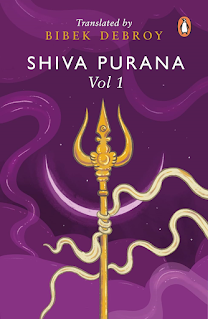
Shiva Purana, Vol.1, tr. by Bibek Debroy

Shiva Purana, Vol. 1, tr. by Bibek Debroy


Shiva Purana, Vol, 1 is the first of a three-volume unabridged English translation of the Shiva Purana, accompanied by more than one-thousand explanatory footnotes. 

In the corpus of religious texts in Hinduism, the Puranas are classified as smritis (remembered texts), as opposed to the Vedas, that are classified as shruti (those that are heard and divine and timeless in origin). Purana literally means old. They are encyclopaedia texts on many, many topics. Specifically, a Purana is supposed to cover five topics—sarga (cosmogony), pratisarga (cosmology), vamsha (genealogy), manvantara (cosmic cycles), and vamshanucharitam (accounts of royal dynasties). 

There are eighteen major Puranas, also called Maha Puranas. There are minor, or upa, Puranas, and then there are local, or sthala, Puranas that are devoted to sites of religious importance. The Shiva Purana is, interestingly enough, sometimes not counted as one of the 18 major Puranas, mostly on account of the fact that much of this purana is also to be found in Vayu Purana. However, the Shiva Purana is counted as a maha Purana in most enumerations. 

Saturday, September 23, 2023

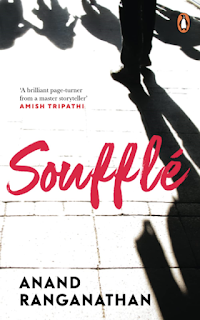
SoufflĂ©, by Anand Ranganathan—Review


Soufflé, by Anand Ranganathan

At under 200 pages, Anand Ranganathan’s fiction thriller-mystery novel is an ideal read on a Delhi-Mumbai or Bangalore-Delhi plane ride. The book starts off in India’s business capital, Mumbai, where, at a lavish party at a luxury hotel, business tycoon Mihir Kothari takes a spoonful of Michelin star chef Rajiv Mehra’s soufflĂ© and drops dead. The police find Rajiv in his hotel room’s bathroom, barely alive after what looks like an attempted suicide. CCTV footage shows him adding what is later confirmed to be cyanide from a vial to the soufflĂ© marked for Mihir Kothari. An open-and-shut case, with a speedy trial and a death sentence guaranteed. Except he is not guilty. He cannot be guilty. Could he? Is he?  

Saturday, May 6, 2023

Spy Stories: Inside the Secret World of the RAW and the ISI, by Cathy Scott-Clark Adrian Levy - Review

This is a fast-paced read, but which comes across more as a Pakistan ISI sponsored pamphlet. 

The material is haphazardly put together. The veracity of several key conclusions is unsubstantiated. One has to rely on the authors' word. No corroborative evidence is presented. Pakistan's point of view is presented without critical scrutiny, as gospel. India's external intelligence agency, R&AW, is painted as a diabolical outfit that is incompetent and unaccountable by turn. 

The strife in Kashmir is presented after suppressing all accounts of horrors perpetrated over the decades against the ethnic Hindu minority. Former Pakistan president Pervez Musharraf is shown as a leader who tried to solve the Kashmir crisis, notwithstanding his complicity in several terrorist attacks on India. 

The authors draw an equivalence between terror groups like LeT, Al Qaeda, and Jaish on the one hand and so-called Hindu terror organizations on the other. The authors' dislike for India's National Security Advisor, Ajit Doval, borders on the disturbing. 

The Pulwama terrorist attack of 2019 is hinted at as a "false-flag" operation, using the same line of reasoning that would also make the 9/11 attacks in the United States a similar false flag operation. Yes, truly. 

India is the perpetual aggressor in this book, Pakistan the eternal wronged state at the receiving end. In other words, the authors seek to profit from luring gullible Indians into buying the book by promising them lurid details of spycraft, but delivers a left-liberal screed that whitewashes radical terrorism without compunctions.


© 2023, Abhinav Agarwal (अभिनव अग्रवाल). All rights reserved.

Saturday, April 15, 2023

Aryaa: An Anthology of Vedic Women—Review

Aryaa: An Anthology of Vedic Women


Ten Women Who Shaped Ancient India.


Aryaa is a collection of ten stories from Vedic and post-Vedic literature that brings to life the stories of ten women, each unique, each strong, each of whose story is an adventure in itself, and who shaped in small, and big, ways ancient India.

Eight of the women featured figure in the Mahabharata, while two are from the Upanishads. There is Shakuntala, born to an apsara and a sage, and who became the progenitor of the race of the Bharatas. Chitrangada, the warrior princess who married the Pandava Arjuna and whose stepson, Babruvahana, would meet his father in battlefield. One cannot talk about Chitraganda without also writing about Ulupi, the Naga princess who basically kidnapped Arjuna to have as her husband. From that union was born Iravan. The tale of Damayanti is perhaps the most romantic tale ever penned and whose account was narrated to Yudhishthira as a reminder that what was the present had repeated in the past; such was the way of itihasa—history. Subhadra, whose posthumous son was carried on the lineage of the Pandavas. Or Madhavi, who raises her father, Yayati, back to heaven after his fall on the strength of her merits. Then there is Satyavati, the fisherwoman who ensured her lineage survived in the face of the vicissitudes of fate and the dictates of karma. That leaves two women—Gargi and Maitreyi. Their accounts figure prominently in the Brihadaranyaka Upanishad. Whereas Ved Vyasa is considered the composer of the Mahabharata, he is called the collector, organizer, of the Vedas. In that sense, even these two accounts are of women Vyasa wrote about. These two women are not only unique individuals in their own right, but also one of the most learned sages mentioned in the Vedas. 

Sunday, April 9, 2023

Mahabharata The Epic and the Nation, by GN Devy - Review


Mahabharata The Epic and the Nation, by GN Devy

What gives the Mahabharata its "timeless magic", what about the epic has captivated the imaginations of millions, do its characters make it so captivating, or is it the philosophical ideas captured therein? The book avers that it answers all these questions. 

Ved Vyasa is considered the author of the Mahabharata. The appellation Ved Vyasa means someone who divided the Vedas. Ved Vyasa can therefore refer to more than one person. Krishna Dwaipayana is also called Ved Vyasa. 'Krishna' means dark, and Dwaipayana means 'island born' and is derived from 'dweep', which means island. He was dark in color and was born on an island, which is why he was called Krishna Dwaipayana. The author translates it as 'Krishna of the Dark Island'. A cursory look at any Sanskrit dictionary may have sufficed by way of clarification, like Monier-Williams or Apte. The author didn't deem it necessary. One expected better from someone who has written and edited ninety books and was awarded a Padma Shri in 2014.

Thursday, March 30, 2023

Ajaya, by Anand Neelkanthan—Review


Ajaya: Roll of the Dice, by Anand Neelkanthan

A screed and a rant, but not a book or a story.

This is a book written with the sole purpose of inciting outrage, and therefore, publicity, and therefore sales. 

Is this an alternate retelling of the Mahabharat? No. It reads more like the outpouring of a mind that sees discrimination everywhere and consequently projects it on to the characters in his book. The molester of a woman, the instigator, the one who cheered are the heroes and protagonists. Tells something, tells all, doesn’t it, and then some more, about the book and its author? 

Saturday, December 17, 2022

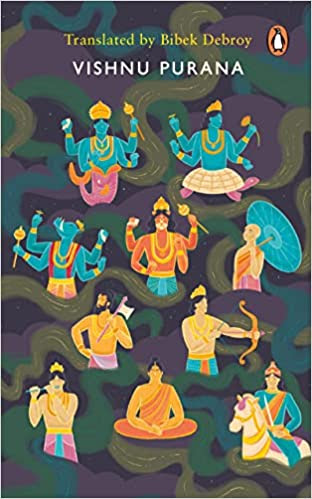
Vishnu Purana, tr. by Bibek Debroy

Vishnu Purana, translated by Bibek Debroy


A book that stays close to its definition


Why was Drupada, father-in-law of the Pandavas and Draupadi’s father, called a Panchala? Because one of Puru’s descendants was Haryashva, who had five sons — Mudgala, Srinjaya, Brihadishu, Yavinara, and Kampilya. So confident was Haryashva in his five sons’ valour that he declared that these five alone were capable of protecting the kingdom. Thus, these five brothers came to be known as Panchalas.

Or why was the capital of the Kurus called Hastinapura? Because one of Puru’s descendants was Hasti, and who established the city of Hastinapura. Both nuggets of information come to you in the 19th chapter of the 4th part of the Vishnu Purana.

King Rituparna was a descendant of Bhagiratha; the same Bhagiratha who brought down Ganga from the heavens. Karna’s foster father was Atiratha. He found the infant Karna floating on the Ganga, took him home, and was raised by him and his wife, Radha. It turns out that Atiratha was one of Anu’s descendants. Anu was one of Yayati’s sons. This is described in the 4th chapter of the 4th part of the Vishnu Purana.

Friday, August 19, 2022

Buried (Hush Collection), by Jeffrey Deaver

Buried (Hush Collection), by Jeffrey Deaver


'Buried' is a short novella, at under 100 pages, and runs at a fast clip, keeping me - the reader - engaged throughout. 
The plot is simple enough - a serial killer has returned to the small town of Garner and a too-old-to-be-taught-new-tricks journalist, Edward “Fitz” Fitzhugh, heads out to report on the story the old fashioned way. Meanwhile, the kidnap victim is in a race against time to free himself before time, air, and opportunity run out. One eyewitness to the kidnapping refuses to reveal himself and come out in the open, till Fitz employs good old journalistic skills to track him down and get some hints about the probably kidnapper. 

There are some brief passages where the pace slackens and one gets the impression that Deaver is perhaps filling the pages, but those passages are brief. This is a fast-paced novella that kept me turning the pages. All in all, a satisfying read. 

In particular, the opening chapter grabs you by the neck. If I were in a store leafing through books at random and if I came across this book, the first three pages would be enough to make me buy it. Yes, openings matter.


© 2022, Abhinav Agarwal (अभिनव अग्रवाल). All rights reserved.

Saturday, July 16, 2022

Classified: Hidden Truths in the ISRO Spy Story”, by J. Rajasekharan Nair - Review

Classified: Hidden Truths in the ISRO Spy Story, by J. Rajasekharan Nair 


A Sharp Look at the ISRO Spy Case.

The short of the matter, for people who have not followed the case closely, is that Indian Space Research Organization (ISRO) scientist S. Nambi Narayanan and others were accused of spying and conspiring to sell to Pakistan cryogenic engine technology. For close to three decades the matter rolled around in the corridors of the judiciary, roiling and ruining lives, till 2018, when the Supreme Court ruled that Narayanan’s arrest had been unwarranted, and ordered compensation of Rs. 50 lakhs to be paid to him. Another accused, scientist K. Chandrashekhar, slipped into a coma hours before the verdict was announced, and died soon thereafter. 

Veteran journalist J. Rajasekharan Nair has been following the case since it broke out. His book, “Classified: Hidden Truths in the ISRO Spy Story”, is an updated version of the book he had written in 1998, “Spies from Space: The ISRO Frameup”. He has brought out additional facts and updated the book based on the Supreme Court verdict of 2018 and developments since. What the book reveals is a story of bureaucratic egos and petty revenge dramas, of foreign agents embedded high up in the government, of political games and apathy, cover-ups galore, and international games of espionage and arm-twisting. 

Saturday, March 26, 2022

The Reacher Guy: The Authorized Biography of Lee Child, by Heather Martin - Review

The Reacher Guy: The Authorized Biography of Lee Child, by Heather Martin

(Amazon India, Kindle)

Heather Martin’s authorised biography of Lee Child, ‘The Reacher Guy’, is the story of James Grant the person, Lee Child the author, and Jack Reacher the character.

James Dover Grant goes out on 1 September 1994 and buys “three pads of lined paper, one pencil, one pencil sharpener and an eraser for a total of £3.99.” In March 1995, he sends out his first ever letter pitching his novel. Writing as Lee Child, his first book, Killing Floor, is published in 1997. It is the first book to feature Jack Reacher as the protagonist. Two decades later, by 2018, it is estimated that approximately 400 Lee Child books, on average, sell every hour of every day. Night School, published in 2016, sells 18,000 copies a day. Lee Child’s Jack Reacher books have sold well over a hundred million copies.

Thursday, January 6, 2022

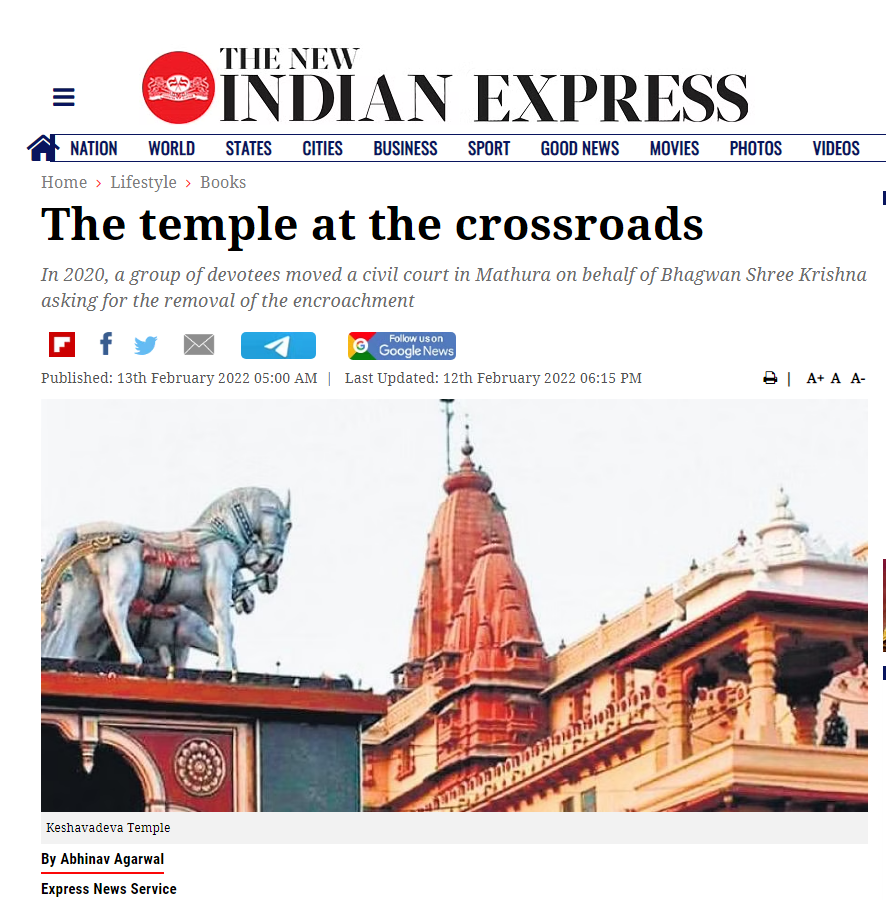
Krishna Vasudeva and Mathura, by Meenakshi Jain - Review

Vasudeva Krishna and Mathura, by Meenakshi Jain

Amazon

Indians may know Mathura as an important railway station on the way to Agra, as the site of a large oil refinery and a place of connection with the Hindu god, Krishna. But not many will know of its significance in India’s socio-political landscape. Even fewer will know enough to separate fact from fiction. Meenakshi Jain’s Vasudeva Krishna and Mathura attempts to summarise, in a short and readable book, the available literature about Mathura, its history, and association with Vasudeva Krishna over the ages.

While the book is divided into 10 chapters, it can be broken into three logical parts. In the first part, going back to almost 3,000 years, ancient Sanskrit grammarian Yaska’s treatise Nirukta gives an indication of the transition from “the gods of sacrificial fires to the deities of the Epics and Puranas”. The Svetasvatara Upanishad propounded the idea of bhakti and there was also the emergence of images (murti, vigraha, pratima) where “images served the same purpose as Agni in Vedic rites”. There was a gradual merging of Bhagavata and Vaishnava, with Vasudeva Krishna being identified with the Vedic Vishnu.

Rukmini, by Saiswaroopa Iyer


Rukmini: Krishna's Wife, by Saiswaroopa Iyer

 
Writing fiction based on our epics is easy. Writing fiction based on our epics is tough. Somewhere along this dichotomy lies the secret to writing a story that holds your attention and interest while at the same time staying faithful to the original. 

Saturday, July 17, 2021

HBR's 10 Must Reads - Management Ideas 2021 - Review


HBR’s 10 Must Reads - The Definitive Management Ideas of the Year from Harvard Business Review – 2021

(Amazon)

HBR’s 10 Must Reads - The Definitive Management Ideas of the Year from Harvard Business Review – 2021 is a good collection of short articles covering diverse topics. Of all, however, The Hard Truth about Innovative Cultures, by Gary P. Pisano, is the most important, and also the best written, piece. 

It may seem harsh to use the saying – ‘Monkey See, Monkey Do’, but success begets imitators. Decades ago, there was the ‘HP Way’, then came Google’s ‘20% Project’ and Amazon’s ‘extreme tolerance for failure’. If HP was the original garage startup that became one of the most successful companies of Silicon Valley (before suffering the inevitable decline, terminal in many cases, that every company goes through; Jim Collins' 2009 book, How the Mighty Fall, is a good read on the subject), Google and Amazon have grown to become trillion-dollar industry leaders. It is unsurprising that leaders at companies look to these successful companies for best practices to emulate. However, a superficial adoption of these practices without an understanding of what makes them successful in the first place is a recipe for failure. The article brings out the truths about five of the best practices of these innovative corporate cultures. 

Tuesday, July 13, 2021

Indraprastha, by BB Lal - Review

Indraprastha: The Earliest Delhi Going Back to the Mahabharata Times

Author: B.B. Lal
Publisher: Aryan Books International


After Independence in 1947, the two most famous sites associated with the Indus Valley civilisation, Harappa and Mohenjodaro, became part of Pakistan. Indian archaeologists began a hectic campaign of excavations to discover more Harappan sites in India. One such excavation was at Lothal by S.R. Rao in 1954-55. In the coming years more than a thousand sites would be excavated, many along the route of the long dried-up Saraswati river. It is a matter of lament from archaeologists, including B.B. Lal that many of these sites have been subject to abject neglect and apathy and are in danger of being lost forever.

B.B. Lal, as a young archaeologist with the Archaeological Survey of India, wanted to examine whether places mentioned in the Mahabharata had an existence that went back to the times of the epic. It helped that the names of many of these places had remained unchanged from the times of the Mahabharata. The first excavations at Indraprastha were conducted in 1954-55, resumed after a gap of fifteen years, in 1969-70, and which continued till 1971-72. There was another round of excavations that was performed in 2014. A total of ten periods identified based on the excavations and the stratification were observed. These periods started with the Painted Gray Ware period, dated to the 10th century BCE; the Northern Black Polished Ware, dated to circa 600BCE; and all the way to the British period, dated to the 19th to mid-19th century CE.

Friday, March 5, 2021

yataḥ kr̥ṣṇas tato jayaḥ - Tales from the Mahabharata

In an earlier article, I looked at the thirteen occurrences of the words, यतो धर्मस्ततो जयः (where there is dharma, there is victory) in the Mahabharata, using the Critical Edition as my reference. These words are spoken by Arjuna, Dhritarashtra, Drona, Gandhari, Karna, Krishna, and Sanjaya.

These words are also the emblem of the Supreme Court of India. The first time these words are spoken in the epic is in the Udyoga Parva, by Dhritarashtra, and the last time by Bhishma, in the Anushasana Parva, just before he takes Krishna’s permission to depart for heaven.

I also pointed out, as best as I could find, only once are these words, an expansion of the earlier phrase, spoken in the Mahabharata, Bhishma – यतः कृष्णस्ततो धर्मो यतो धर्मस्ततो जयः (where there is Krishna, there is dharma; where there is dharma, there is victory), but a variation of these words can also be found in the text – यतो धर्मस्ततः कृष्णो यतः कृष्णस्ततो जयः (where there is dharma, Krishna is there; where there is Krishna, victory is there), also spoken by Bhishma.

So, that led me to another search, of another set of words – यतः कृष्णस्ततो जयः (where there is Krishna, there is victory). These words, in this order, are said six times in the Mahabharata (going by the Critical Edition) – thrice in the Bhishma Parva (all in the Bhagavada Gita Parva, though not in the actual Bhagavada Gita), and once each in the Adi (Viduragamana), Udyoga (Yana-Sandhi), and Shalya Parvas (Gada-Yuddha).

Saturday, February 13, 2021

The Curse of Bigness, by Tim Wu - Review


The Curse of Bigness: How Corporate Giants Came to Rule the World, by Ti Wu


Evidence of the power that tech behemoths have come to wield in the world was on display on 7 January 2021, when Google, Facebook, Twitter, Shopify, Snapchat, Discord, and others came together to ban the 45th US President, Donald Trump, from their platforms. It was reminiscent of Stalin’s Great Purge, with a promise of more to come. With even Russian dissident Alexei Navalny and German Chancellor Angel Merkel criticising the ban, back in stark focus are issues of intolerance, accountability, free speech, incitement, and monopoly power.

On 20 October 2020, the US Department of Justice sued internet search giant Google over what it claimed was an unlawfully maintained monopoly. A few weeks later, on 9 December, the Federal Trade Commission and 48 other states and districts sued social media behemoth Facebook, alleging that it had illegally maintained its social networking monopoly through anticompetitive conduct. How companies, especially tech companies, came to wield so much power and become the behemoths they are today is the subject of legal scholar Tim Wu’s short book, The Curse of Bigness.

Monopolies are not new; in fact, have been around for centuries, with the monarchy in England employing what was called the Crown monopoly as political patronage as well as to encourage innovation. The English Parliament banned monopolies in 1624 by enacting the “Statute of Monopolies”, which became the precursor to almost every anti-monopoly law, including the American Sherman Act and the EU’s competition laws. It, however, did not stop the King of England from granting a de-facto monopoly on the sale and export of tea in the British colonies to the British East India Company. This led to what is now known as the Boston Tea Party episode in December 1773, which led to harsh steps taken in retaliation by the British, and eventually sparked the American Revolution.

This anti-monopoly spirit ran deep in some of the founders of the United States, including Thomas Jefferson and James Madison. Jefferson called for a declaration of rights to include a “freedom of commerce against monopolies”. Much of the zeal the American government showed in breaking up what it called “Trusts” of the Gilded Age can probably be attributed to the ideas of American jurist and later justice of the Supreme Court, Louis Brandeis, who came to believe in the dangers of what he called “excessive bigness”. One of the triggers was J.P. Morgan’s attempts to combine more than three-hundred firms into a single entity—the New Haven Railroad, creating a monopoly of the Northeastern transportation infrastructure. Brandeis wrote that “Men are not free if dependent industrially on the arbitrary will of others”. Freedom, in his view, meant freedom not only in a political and individual self, but also freedom from industrial domination and exploitation.

Post World War II Europe was so scarred by the experiences of monopolies, particularly in Nazi Germany, that its anti-monopoly ideology was even stronger than in America and came to be known as Ordoliberalism. Ordoliberals, Wu writes, “wanted a state that was strong enough to break private power, but not so strong as to take over society. They wanted the state to guarantee certain economic securities, but to leave the provisioning of most goods to the market process.”
In 1945, American company Alcoa was broken up, and in the 1960s, anti-monopoly action by the regulators peaked, with the Justice Department going after banks, grocery stores, shoe manufacturers, and others, implementing what it saw as a “broad anti-concentration mandate” given to it by Congress to stop “creeping concentration”.

By 1969, IBM, with annual revenues of $7.2 billion, ranked as the fifth-largest company in America. Only General Motors, Exxon Mobil, Ford Motor, and General Electric were bigger. The same year, it was sued by the Justice Department with “monopoly maintenance”, and the case went to trial in 1975. The trial continued for another six years, and after what many called “a farce of mind-boggling proportions”, the case was dropped shortly after Ronald Reagan became President. The case, however, did result in two major changes. One, even before the case began, IBM made the decision to unbundle its software from its hardware offerings. This effectively birthed the modern software industry as we know it. The other, in 1981, was when IBM entered the personal computer market and chose to make it “open”—with a hard drive from Seagate, printer from Epson, processor from Intel, and the operating system from Microsoft.

Microsoft made the most of IBM’s decision and grew to become the world’s largest software company, pursuing a strategy of bundling applications with its Windows operating system to enter and dominate new markets. This strategy did not go down well with the regulators or competitors and it wound up facing the ire of the government when it was sued by the Justice Department in the 1990s. The case went to trial in 1998 and the government won in both the district court and in appeal, but just when it seemed a breakup of the company was inevitable, regulatory winds changed with the election of a new President in 2000.

The trial did, however, reveal the strong-arm tactics of the company and the ruthlessness of Bill Gates, its co-founder. The after-effects of the trial were to “distract” the company from competing effectively in the booming internet age, with lawyers looking over the executives’ shoulders. This paved the way for companies like Google, Facebook, Amazon, and others to thrive, grow, and grow.
During the George Bush and Obama years, there would be virtually no major anti-trust action by the government. These regulatory shifts in anti-monopoly action over the last four decades can mostly be traced to what Wu calls the victory of “neoliberalism” in American academia. This philosophy argued that the one and only measure of consumer welfare was prices. Lower prices meant that consumers could not be seen as harmed, and therefore, companies could not be penalised for concentrating too much market share and power as long as prices did not go up. Neoliberals were also “opposed to almost all forms of state intervention in the economy”. Aaron Director, “the father of the neo-conservative Chicago School of antitrust,” believed that breaking up larger companies protected weaker companies and reduced efficiency by stopping these larger companies from lowering prices. This thought percolated to the regulators, with the European regulator, in 1997, suggesting the “lowered prices” and “consumer welfare” were its goals.

What have been the consequences of this thinking? The market for glasses and sunglasses, which looks a hotbed of competition with companies such as Armani, Ray-Ban, Tiffany, DKNY, and dozens of others available to choose from. Except it isn’t. All these brands are owned, or exclusively licensed, by just one company—Luxottica. Consumers pay over $200 for a pair of glasses that cost no more than $20 to manufacture. Prescription glasses retail for $400, but cost under $20. Or the beer market, where two companies—InBev and Heineken—own nearly “every single major brewer in the world”. In the technology industry, it allowed Facebook to buy out fast-rising competitor Instagram for $1 billion in 2012, and WhatsApp for $16 billion in 2014. It allowed Google to acquire 270 companies, including competitors like Waze, YouTube, and AdMob. The change in attitudes even in Silicon Valley was captured best by PayPal founder Peter Thiel, who wrote, “only one thing can allow a business to transcend the daily brute struggle for survival: monopoly profits”.

Perhaps the most alarming lesson one may draw from the book is how the growth of cartels and monopolies may foreshadow a coming of totalitarianism. In many ways, the last couple of years showed how tech platforms that now control all social media apps have begun to increasingly exercise censorship on content that they determine to be ideologically contrary to their own beliefs.
Wu writes that “extreme concentration of German industry before the war was an aid to Hitler’s rise to power…” This is lesson we simply cannot afford to ignore. Indeed, German companies like United Steel, Krupp, Siemens, IG Farben and others were major beneficiaries as well as contributors to the Nazi military build-up of the 1930s. IG Farben was perhaps the only company to run its own concentration camp as well as operate a rubber plant in the Auschwitz campus. In case the name IG Farben does not ring a bell, the company was broken up into its original six constituent companies, including BASF, Agfa, Hoechst, and Bayer.

While it is too short to do justice to a subject as complex as antitrust enforcement, Tim Wu’s book nonetheless serves as an accessible primer to some of the thinking that has guided authorities in the US and Europe, and what challenges these authorities face in their enforcement battles against companies that have become larger and more powerful than ever before.

This review first appeared in The Sunday Guardian on the 16th of January, 2021.

Disclaimer: Views expressed are personal.
© 2021, Abhinav Agarwal (अभिनव अग्रवाल). All rights reserved.

Friday, February 5, 2021

Where thee is Dharma, there is Victory - Tales from the Mahabharata

The emblem of the Supreme Court of India is “yato dharmas tato jayaḥ”, which is translated as “where there is dharma, there is victory”. These words are taken from the Mahabharata. When asked to identify the person who speaks these words, most people would answer that it was Gandhari who responded thus when her son Duryodhana came to her before the Kurukshetra war to get her blessings for victory. Gandhari did not bless her son with victory; she instead told him that victory would be where there was dharma. While Gandhari did say these words, they are uttered not once, but thirteen times in the Mahabharata, if we take the Critical Edition of the Mahabharata as our reference. 

Some other factoids that should interest people, as they did me. These words are uttered once each by Arjuna, Dhritarashtra, Sanjaya, Drona, Karna, Gandhari, and Krishna. Bhishma and Vyasa say these words thrice each, unsurprisingly. They are spoken once each to Vidura and Karna, twice each to Dhritarashtra, Duryodhana, Gandhari, and Yudhishthira, and thrice to Krishna.

Finally, these words occur once each in the Drona, Shalya, and Anushasan Parvas, twice in the Stri Parva, thrice in the Udyoga Parva, and five times in the Bhishma Parva.


Let’s dig into the thirteen occurrences, in the order they appear in the Mahabharata.
Image credit:detechter (via IndicToday)