Sunday, September 9, 2012

Londonistan, By Melanie Phillips - Review

Londonistan, By Melanie Phillips

"Right-Wing Leanings Aside, Some Serious Questions."
 
Review in short: The author casts a critical eye on the direction British society and the nation have taken that seem to have resulted in a radicalization of the Islamic community in the country. Substantial documentation of the foibles of the British polity, intellectuals, judiciary adds heft to the message. An important and trenchant, if somewhat disturbing and critique. Many of the questions and context are eerily applicable in the Indian context too.

Longer Review.
As Britain becomes more multi-cultural and more heterogeneous a society, it has also had to face a most unfortunate consequence of this intermingling. People - immigrants - who have turned against their motherland. The London terrorist attacks of 2005 brought this problem to the forefront for much of Britain - "The realization that British boys would want to murder their fellow citizens was bad enough." What some have perceived as a lax and permissive attitude among the intelligentsia to the sprouting of Islamic fundamentalism has led to the coinage of a pejoration: "Londinistan" - "a mocking play on the names of such state sponsors of terrorism as Afghanistan", and the despair that London itself has become "the major European center for the promotion, recruitment and financing of Islamic terror and extremism." This book, then, is a scathing look at the players that have led to, in the author’s view, a surrender to the forces of Islamic fundamentalism in Britain.

In the author’s view, and backed by considerable data, such a pejoration - the term ‘Londonistan’ - may not be without merit, especially if one considers the vast numbers of Britons engaged in nefarious activities. "According to British officials, up to sixteen thousand British Muslims either are actively engaged in or support terrorist activity, while up to three thousand are estimated to have passed through al-Qaeda training camps, with several hundred thought to be primed to attack the United Kingdom."

The author has tackled different aspects of this issue in a separate chapter each. Therefore, in chapter two, for instance, she takes on the lax immigration system for the uncontrolled influx of people claiming persecution in their home countries, so much so that "many Islamist terrorists and extremists found Britain to be such a delightful and agreeable destination." She harshly condemns "Ministers and officials in charge of the asylum system" as being "among the least likely to possess either the intellectual or the political clout to tackle the problem". She also pillories the European Court of Human Rights for extending "the scope of the provision in the European Convention on Human Rights that prohibits torture or degrading treatment" as it became "impossible to deport illegal immigrants - including suspected terrorists - to any place where the judges thought such abuses might be practiced." Worse was the British judiciary, while "independent of political control", came to "see themselves, rather than the democratically elected politicians, as the true guardians of the country’s values."

To take a more detailed look at some of the arguments put forth in the book, let us start with the evidence that points to a radicalization of Muslims in the UK itself. To that end there is an impressive array of facts the author marshals to argue the point that, to begin with, UK has played host to terrorists and organizations with terror-links, unequivocally.
"UK-based terrorists have carried out operations in Pakistan, Afghanistan, Kenya, Tanzania, Saudi Arabia, Iraq, Israel, Morocco, Russia, Spain and the United States."
"And the number of terrorists who have come roaring out of these polluted British waters is startling. UK-based terrorists have carried out operations in Pakistan, Afghanistan, Kenya, Tanzania, Saudi Arabia, Iraq, Israel, Morocco, Russia, Spain and the United States. The roll call includes Ahmed Omar Saeed Sheikh, killer of the journalist Daniel Pearl and disaffected, brilliant son of Pakistani immigrants; Dhiren Barot, Nadeem Tarmohammed and Qaisar Shaffi, British citizens and al-Qaeda members who plotted to attack major financial centers in the United States; Mohammad Bilal from Birmingham, who drove a truck loaded with explosives into a police barracks in Kashmir; the "shoe-bomber" Richard Reid, who was converted to Islam at Brixton Mosque in south London; Sajid Badat from Gloucester, a putative second shoe-bomber but who was also caught and is now in jail; and Omar Khan Sharif and Asif Mohammed Hanif, the British boys who helped bomb a Tel Aviv bar in 2003 and killed three Israeli civilians. And let’s not forget Azahari Husin or the "Demolition Man," the Malaysian engineer who belonged to the al-Qaeda-linked terrorist group Jemaah Islamiyah ( JI). He had studied at Reading University in the 1980s, honed his bomb-making skills in Afghanistan in the 1990s, helped mastermind the terrorist attacks in Bali (twice) and finally blew himself up in a gun battle with Indonesian police in November 2005."

"One of the world’s most radical Islamist organizations, Hizb ut-Tahrir, which is banned in many countries where it is considered a major threat, has its headquarters in Britain."
"Scarcely less significant is the European headquarters of the radical proselytizing movement Tablighi Jamaat at Dewsbury in Yorkshire."

"Al-Sunnah, the Islamist magazine that calls repeatedly for human-bomb terror operations against the United States, is published from London,"

"Indeed, one could say that it was in Britain that al-Qaeda was actually formed as a movement."
"Many of Osama bin Laden’s fatwas were first published in London."

"The foiled millennium plots of 1999 and 2000, when al-Qaeda planned a series of attacks in Europe, the United States and the Middle East, all led back to London."
You know things were bad when Egypt "denounced Britain as a hotbed for radicals" after "Abu Hamza welcomed the massacre of fifty-eight European tourists at Luxor in October 1997".  Abu Hamza was "an Egyptian-born former engineering student and nightclub bouncer, who had lost an eye and an arm in Afghanistan and sported a hook instead of a hand", and was allowed to live and preach in Britain for several years, till he was finally jailed in "February 2006 for soliciting murder and inciting racial hatred"

It is useful to describe the term Islamism itself as it is used extensively in the book. "Islamism is the term given to the extreme form of politicized Islam that has become dominant in much of the Muslim world and is the ideological source of global Islamic terrorism." The author states "It derives from a number of radical organizations", prominent among them being the Tablighi Jamaat in India/Pakistan, the Muslim Brotherhood ("which was founded in Egypt by Hassan al-Banna with Sayed Qutb its leading ideologue. Its creed is known as Salafism and is deeply antisemitic; this is virtually indistinguishable from Saudi Arabian Wahhabism"), and "the Jamaat al-Islami, founded by Sayed Abu’l Ala Maududi in India/Pakistan"

So how did such a radicalization came to happen? And why wasn't anything done about it? Were the Muslims residing in Britain, all 1.6 million out of a population of 60 million, siding with the terrorists? Were they sympathizing with these Islamists? No, not quite, argues the author, and there is nuance to the "no".

"In Britain, hundreds of thousands of Muslims lead law-abiding lives" However, and this is where the nuance appears, in the author’s opinion, the majority of the pacifists need to be more vocal about their abhorrence for Islamist violence, and more disturbingly, moderation among them is relative, "considering their widespread hostility towards Israel and the Jews, for example, or the way in which the very concept of Islamic terrorism or other wrongdoing is automatically denied."

More disturbingly, for Britain, there has also been this barely hidden desire within the British Islamic community to see more Islamization in society in general. Consider this:
"A poll conducted by the Guardian newspaper found that 61 percent of British Muslims wanted to be governed by Islamic law, operating on Sharia principles - "so long as the penalties did not contravene British law." A clear majority wanted Islamic law introduced into Britain in civil cases relating to their own community. In addition, 88 percent wanted to see British schools and workplaces accommodating Muslim prayer times as part of their normal working day."
This is perhaps by no means unsurprising - if a community wants more elements of its traditional jurisprudence to be integrated into their adopted country. Perhaps. But what about taking offence at the slightest pretext? What about self-censorship because of fear of causing offence to the easily-offended by vocal minority among Muslims?
"Novelty pig calendars and toys were banned from a council office in case they offended Muslim staff. Ice creams were withdrawn from the Burger King chain after complaints from Muslims that a whorl design on the lid looked like the word "Allah." Various councils banned the concept of Christmas, on the grounds that it was "too Christian" and therefore "offensive" to peoples of other faiths"
Or
"There are now more than 140 housing associations in England catering to ethnic minorities; one of them, the Aashyana in Bristol, provides special apartments for Muslims with the toilets facing away from Mecca."
So, why not debate this issue? After all, these are fairly existential questions for British society, one would assume. But here one has to tread carefully. It is easy for such debates to get hijacked by extremists on both sides, and for stereotype-driven accusations to fly fast and furious.
 "One of the reasons why people shy away from acknowledging the religious aspect of this problem is, first, the very proper respect that should be afforded to people’s beliefs and, second, the equally proper fear of demonizing an entire community. There is indeed a risk of such a discussion exposing innocent Muslims to attack."
If the majority of Muslims in Britain do not agree with or subscribe to the extremist views of those within their community, then they need to be more vocal about it. Which they are not. "If "moderation" includes reasonableness, truthfulness and fairness, the reaction by British Muslims to the London bombings was not moderate at all. Yes, they condemned the atrocities. But in the next breath they denied that these had had anything to do with Islam. Thus they not only washed their hands of (sic) any communal responsibility but - in denying what was a patently obvious truth that these attacks were carried out by adherents of Islam in the name of Islam - also indicated that they would do nothing to address the roots of the problem so as to prevent such a thing from happening again."

It is not as if there is no one speaking out against the Islamists from within the Muslim community. The most eloquent case for the Muslim community to speak against terrorism perhaps comes from Mansoor Ijaz, who wrote in the Financial Times, "It is hypocritical for Muslims living in western societies to demand civil rights enshrined by the state and then excuse their inaction against terrorists hiding among them on grounds of belonging to a borderless Islamic community. It is time to stand up and be counted as model citizens before the terror consumes us all."

Dissenting voices are often either silenced or threatened into submission. "Reda Hussaine is an Algerian journalist who started inquiring into Algerian radicals in London after his Paris office, where he was trying to start up an independent Algerian newspaper, was ransacked in 1993. The French police told him that the attack had been organized from London, that the group responsible was sending money to terrorists in Algeria, and that Abu Qatada was behind it."

What about representatives of the Muslims in Britain? You know you may have a problem of sorts when Sir Iqbal Sacranie, secretary-general of the Muslim Council of Britain, "regarded by the British establishment as the most reliable mainstream voice of the Muslim community", compares "Hamas suicide bombers to Nelson Mandela and Mahatma Ghandi (sic)."

Or take the words of Tariq Ramadan, who, according to "researcher Caroline Fourest", "speaks with two voices". When "asked whether he approved of the killing of an eight-year-old Israeli child who would grow up to be a soldier, he replied: ‘That act in itself is morally condemnable but contextually explicable,'"

A piece in the middle of the book is very illuminating in shedding some light on the topic of Islamopobia. She quotes Kenan Malik, ""antiracist" Asian writer", who suggests that "Islamophobia is a myth and is being exaggerated to suit politicians' needs and silence the critics of Islam: The more the threat of Islamophobia is exaggerated, the more ordinary Muslims believe that they are under constant attack. It helps create a siege mentality, it stokes up anger and resentment, and it makes Muslims more inward looking and more open to religious extremism. It also creates a climate of censorship in which any criticism of Islam can be dismissed as Islamophobic. The people who suffer most from such censorship are those struggling to defend basic rights within Muslim communities"

Islamic theologians are not to be left behind in strengthening the needle of suspicion that some harbor against Islam.
"In 1980, the Islamic Council of Europe published a book called Muslim Communities in Non-Muslim States, which explained the Islamic Agenda in Europe. When Muslims lived as a minority, it said, they faced theological problems, because classical Islamic teaching always presupposed a context of Islamic dominance. The book told Muslims to organize themselves with the aim of establishing a viable Muslim community, to set up mosques, community centers and Islamic schools. The ultimate goal of this strategy was that the Muslims should become a majority and the entire nation be governed according to Islam." 
This is a deliberately and dangerously confrontationalist approach to take, and its effects can be seen even in the beliefs slowly gaining ground among Muslims in Britain.

In all this, it would be awfully remiss to not take a look at politicians and politics. It is a universally acknowledged truth that an amoral politician in need of electoral safety will seek refuge in divisions in society. This has been true with Indian politicians for over half a century, and it should be of no surprise to people that Britain is no different.
"Labour was traditionally the party that appealed most to new immigrants, and Britain’s Muslims were no exception. Many Labour MPs, including the foreign secretary, Jack Straw, found themselves representing constituencies with significant Muslim populations. This had a number of consequences, one of which was that some Labour politicians allowed Pakistani politics to influence British politics." And thus you come across the concept of "vote-banks" in Britain. " 
On the day of the 2005 British general election, Faisal Bodi wrote in the Guardian: "Labour politicians have cultivated the "community leader", the modern-day equivalent of the village chief, whose unique selling point is that he can bring in the vote of the particular ethnic sub-category he belongs to, be it by fair means or rigged postal votes." This seeking of votes goes beyond the shores of the island nation. "According to the bishop of Rochester, Dr. Michael Nazir-Ali, himself of Pakistani origin, a number of Labour MPs with large numbers of Muslim voters need the support of various Islamic leaders in Pakistan who tell their followers in Britain how to vote."

It is a reasonable expectation that the media engender debate on topics that are of interest and of importance to society. In the author’s opinion, when it comes to discussing Islamism in Britain, the media has practiced self-censorship at best, if not outright intellectual dishonesty. Two incidents cited are the murder of "Theo van Gogh, the Dutch filmmaker who was killed for questioning Islamic attitudes to women", or the protests "over the publication in Denmark of a batch of cartoons linking the Prophet Mohammed with violence".

If Muslims, even those born and raised in Britain, were to take up terrorism, surely the fault could not be all lain at the door of either Islam, or radical Islam, or the Muslim community. That is only a very reasonable position to take. The author is also on board with this position. So the fault must be shared with Britain also, right? Yes, sort of. The author seizes upon the ‘liberal’ ethos and casts an accusatory finger upon it. Things get wider in scope from here. But let’s look at the author’s articulation. The author believes that the process of radicalizing started more than three decades ago, in the 1970s, when Muslim immigrants arrived in large numbers from "Pakistan, Bangladesh and India" to "work in the cotton mills in England’s northern industrial towns such as Bradford and Burnley, Oldham and Rotherham." These immigrants' faith was "largely influenced by introspective, gentle Sufism and was thus passive and quiescent." But all that changed in "in the space of a few years" and "it became an increasingly activist faith centered on the mosques, which were transmitting a highly radicalized ideology."  "Such young men, stranded between the mores of Mirpur village life on the one hand and the degraded nihilism of British "liberal" society on the other, are thus easy prey for the puppet-masters of terror."

Ok, if she says so. And then there is a roadhouse punch at Islamic society itself:
"What makes these fragile egos yet more vulnerable still, moreover, is the pathological inferiority complex that afflicts Muslim society, the exaggerated notions of shame and honor which mean that every slight turns into a major grievance, disadvantage morphs into paranoia, and Islam itself is perceived to be under siege everywhere."
One gets the impression that she really wanted to take a sledgehammer at all of Asian Third World, but perhaps thought it more politically correct, in a manner of speaking, to direct this broadside against Muslim society, obligatory refrains of avoiding stereotyping notwithstanding.

So why are liberals to blame for this? Well, if I understand the line of thinking taken by the author, and this is a simplification, it is because liberals hate capitalism and capitalists. The United States is the embodiment of capitalism. Preconceived notions and stereotypes of Jews mean that Jews are associated with capitalism. Hence the liberal hatred of Jews. Fundamental Christians have, on their part, believed, and have been taught, that Jews murdered Jesus. Hence Jews are evil, and hence Jews need to be eliminated. There is an actual theological doctrine that exists to justify this. Known as ""replacement theology," or "supercessionism,", it goes like this: "going back to the early Church Fathers and stating that all God’s promises to the Jews - including the land of Israel - were forfeit because the Jews had denied the divinity of Christ. This doctrine lay behind centuries of Christian anti-Jewish hatred until the Holocaust drove it underground." Islamists, on their part, have bought into the wholesale portrayal of of Jews as evil - "Drawing on a theological animosity, it is based on the belief that the Jews are a Satanic force and a conspiracy to destroy Islam and rule the world; and that, since the Jews control Western society, it follows that Israel is the forward flank of the West's attempt to subjugate Muslims everywhere ... Fixating upon the early conflict between the Prophet Mohammed and the Jewish tribes of seventh-century Arabia, the Islamists became obsessed with the archetype of a universal Jew, treacherous by nature, whose perfidy threatened not only Islam but all humanity."

The enemy of my enemy is my friend, and hence the liberal’s chumminess with Islamists. One can see strong traces of this line of thinking on the part of liberals also manifest itself in India, where there is a strong aversion to criticism of Islamic terrorism, or to ask searching questions of Islamists in India who covertly or overtly broadcast messages of hate against non-believers.

Conclusion:
The book has what I would call a definite right-wing, nationalist, Christian conservative slant.  The author herself does not shy away from it. She argues that these are in fact required for the maintenance of peace in British society. If, however, it was just that, the book could have been easily dismissed. However, what elevates the book from the ranks of a xenophobic screed is the fact that it is well-researched, disturbing, and thought-provoking. Yes, there is a selective cherry-picking of facts and a selective interpretation too, but even taking both into account, this book still raises several questions about the direction the nation of Britain is taking, the culpability of its politicians, and whether its Muslim clergy and intellectuals wants their community to be held hostage to the philosophy of its fringe fundamentalists.

The  other issue that people may find with the book is its sweeping pronouncements heralding the end of Britain and of Western society in general. Consider this, "What if, instead of holding the line for Western culture against the Islamic jihad, Britain is sleepwalking into the arms of the enemy?" Or "In the United States, at least there are wars over culture; in Britain, there has been a rout."

In some cases the flowery prose is outright bizarre. Like where she writes, "helping sow the dragon’s teeth from which would spring the killers". I stopped counting how many metaphors had been mixed and mangled.

For Indians this book should hold an added element of interest. The reason should not be difficult to find. Terrorism, especially terrorism inflicted in the name of and by radical Islamists, has been borne by India for over twenty years. Many of the topics that the book dwells upon are equally germane in India too. Any and all attempts to debate the theological basis for such radicalism are quickly shouted down by equally radicalized voices.

Lastly, it is somewhat ironic that Britain today stands at the junction of trying to assimilate heterogeneous cultures, religions, and identities, while still providing enough space for these identities to preserve their uniqueness. It is after all Britain that pursued a considered policy of racial and religious divisiveness in the Indian subcontinent for two centuries. Whether it was to make caste the sole differentiating factor among Hindus, or using a manufactured Aryan Invasion theory to divide North and South Indians, or pitting Hindus vs. Muslims, it was all part of what Lord Elphinstone called a "divide et impera" policy. One is tempted, almost, to use the phrase that the chickens have come home to roost, or the other phrase that stings even more - "as you sow, so shall you reap".

en.wikipedia.org/wiki/Londonistan_(term)
www.melaniephillips.com/londonistan


Sunday, September 2, 2012

After the Prophet, Part 4

Deeply Sympathetic, Gripping Page-Turner. Though At Times Overly Melodramatic Narrative.
(Kindle, Amazon, Flipkart, my review on Amazon)
5 stars

Part 4 - The End of Ali, and the Beginning of the Split.  (See Part 1, Part 2, Part 3)

Thus outmaneuvered, as Ali's army began the march back to Kufa, the murmurs of disappointment began to arise. Rather than confront their own gullibility, some turned an accusatory finger at Ali. The leader of the disgruntled was Abdullah ibn Wahb, and they were to be the "first Islmaic fundamentalists". The name Abdullah ibn Wahb "still reverberates in the Islamic world since it calls to mind Abd al-Wahhab, the founder of the fundamentalist Wahhabi sect." Wahb and his followers accused Ali of sinning by entering into an agreement with Muawiya. Yet it was Ali's followers who had forced him into negotiations. Wahb would hear none of it, and argued that he had repented, and so was clear of sin. Ali would have to do the same. Wahb, and some three thousand of his followers, left and,  "Fifty miles north of Kufa they established a new settlement on the Tigris at Nahrawan. It was to be a haven of purity"

These self-proclaimed purists, fundamentalists, "began to terrorize the countryside around Nahrawan, submitting everyone they caught to a kind of mini Inquisition. If the answers failed to satisfy their rigid standards, the punishment was death. Matters came to a head when they chose the farmer son of an early companion of Muhammad’s as their victim." The gory end that the farmer and his wife and their unborn son met is too barbaric to imagine, but it is nonetheless instructional to reproduce it here:
"They made the farmer kneel and watch as they disemboweled his wife, cut out the unborn infant, and ran it through with a sword. Then they cut off the farmer’s head."
Wahb's reply to Ali's demand that they surrender the killers was typical. "All of us are their killers. And all of us say: Your blood, Ali, is now halal - permitted - for us."
Note here that for these fundamentalists, not even the Prophet's son-in-law and adopted son meant anything. Theirs was an implacable fury. You could transport these words into the twentieth century, the twenty-first century, and you will find any number of radicals spouting the same rubbish, with the same zeal and deluded self-belief.

And so Ali led a Muslim army against Muslims at Nahrawan, and less than four hundred of the "Rejectionists" survived.

Meanwhile, things went from bad to worse for Ali. Muawaiya's chief of staff, Amr, represented him at the arbitrations with Ali, who was represented by the ageing and simple Abu Musa. Those arbitrations ended in disaster, with Muawiya proclaiming himself as a second Caliph. Things got even worse when, in response to an imminent invasion of Egypt by Amr, Ali sent one of his "most experienced generals" to help shore up Egypt's defenses. The general was welcomed by the chief customs officer, who offered Ali's general "the customary honeyed drink in welcome." The drink was laced with poison, and the general was dead within hours. Egypt fell soon thereafter. Muhammad Abu Bakr, Aisha's half-brother and Ali's stepson, was hunted down and killed.
"...the Syrian soldiers carried out their revenge for Othman on the man who had led his assassins. Ignoring orders to take Abu Bakr alive, they sewed him into the rotting carcass of a donkey, then set it on fire. Some accounts have it that he was already dead by then; others, that he was still alive and burned to death."
If the brother was a demon, the sister was no less sadistic. "Muawiya’s sister Umm Habiba", sent Aisha a "'condolence gift' of a freshly roasted leg of lamb, dripping with bloody juices. The accompanying message read: 'So was your brother cooked.'"

Ali's end also came soon after - "at dawn on Friday, January 26, in the year 661, midway through the monthlong fast of Ramadan. Ali had walked to the mosque in Kufa for the first prayer of the day" A Rejectionist, hiding, fell upon Ali, and opened a large wound on his head with a sword. While the wound was not fatal, the poison laced on the sword was. What of the assassin? Ali forbade his followers from not only any reprisals but also forbade his followers from mutilating the assassin.
"And do not inflict mutilation on this man, for I heard the Messenger of God say, 'Avoid mutilation, even on a vicious dog.'"
As per Ali's last wishes, Ali's sons set his shrouded corpse on his favourite camel, and "gave it free rein". The camel "knelt some six miles east of Kufa, atop a barren, sandy rise - najaf in Arabic - and there his sons buried the man"

And thus Najaf would come to be the first of the two holy cities in Iraq, where Ali was buried - "revered by all Muslims, but by two very different titles: the first Imam of Shia Islam, and the last of the four rashidun, the Rightly Guided Caliphs of Sunni Islam."

(... to be concluded)

http://www.aftertheprophet.com/
The Accidental Theologist
After the Prophet by Lesley Hazleton « Knopf Doubleday - Doubleday
@accidentaltheo

Kindle Excerpt:


-->
© 2012, Abhinav Agarwal (अभिनव अग्रवाल). All rights reserved.

Saturday, September 1, 2012

Dwarkadhish Temple, Rukmini Temple, Dwarka, Gujarat

Autorickshaw, parked at the edge of Aji Dam, outside Rajkot, Gujarat
This is a post about the temple city of Dwarka. Not the Dwarka in Uttar Pradesh, but the Dwarka where Lord Krishna escaped to and established the city of Dwarvati to escape from the repeated attacks by his uncle Kansa's father-in-law Jarasandha. On a more modern footing, the town of Dwarka falls within the district of Jamnagar, and is in the state of Gujarat. Jamnagar is famous for the massive refineries and petrochemical plants run by the Tata, Reliance, and Essar groups.

There are two ways to get to Dwarka, and while all routes do lead to God, on the more physical plane, you can either approach it from the coastline that runs along the southern border of Gujarat. This would mean driving past Diu, Somnath, Porbandar, and on to Dwarka. NH 51  runs along this coast and is mostly in bad shape, and driving is slow.

The other option is to take the Ahmedabad-Rajkot state highway, proceed on to Dhrol, and then via Jamnagar, Khambaliya, and on to Dwarka. This is a beautiful highway, and the four-laning work there is nearing completion. This particular stretch below is from the state highway SH25, a short distance from Rajkot, on the way to Jamnagar.

Tuesday, August 28, 2012

F in Exams, Richard Benson - my review

F in Exams: The Very Best Totally Wrong Test Answers, by Richard Benson
4 stars
If not for the price, I would have been a little disappointed.
(Amazon Paperback, Kindle, my review on Amazon)
Don't get me wrong. This a an entertaining book. It's full of answers, intentional and unintentional, that students gave in exams, when they did not know the correct answers. It's just that the book is short. On my Kindle app for Android, I read it in less than an hour, with time to go back and re-read some of the funnier answers. There is perhaps a fine line between funny and repetitive, as the answers may get if you put too many of them, but I would surely have been disappointed had I paid list price, or even half-price, for the book. I paid $0.99 for the book, so I am certainly not complaining about the price. No sir.

The book is divided into seven topics: Chemistry, Biology, Physics, Math, Business & Technology, Psychology, and History & Geography.

Here are some of the answers and images from the book.

Give the names of two gases that might contribute to global warming. 

This is the math lesson I missed in school. About dots and lines and how to convert one to the other.
Change 7/8 to a decimal.

When learning division, you just need to get to the root of the problem.
Simplify the following equation


To be or not to be, that is probably the problem.
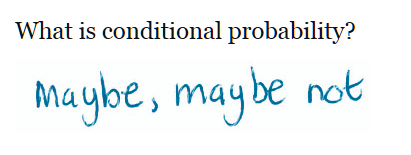
What is conditional probability

Remembering to forget is, easy.
Describe what is meant by "forgetting"

6. Young at heart, is the river.
Name the smaller rivers that run into the Nile

7. Need I say more?
In Pride and Prejudice, at what moment does Elizabeth Bennet realize her true feelings for Mr Darcy. 

Kindle Excerpt:


© 2012, Abhinav Agarwal. All rights reserved.

Sunday, August 12, 2012

Bali and the Ocean of Milk - Review

Bali and the Ocean of Milk, by Nilanjan P. Choudhury

 (Flipkart, Amazon, my review on Amazon)
Hindu mythology-based fiction has been fashionable for a few years now. This book is a standout in the genre, and succeeds on many, many levels.
5 stars
This is a notable book I read and reviewed. Click to see more such books.

Having read one mythology-based fiction bestseller some time back, I had sworn off the entire genre. When I found myself reading Bali and the Ocean of Milk, I had at least one trusted recommendation to go on. I had also promised myself that I would read this book, cover-to-cover, as the trite cliche goes. The delightful surprise was that I could not stop turning the pages of this very, very good thriller.

The plot, in a nutshell, is that Indra (spelled Indrah in the book), the King of gods, is out of shape and out of form, and cannot perform, err... his duties as a king. It is the result of the dying Asura Vritra's curse, killed by Indra by deceit. Viru, or Lord Vishnu, promises to reverse the effects of the curse, and the sin of killing a brahmana, if the devas and asuras can come together to churn the ocean of milk to retrieve a jar of nectar. So far, so good. But will the asura king Bali, son of Vritra, want to have any truck with the killer of his father? Furthermore, can Indra be trusted to keep his word and share the nectar with the asuras?  Yes, yes, we all know that he did not, but even then there is a twist in this tale also. Will the Mahakali priests in Bali's kingdom of Tripura, who have seen their power cut to the bone, rise in revolt against Bali, if only to reclaim power and reimpose their puritanical way of life? And who exactly are behind the assassination attempt on Bali?

While the book does not strictly following the Puranic mythological canon, nor does it claim to, it still reveals an admirable amount of knowledge on the part of the author. To modify intelligently, you also need to know what you are changing, and from what.

The language and the style of writing are confident and assured. Yes, there are words that made me wish I remembered my GRE and CAT word-lists, but they add to the texture of the narrative, not detract or distract.

Some of the tongue-in-cheek dialog between the gods is hilarious. Whether it is Viru, as Lord Vishnu is referred to, and there is a Jai and Sambha also, in case you were wondering where some members of the other cast of Sholay were lurking (sadly, no Basanti, no Thakur, no Ramlal, and no Gabbar), or referring to Indra's not so omnipotent problem, or Indra's gloriously desperate attempts to extricate himself from the clutches of Urvashi,  the effect has the desired effect of puncturing any feeling of celestial awe the reader may have.

There are two sub-plots running in the book. They intersect at times, as when Indra and the bumbling celestial physicians visit Bali's court. More than two sub-plots and it can become a challenge for both the writer and reader to stay fully informed and engaged. Switching between the sub-plots also keeps monotony away.

The story takes a decidedly dark turn after the first half or so. The puns taper off, almost completely, and the narrative turns uncomfortably dark. There is talk of fundamentalism, and such that it can evoke memories of the Holocaust, Stasi-style civilian spying, ethnic cleansing, and of religious intolerance - and take your pick of religions and ideologies. That it does not fall into the messy morass of preachiness is achieved by not moralizing, and by weaving all this into the plot, making it an inextricable part of the plot at that, and by resisting the temptation to dive into a sermon in the middle of the book.

One quibble that I do have is with the dialogue. At times, in a few places, not many, the dialogue seems somewhat stilted and not consonant, so to say, with the emotions running in the scene.

In all, a very satisfying read.

Disclosure: Nilanjan, the author, provided me with a copy, ex-gratis, on the recommendation of Dr. Bibek Debroy, economist and author. I am grateful to both.

http://www.harpercollins.co.in/BookDetail.asp?Book_Code=3049
http://baliandtheoceanofmilk.blogspot.com/

Author: Nilanjan P. Choudhury
ISBN: 9789350291252
Cover Price: Rs. 199.00
Format: ‘B’ Paper Back
Extent: 320  pages
Category: Fiction
On Sale: December 2011


--> © 2012, Abhinav Agarwal (अभिनव अग्रवाल). All rights reserved.

Saturday, August 4, 2012

Ten Years with Guru Dutt: Abrar Alvi's Journey

Ten Years with Guru Dutt: Abrar Alvi's Journey, Sathya Saran (Amazon, Flipkart, my review on Amazon.com)
An Honest Reminisce, But Doesn't Quite Flow Well Enough
4 stars
Abrar Alvi penned most of the screenplays for Guru Dutt's productions, either by writing the screenplay, or the dialogues, or both, in movies like Aar Paar, Mr & Mrs 55, Pyaasa, Kaagaz Ke Phool, and Sahib Bibi Aur Gulam. His influence on Guru Dutt's craft however went beyond being a scriptwriter, and his 10-year collaboration with Guru Dutt ended only in 1964, with Guru Dutt's suicide.

In this book, Abrar Alvi's recollects his decade of working with Guru Dutt, from the time he was virtually locked up in a room, asked by Guru Dutt to write dialogues as a test, to the time after Guru Dutt's suicide where he persuaded Dharmendra to act in "Baharen Phir Bhi Aayengi", and also ghost-directed the movie. The movie flopped, but is still remembered today for its silky melody, "aapke haseen rukh pe aaj naya noor hai", sung by the legendary Mohd Rafi. And while on the movie, there was a song that "SD Burman had composed for Baharen ("Baharen Phir Bhi Aayengi"), which remained unused in the film, was later shot on Dev Anand in Jewel Thief. The song: 'yeh dil na hota bechara.'" [page 118]. Interspersed in the book, between Abrar Alvi's recollections, are comments by Sathya Saran, the author of this book, who also adds some background information that helps clarify Abrar Alvi's recollections. It makes for fascinating reading. Whether reading how Guru Dutt would make sure his friend Johny Walker (real name 'Badruddin') got a role in every Guru Dutt movie, or how Guru Dutt enlisted the help of his cameraman, V.K. Murthy, to play a prank on Abrar, or the poignant story of why Mehmood refused to drink any alcohol. We also get to know why SD Burman, the great composer, refused to work in any movie with Sahir after Pyaasa - no, it was not jealousy that Sahir got the greater plaudits for Pyaasa, as has been often suggested.

If there is one would thing that Abrar Alvi remained (he died in 2009) somewhat bitter about, it was the lingering doubts people have whether it was he who directed the hit "Sahib Bibi Aur Gulam" or Guru Dutt handled the baton there also.
"From his tone I knew there was trouble ahead. I went to the first floor where Guru Dutt had his office, and entered the room. He started shouting at me almost immediately: 'Who do you think you are? Is it your film? It is my film.'
...
I left the room, went back to my place and wrote a letter to him, telling him it was his film, and that I did not want to be part of it. 'Do what you want with the movie,' I wrote. 'I want no credit - I have nothing to do with the film.' I dropped the letter off at his house at about five p.m.
He wrote me a reply: 'You have directed the movie, the credit, and the discredit, if any, is yours.' I still have that precious letter with me and it is the irrefutable proof, to all those who claim that my name was merely a front for Guru Dutt, that I was indeed was the director of Sahib Bibi Aur Ghulam." [page 158]
Abrar however notes that Guru Dutt wanted to, and did indeed shoot the songs for the movie, Saibh Bibi aur Ghulam.. Abrar refused to be on the sets when Guru Dutt shot these songs, because he believed that two directors could not be on the sets at the same time. Abrar Alvi also says that Guru Dutt had a remarkable ability to use songs to advance the story, and where songs would end up becoming an integral part of the story, a narrative continuum rather than a forced contrivance.

Sahib Bibi Aur Ghulam was the only movie that Abrar Alvi directed, a Guru Dutt production, and which became one of the biggest, if not the biggest, hits of Guru Dutt Productions. That movie provides us, the readers, with a rich and fertile ground from which Abrar digs out innumerable anecdotes.
"I learnt a lot about lighting from him. It came in handy while directing Sahib Bibi Aur Ghulam. But I could never really rise to his standard of using light in a scene to make it unique and painterly." [page 103]
The most painful recollections are about the movie's heroine, Meena Kumar, however. More on that toward the end of the review.

Chaudhvi Ka Chand was perhaps the biggest hit till that time among period movies set in a Muslim milieu. The movie was also a monster hit in its own right. Abrar Alvi sheds some light on the modifications he had to make to the script, to not only improve the plot, but also to correct the stereotypical reinforcement of Muslims the story would have fortified. That Guru Dutt played a major part in the direction of the movie is also obvious, not to mention in the cinematography of the title song, "Chaudhvi Ka Chand", an incredible song with also superb music, lyrics, and singing by Mohd. Rafi.
"For six years I would not let the film, now titled Chaudhvi Ka Chand, be made. I said, 'Muslims do not really believe that their women are like a pair of shoes.' I felt it completely wrong to let a man, the hero of a film, pass on his wife to another man. I said, 'This writer has run off to Pakistan and left this third-rate story behind.'
...
Luckily for the fate of the film, Guru Dutt paid heed this time, and the script was turned around. ... Though the film's direction is officially credited to Mr Sadiq, it bears Guru Dutt's stamp all over. .. It has cinematography that once again proved that Guru Dutt was a master of lighting as well as shot composition."
Pyaasa, another Guru Dutt movie that was not only critically acclaimed but also a huge commercial success, provides us with several more anecdotes. It was also during the making of this movie that S.D. Burman decided not to work again with lyricist Sahir Ludhianvi. There are two anecdotes here worth recounting; both center around songs, one is a recitation that the movie's hero, Guru Dutt, gives at a school reunion, and the second is the movie's acclaimed song that appears in the climax, "ye duniya agar mil bhi jaye."
"It was decided that a poem by Sahir should be used for the scene. Burman Dada had to work out a tune for the poem. On the appointed date, Rafi, who was a thorough professional, came over to Guru Dutt's place for the sitting right on time. But unfortunately for us, Dada was nowhere to be seen. I told Rafi, 'You are a master at music, why don't you recite the poem in your own style?'
Rafi thought about it a bit, and then started reciting the poem in the clear, musical voice that was his signature. And we recorded it right there, on a spool of tape, on Guru Dutt's tape recorder. So clear and distinct was the voice and the recording that we could use the copy as it was without having to record it again in the studio. In fact, the somewhat rough quality of the recording gave the scene greater authenticity." [page 73]
Abrar had to make some last minute adjustments to the script to make a somewhat lapse of judgment on Sahir's part not seem incongruous to the movie.
"But somewhere along the way, he seemed to have lost track of the millieu of the story. However, the song he wrote had enough punch and pathos in it to excite the director in Guru Dutt, who filmed it immediately.
...
I was impressed by the wonderful way he had shot it, but the lyrics dismayed me. Guru Dutt could not understand why, so I had to explain. 'The era we have placed the film in is in the mid-fifties,' I said. 'and Sahir has written about the mahelon, the takhton, the tajon ki duniya... these symbols of the Raj, royalty and zamindari are defunct; that era is past in the period our movie is set in...
Of course, it was impossible to change the lyrics; the song had already been shot. I had to do some damage control at my end and bring in relevance to the lines ... I thought about it seriously and decided to give Rehman, the publisher, some rhetoric that would justify the references to royalty. Which is why Rehman talks about the dead poet and says if Vijay were alive today he would place him on a takht and place a crown (taj) on his head ... which Vijay, standing framed in a flood of light at the door of the hall, overhears and responds to with the now-famous renunciation of the world of falsehood and hypocrisy." [page 75]?
The movie's heroine, Waheeda Rehman, plays the part of a streetwalker, and the character was portrayed somewhat on a person Abrar had met some time back, and whose real-life story was much more tragic than "Gulabo's", the name of Waheeda Rehman's character in the movie.

But the most poignant and sad recollections are that from Sahib, Bibi, Aur Ghulam, and the movie's heroine, Meena Kumari. She was a virtual slave to her exploitative husband, Kamal Amrohi, as well as her sister and nephew. She was not only robbed of her money by her relatives, but also subject to physical violence. Her tale is not a happy one that Abrar recounts.
"'Today I will get a thrashing because I am so late,' she said to me, tears streaming down her face. It was well known that not only Kamal Amrohi but even Baker would beat her quite mercilessly. Kamal exploited her monetarily too, and at one point, when she came to stay with her brother-in-law, Mehmood, the actress who had ruled Hindi cinema successfully for so many years and had been the darling of millions did not even have suitable clothes to wear.
...
It is another well-known fact that one of India's biggest stars died in absolute penury, having been successfully looted by her husband and by her own relatives. She lived next door to our bungalow. Her sister and nephew moved in with her and looted her methodically. There would be days when she would drop in to ask my wife for food, as there would be nothing for her to eat at her home. She would eat the leftovers or content herself with bread dipped in tea. It was tragic to see her that way. She was steadily ruining herself with drink, turning into an alcoholic, and to me it appeared as if the story of Chhoti Bahu was being repeated in real life." [page 167]
The book also covers more commonly known topics and controversies such as Guru Dutt's dalliance with Waheeda Rehman - Guru Dutt found companionship and fulfillment with Waheeda Rehman, but could not see his wife with another man, such was the age-old conflict that he found himself in - the consequent tensions between Guru Dutt and his wife, singer Geeta Dutt, as well as the downward emotional spiral that ultimately resulted in Guru Dutt's suicide.

This is a first-rate book, and I would highly recommend it. The first-person narrative style interspersed with commentary by the author, Sathya Saran, has its advantages, the biggest one being to keep the attention and focus on Abrar Alvi. The disadvantage is that you miss the simpler, linear arc that you otherwise would get from a story written in the third-person. I liked the book's style, but remained somewhat ambivalent as to its efficacy.


© 2012, Abhinav Agarwal (अभिनव अग्रवाल). All rights reserved.

Sunday, July 29, 2012

Mummies in the Morning (Magic Tree House, No. 3)

Mummies in the Morning (Magic Tree House, No. 3), Mary Pope Osborne (Author), Sal Murdocca (Illustrator) (Amazon, Kindle)
3 stars
Magical Adventure, But This One Is a Bit Slack
The third magical adventure of Jack and Annie takes them back to the land of the Mummies, in Egypt. Here, they find themselves inside a Pyramid, and have to help a ghost-queen find her way to the otherworld. The queen, dead for over a thousand years, is stuck in this world, and needs to decipher some hieroglyphs to get to the otherworld. She can't, because of short-sightedness. Jack's glasses are of no help to a person made up of air, because she is made up of air! A real-world ailment for the departed, but without a real-world cure.
Jack and Annie are siblings, eight-and-a-half years and seven years old respectively. They find a tree house high up in a tree one day, and which has several books in it. Jack loved reading, while Annie had a sense of adventure. Looking at a book and wishing to go there took them to that place.

In both their earlier adventures, Jack and Annie got into some trouble, and received some help from unexpected quarters. In this third adventure too they get help, from a cat!

Like the earlier adventures, this book also contains eye-catching illustrations, some of which are full-paged. The style of writing is engaging, the language simple, the plot interesting, and the dialog of and between Jack and Annie brings out the personalities of the two children.

Unlike the first two adventures, however, this third adventures felt a bit contrived. I got the impression that the adventure lacked enough surprises to keep my fully engaged.


© 2012, Abhinav Agarwal (अभिनव अग्रवाल). All rights reserved.

Friday, July 27, 2012

After the Prophet, Part 3

Deeply Sympathetic, Gripping Page-Turner. Though At Times Overly Melodramatic Narrative.
(Kindle, Amazon, Flipkart, my review on Amazon)
5 stars

Part 3 - Aisha, Muawiya, and The Night of Shrieking (See Part 1, Part 2)

Even though it had been Aisha, the Prophet's youngest widow, The Mother of the Faithful, who had instigated the crowd against Othman, the Caliph, it was Aisha who was also shocked and infuriated by Othman's assassination, and it was Aisha who marched straight to the the "great mosque", the Kaaba, at Mecca, and roused the people to rise against Ali, with words that were to be echoed by different people in different circumstances, ""Seek revenge for the blood of Othman, and you will strengthen Islam!"" Whether Aisha was more concerned about strengthening Islam or whether more concerned about Ali, her bete-noire, becoming the Calipph, is open to conjecture. However, for the people of Mecca, the argument being made against Ali was the same as what Abu Bakr had used, and the words similar - that Ali's blood was now fair-game, "haraam". Aisha was supported by her brothers-in-law, Talha and Zubayr, who had been part of the six that had voted for Othman after Omar's death, and "each wanted the caliphate for himself". Both Talha and Zubayr would perish the civil war that followed, both done to death, many alleged, by Marwan.

It is useful to include a brief description of Marwan, also known as "Ibn Tarid, the Son of the Exile". His father had been so distrusted by the Prophet that he had been "banished along with his family to the mountain city of Taif." Othman would later reverse this banishment, and recall Marwan to Medina to serve as his chief-of-staff. Furthermore, "no sooner was the battle lost than he rode across the desert to Damascus, to become a senior counselor in the court of Muawiya, the governor of Syria." Muawiya, brother-in-law of Muhammad (his sister, Umm Habiba, had been the Prophet's eighth wife) is another character that belies belief, and more on him later. If ever there was a medieval machinator par-excellence, and without compunctions of any sort, it has to be Muawiya.

Aisha marched from Mecca to Basra, and Ali marched with his army from Medina.
"So when Aisha rode out onto that battlefield outside Basra on her red camel, it was the first time a Muslim woman had led men into war. It was also to be the last."
Actually, this particular bit is not quite true, since Razia Sultan, Sultana of Delhi from 1236 to 1240 CE, led her army in battle against Malik Altunia, her childhood friend and governor of Bhatinda. http://en.wikipedia.org/wiki/Razia_Sultan)

Despite entreaties from several, including Ali, war was not avoided, and the first of what would be an endless elegy of civil wars amongst the Islamic community was fought in October 656CE, less than twenty-five years after the death of the Prophet.
"Hand-to-hand combat was utterly and horribly visceral."
...
"Hardened warriors swore the rest of their lives that they had never seen so many severed arms and legs. It lasted from early morning to midafternoon, and by the time it was done, three thousand men, most of them from Aisha’s army, lay dead and dying."
In the end, the battle was fought around Aisha's camel, with Ali's soldiers appealing to her to surrender, and Aisha sent soldier after soldier to his death. "Seventy men were cut down as they held the reins of Aisha’s camel," and Aisha's own armoured howdah was peppered with so many arrows it "bristled like a porcupine."

As I  read the pasages describing the brutal war, I was reminded again and again about the Mahabharata, and the passages describing the mayhem and severing of limbs that took place in that terrible war.

Aisha was finally defeated, and she returned to Medina, escorted for the first few miles on the journey by Ali and his two grandsons, Hasan and Hussein, as a gesture of respect for the defeated and also to the widow of the Prophet.

Muawiya

Meanwhile, Muawiya, governor of Syria, and "a clear-eyed pragmatist who delighted in the art and science of manipulation, whether by bribery, flattery, intelligence, or exquisitely calculated deception" had watched the outcome of this battle between Aisha and Ali from Damascus. power,  He had let Othman's bloodstained clothes be displayed for a year, to derive maximum mileage from that sight.
"Caliph, Muawiya had ruled Syria for close to twenty years, and the whole province - nearly all the land now known as Turkey, Lebanon, Syria, Jordan, Israel, and Palestine - had become his own personal fiefdom, a powerhouse in its own right."
While Muawiya lived in a luxurious palace, he had however escaped any resentment from the people, thanks to his exquisite cunning. He "prided himself on being exactly as generous and precisely as ruthless as he needed to be."
"“If there be but one hair binding someone to me, I do not let it break,” he once said. “If he pulls, I loosen; if he loosens, I pull.” As for any sign of dissent: “I do not apply my sword where my whip is enough, nor my whip where my tongue is enough.”
...
As one of his senior generals put it, “Whenever I saw him lean back, cross his legs, blink, and command someone ‘Speak!’ I had pity on that man.”
...
“I do not come between people and their tongues,” he said, “so long as they do not come between us and our rule.""
When Ali recalled all governors appointed by Othman, all but Muawiya complied. Ali rejected sage advice from his advisers, who asked Ali to play the same devious political games as Muawiya. Ali would have "nothing to do with such underhand schemes". His advisers assured Ali that he would not have had to do any of the dirty work required to secure allegiance from Muawiya. His aides would do that for him.
"...one of his top generals had promised. “I swear I will take him to the desert after a watering, and leave him staring at the backside of things whose front side he has no idea of."
Four months later Muawiya replied to Ali's missive with an "openly hostile" letter. Ali's inevitable response was to lead "his battle-tested army north out of Basra to Kufa, a hundred and fifty miles closer to Damascus," This would also lead to Iraq becoming the cradle of Shia Islam. Muawiya, in the meantime, set about manipulating popular opinion in his favor, and this included "a carefully staged campaign to present himself as loath to take action. He would have to be forced into it by the outraged conscience of the people."

And thus it came to war, "Early that summer of 657 the two armies, Syrian and Iraqi, met at the Plain of Siffin just west of the Euphrates, in what is today northern Syria." Ali even went to the extent of challenging Muawiya to a one-to-one duel, and to avoid the inevitable "mass bloodshed". Muawiya refused, even though it was not "fitting for him to refuse such a challenge", with the practical reply that ""Ali has killed everyone he has ever challenged to single combat.""

And so the war began. The Battle of Siffin, as it was called, continued into the second night, which came to be known as the "Night of Shrieking", so called for the "unearthly howls of men in mortal agony, a sound more fortunate people now know only as that of an animal hit by a car, dragging itself to the side of the road to die." Hasan and Hussein, Ali's sons, and the Prophet's grandsons, urged Ali to move faster on the battlefield to avoid being so exposed a target. Ali's famed response was:
""My sons," he said, "the fateful day will inevitably come for your father. Going fast will not make it come later, and going slow will not make it come sooner. It makes no difference to your father whether he comes upon death, or death comes upon him.""
As the battle progressed, it was clear that Ali's armies were gaining the upper hand, and it was a matter of perhaps only hours before the war was won. But Muawiya was not defeated. He had a masterstroke up his sleeve. Parchment copies of the Quran were distributed to the army's top cavalry, "with orders for each horseman to spear a single parchment sheet on the tip of his lance and then ride into the enemy lines."
Unbelievable. But happen it did.

What was worse, for Ali, was that his army refused to fight at the sight of the Quran, and lay down their weapons. Muawiya then proposed arbitration between the two armies, with the holy Quran as the guiding light. This again was a masterstroke. He had "couched his proposal in the most pious terms" to make it acceptable to Ali's army. Ali, on the other hand, saw the Quran being turned into a political tool, and warned his men, ""Do not forget that I forbade you this," ... "This will only demolish strength, destroy right, and bequeath lowliness. Shame on you!""

Thus outmaneuvered, as Ali's army began the march back to Kufa, the murmurs of disappointment began to arise. Rather than confront their own gullibility, some turned an accusatory finger at Ali. The leader of the disgruntled was Abdullah ibn Wahb, and they were to be the "first Islmaic fundamentalists". The name Abdullah ibn Wahb "still reverberates in the Islamic world since it calls to mind Abd al-Wahhab, the founder of the fundamentalist Wahhabi sect."

(... to be concluded)
http://www.aftertheprophet.com/
The Accidental Theologist
After the Prophet by Lesley Hazleton « Knopf Doubleday - Doubleday
@accidentaltheo

Kindle Excerpt:


-->
© 2012, Abhinav Agarwal (अभिनव अग्रवाल). All rights reserved.

About Me - Photography 2

Buying The Camera

Having decided I wanted a new camera, and hopefully a better camera than the one I had, I now needed to figure out which one to buy, where to buy it from, and what such a camera would cost me. Now remember this was 1999, and the Internet had been around, well, the Internet had been around a few decades, but the world-wide-web was only a few years old. Heck, Netscape was still a flourishing brand and browser. It would slowly self-destruct, pushed further down into a death-spiral by a ruthless Microsoft. You did had a few internet shopping sites out there. I don't think Amazon had started selling cameras yet, but CameraWorld was out there, and as a name for an e-commerce site it was pretty self-descriptive. I had not heard of B&H. I was not keen on going to a store, a brick-and-mortar store to buy one, for reasons that I can't quite recall. I suspect one reason was that I knew next to nothing about cameras. So I would like just another Indian with money in the wallet in search of a toy. The other reason was I didn't trust salespersons to have my, a customer, best interests at heart. Also, perhaps it was the belief that online stores would offer lower prices and a larger selection. In retrospect I think these reasons were pretty valid ones and if I did in fact decide on an online channel for my purchase that was a darn good decision.

A colleague at work suggested I try out CameraWorld. He knew more about photography than I did. Heck, any person picked at random would have known more about photography than I did then. So I took his advice, browsed over to the Camera World web site. Between all the different brands out there, I knew little about the lesser-known brands, so to say, and knew I would be pretty safe if I stuck with Canon or  Nikon. I checked the models and prices, and picked one. Entered my credit card information, got the confirmation, and that was it. Done. The shipment arrived less than a week later, and I was the proud owner of an "SLR" camera with a 28-80mm Canon lens. This was basically the starter kit - the camera body, a started lens, a lens cap, and a strap. The bag, the cleaning kit, the zoom lens would all come later.

Hang on a second. Didn't I do any research? Shouldn't I have done research, some research, any research? Good questions. And indeed I should have - done the research. Which should tell you I didn't. The research would indeed happen. But it would be post-purchase research. In some ways it would be meant to provide confirmation of my purchase decision. I would look for data points to confirm my purchase. In some ways, by making a strictly middle-of-the-road purchase, I knew I could not have gone wrong by much in any way. After all, I didn't really expect anyone to look at my camera and scream, "You stupid f**k!! You putz!! You went and wasted your money on a freaking Canon???!! Who buys Canon??" No, I was sure I wouldn't get that kind of a reaction. And if someone did look at my camera, smile wryly, and shake their head, as if to say, "Another one of these desis, knows squat about cameras or photography, yet wants to be seen with an SLR," that was also just fine by me. Over the next several years, I would develop a thick skin about photography. If I wanted to take photographs, I would carry my camera. If I wanted to place the camera on a tripod, I would do that. It did get me in a little spot of a bother on a couple of occasions, in the US as well as in India, but that was okay by me. "Have camera, will shoot" was what I believed in.


The next thing on my agenda was to actually use this camera.

Bangalore,
July 27, 2012


© 2012, Abhinav Agarwal. All rights reserved.

Sunday, July 22, 2012

After the Prophet, Part 2

Deeply Sympathetic, Gripping Page-Turner. Though At Times Overly Melodramatic Narrative.
(Kindle, Amazon, Flipkart, my review on Amazon)
5 stars

The Ascent of Ali
(See part 1 of review)

Abu Bakr was the new caliph, but Ali had not acknowledged or publicly pledged allegiance to Abu Bakr. The task of making Ali fall in line fell unfortunately on Omar, unfortunate because while Omar was a courageous military commander, he was ill-suited to the task of diplomacy. The task failed, and failed miserably, as Omar crashed his entire body against the locked door of Ali’s house, slamming into the pregnant Fatima, who gave birth to a stillborn boy a few weeks later. This was followed by a social boycott of Ali and his family, to force them to fall in line. Ali soon thereafter pledged allegiance to Abu Bakr, more for the "sake of unity in the face of rebellion" by "Many of the tribes in the north and center of the vast peninsula".

At this point, pause to ponder how the justification of Muslims killing Muslims begins. Islam proscribes the killing of a fellow Muslim. "That was haram, taboo, in Islam."  However, by declaring anyone who refused to pay the taxes due to Islam an apostate, as argued by Omar, "to shed his blood was no longer taboo. It was now halal - permitted under Islamic law." Notice how political compunctions were already triumphing over the Prophet’s words.

The Wars of Apostasy (the "ridda" wars) wars - "were as ruthless as Abu Bakr had promised." However, Abu Bakr died soon thereafter, of natural causes ("He would be the only Islamic leader to die of natural causes for close on fifty years"), but not before he had "appointed Omar the second Caliph." Yet again, Ali, cheated as some would say of his rightful place as successor, pledged allegiance to Omar, and, as "Omar’s rule began, Ali married Abu Bakr’s youngest widow, Asma."
"every time Omar left Medina on one of his many military campaigns, Ali stood in as his deputy. It was a clear sign, understood by all to mean that when the time came, Ali would succeed Omar as Caliph."
Omar as the caliph actually "discouraged conversion. He wanted to keep Islam pure - that is, Arab". This would be seen as an affront by the Persians, and who "would convert in large numbers after his death." This reluctance on Omar’s part to discourage conversions also had an economic angle.
"Omar had set up the diwan, a system by which every Muslim received an annual stipend, much as citizens of the oil-rich Gulf state of Dubai do today." 
More the number of Muslims, lower would be the share of the stipend in each Muslim’s hands. Ergo the policy towards conversions.

Omar was assassinated by a "Christian slave from Persia" who would "stab the Caliph six times as he bent down for morning prayer in the mosque, then drive the dagger deep into his own chest".
However, on his deathbed, Omar threw a googly on the topic of succession. He "named Ali"and "five others"! These six would be the candidates as well as selectors. One of the six would be elected the new, the third, Caliph.

As fate would have it, two of the people shortlisted from among the six were Ali and Othman.
"On the one hand was Ali, now in his mid-forties, the famed philosopher-warrior who had been the first man to accept Islam and who had served as deputy to both Muhammad and Omar. On the other was Othman, the pious and wealthy Umayyad who had converted early to Islam but had never actually fought in any battle and, at seventy, had already survived far beyond the average life span of the time." 
The other men in the room announced, rather pre-empted Ali by announcing, Othman as the third Caliph, and Ali "pledged allegiance to yet another man as Caliph."

Omar had been assassinated by a Christian slave. Othman too would be assassinated, but by a Muslim, and who, "many would argue that he had excellent cause." The reason? Money. Money corrupts. And Money corrupted.
"Muhammad had wrested control of Mecca from Othman’s Umayyad clan, but with one of their own now in the leadership of Islam, the Umayyads seized the chance to reassert themselves as the aristocracy, men of title and entitlement, and Othman seemed unable - or unwilling - to resist them."
The loudest voice to protest Othman came from Aisha, who called the Caliph a "dotard". She was to do more, but before that, Walid, one of Othman’s half-brothers harboured a not unfamiliar aristocratic disdain for the "residents under his control", and dismissed them as "worth "no more than a goat’s fart in the desert plains of Edom."

When Othman dismissed a delegation of Kufans who had come demanding the recall and public flogging, they went to Aisha for justice. Othman’s "sneer", "Can the rebels and scoundrels of Iraq find no other refuge than the home of Aisha?" was like throwing a gauntlet to the Mother of the Faithful, who, took that up. And take it up she did in style. She stood "brandishing a sandal that had belonged to Muhammad" and shouted at "Othman in that high, piercing voice of hers. .. ‘See how this, the Prophet’s own sandal, has not yet even fallen apart?’ ‘This is how quickly you have forgotten the sunna, his practice!’"
"As the whole mosque erupted in condemnation of the Caliph, people took off their own sandals and brandished them in Aisha’s support." 
History had been created. George Bush, US President, would be at the receiving end of this fourteen hundred years later.

Despite a military standoff between the town of Medina and thee armed columns that had come in response to letters asking for strong action, Othman refused to either resign or sanction strong action against Walid. Othman was stoned unconscious at the mosque at the Friday prayers, an ominous prelude to what lay in store. A secret letter, planted perhaps without the knowledge of the Caliph, ignited the attack on Medina. Othman was killed, by devout Muslims.
"Abu Bakr was the first to strike, the son of the first Caliph leading the assassins of the third. His dagger slashed across the old man’s forehead, and that first blood was the sign that released the others. As Othman fell back, they piled in on him, knives striking again and again. Blood splashed onto the walls, onto the carpet, even onto the open pages of the Quran—an indelible image of defilement that still haunts the Muslim faithful, both Sunni and Shia."
Thus, on June 16th, 656 CE, Ali was crowned "Commander of the Faithful", since he refused to take the title of Caliph.
"Ali was destined to be the only man aside from Muhammad himself whom both Sunnis and Shia would acknowledge as a rightful leader of Islam."
However, the bloodsoaked shirt of Othman and the severed fingers of his wife Naila were "on their way to Damascus", while Aisha remained in Mecca.

http://www.aftertheprophet.com/
The Accidental Theologist
After the Prophet by Lesley Hazleton « Knopf Doubleday - Doubleday
@accidentaltheo

Kindle Excerpt:


-->
© 2012, Abhinav Agarwal (अभिनव अग्रवाल). All rights reserved.