Sunday, February 5, 2012

The Filter Bubble by Eli Pariser - Review

The Filter Bubble: What the Internet Is Hiding From You, by Eli Pariser - my review (Amazon, Kindle, Flipkart, Infibeam, my user review on Amazon.com)
4 stars
My review: A City of Ghettos or Mosaic of Subcultures? Excellent book, but its at-times skim-ish coverage is a missed opportunity.

Makes us aware of the risks that the increasingly pervasive and invisible personalization of content on the Internet poses to innovation and creativity, not to mention privacy and liberty. An in-depth look at the technology of data laundering would have elevated the book from very good to truly outstanding.

The premise of the Internet was to open up worlds of information and bring them to our homes via our computers - information that had remained inaccessible to people for a variety of reasons like cost, access, and more. While this premise still exists and has been made possible to a large extent, the increasing amount of personalization of content - done by regular news websites, shopping sites, social media, and search engines -  results in showing us more of what we already know or what we like, and hides what these sites think and decide we do not want to or would not like to view.

This personalization is more pervasive, and in most cases, more invasive of our privacy, than most people realize. Web sites track our clicks, our pageviews, where we come from, where we go, how much time we spend on different sites, what keywords we have searched for, details about our physical location, the types of devices we access these sites from - the type of computer, the browser, the operating system, and more. This rich trove of information allows sites and companies to build detailed dossiers on hundreds of millions of users. If done by governments this would be deemed intolerably intrusive and something done only by totalitarian regimes. However, such gathering of highly personal data when done in the commercial world of the Internet is par for the course.  "...here’s what Acxiom knows about 96 percent of American households and half a billion people worldwide: the names of their family members, their current and past addresses, how often they pay their credit card bills whether they own a dog or a cat (and what breed it is), whether they are righthanded or left-handed, what kinds of medication they use (based on pharmacy records) ... the list of data points is about 1,500 items long." [location 593]
Scary? Well, here is an example of what even a short visit to a nondescript site like www.dictionary.com can do to your computer:
Search for a word like “depression” on Dictionary.com, and the site installs up to 223 tracking cookies and beacons on your computer so that other Web sites can target you with antidepressants. [location 140]
...
BlueCava is compiling a database of every computer, smartphone, and online-enabled gadget in the world, which can be tied to the individual people who use them. [location 1420]
In my own experience, visiting a respectable site like LinkedIn.com resulted in 30 cookies being placed on my computer (see screenshots below). I did not count the beacons placed, but I suspect there were more than a few of those too placed on my computer.

You can run, but you can't hide from the tracking that happens on the Internet.
Say you check out a pair of running sneakers online but leave the site without springing for them. If the shoe site you were looking at uses retargeting, their ads—maybe displaying a picture of the exact sneaker you were just considering—will follow you around the Internet, showing up next to the scores from last night’s game or posts on your favorite blog. And if you finally break down and buy the sneakers? Well, the shoe site can sell that piece of information to BlueKai to auction it off to, say, an athletic apparel site. Pretty soon you’ll be seeing ads all over the Internet for sweat-wicking socks. [location 609]

Tracking by itself may not be very palatable to users and consumers. But where it has the potential to turn decidedly ominous is when you consider the uses to which such information could be put to.
In some cases, algorithmic sorting based on personal data can be even more discriminatory than people would be. [location 1645]
Banks are beginning to use social data to decide to whom to offer loans: [location 1681]
...
...LinkedIn, the social job-hunting site, offers a career trajectory prediction site; [location 1686]
...As a service to customers, it’s pretty useful. But imagine if LinkedIn provided that data to corporate clients to help them weed out people who are forecast to be losers. [location 1690]
By tracking us as we traverse the web, the web (mostly Google, Facebook, and Amazon are the examples the author uses) tracks our clicks, our pageviews, over a period of time, and then shows us a personalized version of the content, stripping out news stories that are contrary to our political views - as determined by these trackers and personalizers. We end up living in an invisible echo chamber that shows us what the chamber thinks we like seeing. This will stifle creativity and innovation. "Creativity is often sparked by the collision of ideas from different disciplines and cultures. Combine an understanding of cooking and physics and you get the nonstick pan and the induction stovetop."

It seems our brains are forever balancing a cognitive tightrope "between the conflicting tendencies to learn" too much from the past" and "incorporating too much new information from the present" [location 1085].

However, "personalized filters can upset this cognitive balance" by surrounding "us with ideas with which we’re already familiar (and already agree), making us overconfident in our mental frameworks." - perpetuating a confirmation bias of sorts. "Second, it removes from our environment some of the key prompts that make us want to learn ... It can block what researcher Travis Proulx calls “meaning threats,” the confusing, unsettling occurrences that fuel our desire to understand and acquire new ideas. [locations 1088, 1157]

Or to put it in other words, what if all you kept seeing were white swans, some system were to determine that you were not interested in seeing black swans, and when a black swan did in fact appear, it were to be hidden from your view. It would only end up reinforcing this very middle-of-the-ground view of the world being inhabited by ONLY white swans. And we know the perils of ignoring black swans.

Furthermore, innovation is sparked by curiosity. According to psychologist George Lowenstein, curiosity is aroused when we’re presented with an “information gap.”
Democracy requires citizens to see things from one another’s point of view, but instead we’re more and more enclosed in our own bubbles. Democracy requires a reliance on shared facts; instead we’re being offered parallel but separate universes. [location 128]
But the filter bubble isn’t tuned for a diversity of ideas or of people. It’s not designed to introduce us to new cultures. [location 1309]
Listening to a radio station, or reading a newspaper, or watching a news channel, you are aware, to some degree at least, that there is a point of view that the newspaper, or radio, or TV channel holds. The choice to switch is yours. Not so with the web.

"On the Internet, personalized filters could promote the same kind of intense, narrow focus you get from a drug like Adderall" - which works by increasing levels of the neurotransmitter norepinephrine, which, for one, "reduces our sensitivity to new stimuli."

As Cropley points out in Creativity in Education and Learning, the physicist Niels Bohr famously demonstrated this type of creative dexterity when he was given a university exam at the University of Copenhagen in 1905. One of the questions asked students to explain how they would use a barometer (an instrument that measures atmospheric pressure) to measure the height of a building. Bohr clearly knew what the instructor was going for: Students were supposed to check the atmospheric pressure at the top and bottom of the building and do some math. Instead, he suggested a more original method: One could tie a string to the barometer, lower it, and measure the string—thinking of the instrument as a “thing with weight.” The unamused instructor gave him a failing grade—his answer, after all, didn’t show much understanding of physics. Bohr appealed, this time offering four solutions: You could throw the barometer off the building and count the seconds until it hit the ground (barometer as mass); you could measure the length of the barometer and of its shadow, then measure the building’s shadow and calculate its height (barometer as object with length); you could tie the barometer to a string and swing it at ground level and from the top of the building to determine the difference in gravity (barometer as mass again); or you could use it to calculate air pressure. [location 1282]
On the topic of fitting information to suit the user, a natural and ominous extension is the area of censorship and big brother - governmental surveillance of its citizenry. When talking of censorship the foremost country that comes to mind is China. Interestingly, the author points out that China does not need to wield a heavy hammer and censor anything and everything it deems inappropriate. Injecting sufficient distortions can also have be just as effective, and with perhaps better results. Censorship need not be absolute as in China. It can be subtle, it can be voluntary, and it can be almost completely invisible, discernible only after careful scrutiny.
China’s objective isn’t so much to blot out unsavory information as to alter the physics around it—to create friction for problematic information [location 1760]
Rather than decentralizing power, as its early proponents predicted, in some ways the Internet is concentrating it. [location 1786]
As long as a database exists, it’s potentially accessible by the state. That’s why gun rights activists talk a lot about Alfred Flatow. [location 1823]
When Amazon booted the activist Web site WikiLeaks off its servers under political pressure in 2010, the site immediately collapsed—there was nowhere to go. [location 1842]
Because of the economies of scale in data, the cloud giants are increasingly powerful. And because they’re so susceptible to regulation, these companies have a vested interest in keeping government entities happy. [location 1848]
Just as black holes can be detected only by the absence of light, similarly, sometimes censorship can be detected only by noting the absence of terms and words that are otherwise to be found in freer societies.
In December 2010, researchers at Harvard, Google, Encyclopædia Britannica, and the American Heritage Dictionary announced the results of a four-year joint effort. The team had built a database spanning the entire contents of over five hundred years’ worth of books—5.2 million books in total, in English, French, Chinese, German, and other languages. Now any visitor to Google’s “N-Gram viewer” page can query it and watch how phrases rise and fall in popularity over time, [location 2526]
And, they argued, the tool could provide “a powerful tool for automatically identifying censorship and propaganda” by identifying countries and languages in which there was a statistically abnormal absence of certain ideas or phrases. [location 2533, emphasis mine]
The constant, unending flow of personal data of Internet users from one server to another, from one company's database to another's, being enriched by the merging of even more personal information, is made possible because data can move with little friction over the web, and because it is so difficult to trace. Like money laundering, data laundering becomes not only possible but possible on a massive scale when done using the Internet.
Data are uniquely suited to gray-market activities, because they need not carry any trace of where they have come from or where they have been along the way. Wright calls this data laundering, and it’s already well under way: [location 2700]
The author comes down harshly on both Google and Facebook for trying to have it their way...
Too often, the executives of Facebook, Google, and other socially important companies play it coy: They’re social revolutionaries when it suits them and neutral, amoral businessmen when it doesn’t. And both approaches fall short in important ways.
...
Facebook describes itself as a “social utility,” as if it’s a twenty-first-century phone company. But when users protest Facebook’s constantly shifting and eroding privacy policy, Zuckerberg often shrugs it off with the caveat emptor posture that if you don’t want to use Facebook, you don’t have to.
...
Google’s founders also sometimes play a get-out-of-jail-free card.
In conclusion, a very common-sensical proposal, almost forty years old and yet mostly valid even today, lies unenforced and mostly forgotten, because it is not in the interests of those who profit from collecting information on their users to do so.
In 1973, the Department of Housing, Education, and Welfare under Nixon recommended that regulation center on what it called Fair Information Practices:
- You should know who has your personal data, what data they have, and how it’s used.
- You should be able to prevent information collected about you for one purpose from being used for others.
- You should be able to correct inaccurate information about you.
- Your data should be secure.
Nearly forty years later, the principles are still basically right, and we’re still waiting for them to be enforced.

This is a very important and very timely book on a very important topic. In that sense this book is a must-read for everyone who spends time on the Internet and has invested in creating a social identity on the net.

On the other hand, this book also falls short on at least one important area. I was expecting at least some in-depth look at how personalizations on the Internet works. This is a lost opportunity in my opinion. As in such books intended for a broad audience, the thinking tends to keep the book non-technical and technojargon-free. However, that comes at a price. The price paid is that the reader gets little in-depth understanding of the issues involved. We know that personalization exists. However, how does it actually work? Yes, there are massive data sets involved. There is data crunching at massive levels - think of Hadoop, Big Table, MapReduce, NoSQL, etc... working on clusters of tens of thousands or even hundreds of thousands of computers. There are data mining algorithms at work here, finely tuned to extract the most insightful of correlations between seemingly disparate pieces of information. Yes. However, take a specific case of a user browsing or searching for a keyword, and then follow the user and the personalization that is attached to that piece of information. Show to the user that cookie, and the tags associated with it, and the path that the information takes as it follows us from a Google search page to a news page where that a contextual, personalized ad is served up.

Or to take another case. The author notes that it is "becoming more important to develop a basic level of algorithmic literacy.". Ok, no issue there; I would tend to wholeheartedly agree with the author. But then what? How? There is a suggestion that we learn basic programming - a quite radical a suggestion from a book aimed at the masses Laudable. But where does that take the average Internet user? How does knowing programming, and having a basic level of "algorithmic literacy" help me become better aware of the way cookies and persistent Flash objects work, or prevent them from tracking me? These are questions that the book could have, should have, answered. But it doesn't.

That is missing from this book. And that is a pity in my opinion. It would have elevated the book from the  very good and timely to truly outstanding.

In closing, I would say that this book is an important addition to the literature that seeks to provide a counter-argument to the wholly uncritical and the absolute way in which the Internet is viewed by technophiles. There are at least two other books I would recommend to people interested in this topic:


Some other books and articles referenced in the book:


Kindle Excerpt:


© 2012, Abhinav Agarwal. All rights reserved.

Saturday, February 4, 2012

Lothal - A Port of Harappan Civilization

The Indus-Saraswati Harappa Civilization is the largest among the pre-historic civilizations that existed and flourished around 3000-2000 BCE. At its peak, this civilization boasted of more than 2000 sites spread across a massive area of 800,000 sq km. Mohejendaro in now Pakistan, and then Harappa, also in now Pakistan, were the the first sites excavated (though Kalibangan in northern Rajasthan had been discovered a few years earlier by , but it was only later that this site was tied to the Indus Saraswati Harappan culture).

Sunday, January 29, 2012

The Westin Gurgaon, New Delhi

Photographs from The Westin Hotel in Gurgaon. This is a relatively new hotel, and came up only in 2011 (or late 2010), and is strategically located just off the Delhi Gurgaon Expressway, at the Mehrauli Gurgaon Marg, popularly known as MG Road, and the site of literally dozens of malls. What used to be a sleepy road connecting Gurgaon to Mehrauli till as recently as 15 years ago is now a picture-perfect example of chaotic unplanned urbanization.

A most peculiar design decision that baffles, nay boggles, the mind is the decision to have this huge glass partition separating the bedroom from the bathroom, instead of the usual solid wall or partition. This may well appeal to the honeymoon couple out on a romantic rendezvous away from home, or to the flirtatious executive looking to bring, err... work, back to the hotel. But to the family looking for a comfortable room this  poses challenges to say the least.


 I shot this photo below from my hotel room at 7AM. Within the next half an hour or so this road would become completely clogged with cars trying to get on to the expressway, get off the expressway, and in general create a chaos.

And this photo below was taken at 7PM. Good luck if you work in this area and need to travel back home, or to the airport for that matter. It is therefore not surprising that prices of residential properties near this place are astronomical. I mean obscenely astronomical. More than a crore rupees of apartments is the norm. And some run as high as 5 crores - that is one million US dollars. For a 2000 sq ft apartment.


View Larger Map


© 2012, Abhinav Agarwal. All rights reserved.

I Am Legend by Richard Matheson - Review

I Am Legend by Richard Matheson (Amazon.comI Am Legend (Movie), Kindle Edition) - my review
4 stars
More nuanced and complex than the movie
Reviewing a book by comparing it to its movie is not the ideal thing to do, but I did watch the Will Smith movie first, which itself was not the first movie adaptation of the book - The Last Man on Earth and The Omega Man both were based on the novel and came out more than 30 years ago, and only more than a year later read the novel.
Robert Neville's character in the book is more complex, more prone to weaknesses, and more fallible than the movie character.
In a post-apocalyptic world where a bacteria has killed most of the world's human population and turned the survivors into blood seeking vampires that stalk Neville's house at night, Robert Neville must live and survive, though seemingly without purpose. He frequently succumbs to bouts of drinking, frustration, and rage. He wages a lone, sometimes gruesome, and what often looks like a pointless battle against the vampires. Company comes in the form of a dog, that brings back to him a modicum of humanity he had long forgotten he had, and then in the form of a young woman who has just lost her husband to the vampires. The end is bleak and quite unlike the movie.
This book is supposed to have inspired such legends, so to say, of the field as Stephen King and Dean Koontz. Not to mention its influence on a whole genre of gore-filled zombie infested movies of the 70s and 80s.

Kindle e-book excerpt:


© 2012, Abhinav Agarwal. All rights reserved.

Friday, January 20, 2012

Boomerang by Michael Lewis - review

Boomerang: Travels in the New Third World, by Michael Lewis

My review: Monkeys and posteriors do not mix. Except when governments start doing financial planning.

Money and morals also do not mix. Lewis captured this in "Liar's Poker", and he travels to Europe to find the same holds true for countries too. A morbidly funny disaster-financial tourist's travelogue.

And oh yes, who would have thought that Arnold Schwarzenegger, former Governor of California, would turn out to be a far, far better governor than actor, not that that bar was too high to begin with. Nonetheless, who woulda thunk?

Monday, January 16, 2012

A King Cobra's Summer, by Janki Lenin - A Reading

"A King Cobra's Summer", by Janaki Lenin - A reading 
(Buy from Pratham Books, Flipkart)
5 stars
Gorgeously Illustrated, educational, informative, entertaining - four books in one!

On a bright Sunday morning on Dec 18, at 9:30AM, our small apartment complex library opened up, and the kids started trooping in - seven of them. All excited by the prospect of a story-telling session and the chance to do some drawing too. At the very outset I had to remind the kids, gently, without dashing their hopes, that we would "try to draw" something from the book after the reading, and that I could not guarantee any sort of decent results. I have the equivalent of "two left-feet" when it comes to drawing. I also have two left feet when it comes to dancing, so both abilities sort of complement each other. Kids being kids, all they wanted a good story and an opportunity to spread color on canvas.

This whole episode had started a couple of weeks earlier, when I had emailed Pratham Books, asking them whether I could volunteer to be a book reader for their soon-to-be-launched book, "A King Cobra's Summer", written by Janki Lenin and illustrated by Maya Ramaswamy, and be what they call a "Pratham Books Champion", an honor to be sure, since I lay no claim to being a champion. They readily accepted. Maya from Pratham Books called back and spoke with me, and a few days later the book had arrived by mail. The first order of business was for me to read the book. Which I did. In half an hour I had gone from cover to cover. I was quite taken in by the high-quality printing, the gorgeous use of colors, and the easy-to-understand prose, and how the story weaved a rich tapestry of information about the king cobra within its pages.

On the Sunday, after the children had all gathered, over the next 45 minutes we spent a very interactive 45 minutes (see - no point in wasting even a single minute) going over the book. Rather than make it a one-way aural street, I had breaks every five minutes or so, asking the children questions about Kalaa. Of course, the kids had questions of their own that couldn't wait even those five minutes! Right on the first-page, where we are told that king cobras grow to over 15 feet in length, one way to bring this length alive for the children was to tell them that 15 feet would have meant placing four kids on top of another - give or take a few feet. Or that 15 feet would have been almost the entire length of the library room. You know that children have 'got' it when you hear the appreciative 'ooh' and 'aahs' from them!

The part where Kaala gulps down the python elicited a few 'eews', and rightly so. One should peel the skin before eating it, right? Don't we peel the skin of a banana before wolfing it down? See, right there there was a distinction to be made between humans and animals, or in this case, reptiles.

A swift 45 minutes later, it was time to start with the drawing, and to bring out the Raja Ravi Verma in all. Or so went the wistful hope.

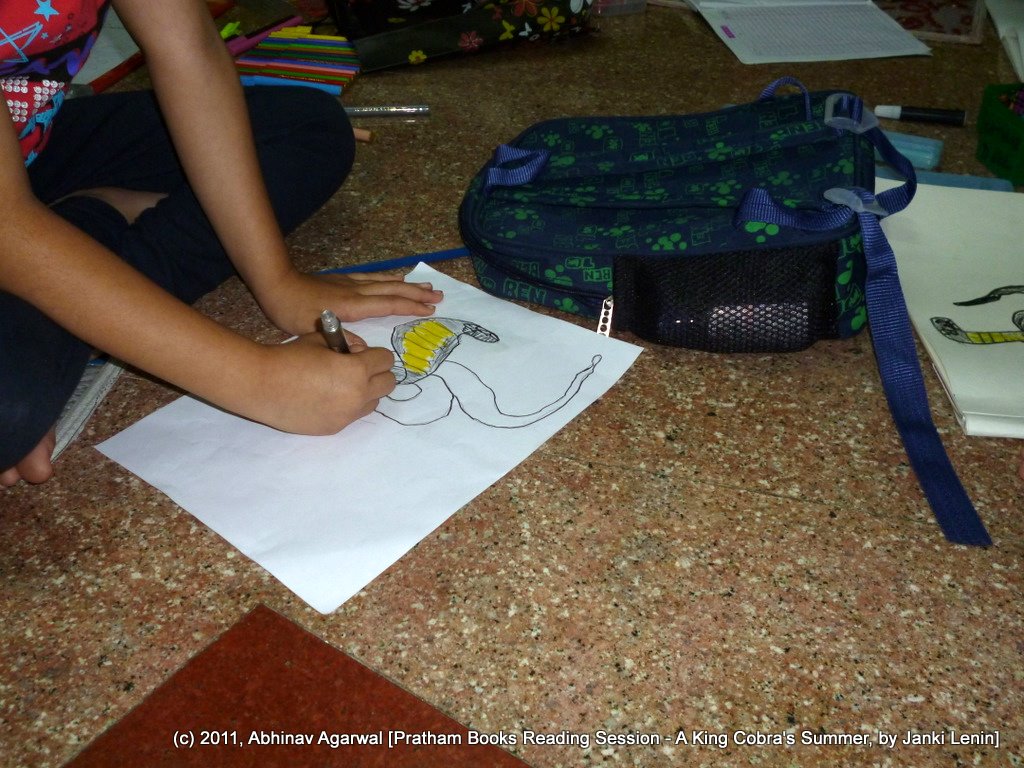
The portraits of Kaala on pages 2 and 20 were quit similar, and in the end we selected the one on page 2 to draw. It also looked the easier of the two. Once the outline had been drawn, the children went about tracing the outline with a black sketch pen, and then started filling in the colors.


What you see on the whiteboard down is my own attempt at fleeting artistic immortality. The book lies at the foot of the whiteboard with its pages opened to the pages.


By about 11AM or so we had decided to wind up - the children had shared a very enjoyable 90 minutes listening to, participating, and then drawing from the lovely book, A King Cobra's Summer.

Kudos to Pratham Books and their amazing team for everything. Their books are informative. They are educational. And they are entertaining. And they are cheap. I kid you not. And that's not even a pun. The books are very affordable, and here's to them coming closer every single day to their aim of getting a book into every child's hands.


© 2012, Abhinav Agarwal. All rights reserved.

Sunday, January 15, 2012

The Artist of Disappearance by Anita Desai


The Artist of Disappearance by Anita Desai  (Kindle, Flipkart, my user review on Amazon.com)
4 stars
The Journey Is In the Evocative Stories, Not the Climax As Such
After reading these three stories, I felt a bit disappointed. After thinking a little bit, I realized that I was mistaking her novellas for some crime thrillers, that needed to have some nailbiting, cliffhanger climactic end. That is not the case. These novellas satisfied my need to read good quality writing.

There are three novellas here - "The Museum of Final Journeys", "Translator Translated", and "The Artist of Disappearance" - eponymous with the title. For my money I enjoyed the second story the most - the story about a middle aged woman who faithfully and lovingly and successfully translates the work of an Oriya language writer, but for the second translation casts a more critical eye ("more professional perhaps?") - "I began to wonder if publishing such a disappointing novel would be good for Suvarna Devi's reputation, which I had worked hard to establish."

The third one is the most abstract, so to say, but not without its moments of levity - "... there was no way they could carry their equipment down there: it was unfortunate that Nakhu was only partially and not completely a donkey." The prose is also sort of reminiscent of RK Narayan's writing perhaps...

Yes - I think I enjoyed the book as a whole. Satisfying in the way that stays with you after you have finished reading the book.

The Artist Of Disappearance


Kindle Excerpt


© 2011, Abhinav Agarwal. All rights reserved.

Saturday, January 14, 2012

About Me - Photography 1


I got interested in photography in 1999. Till that time I had had a point-and-shoot 35 mm Canon film camera, and I would, like most people I knew, carry the camera to places I went, take a few snaps, get them developed, and stick them into an album. In case you are wondering, and this is most likely to happen if you don't 'go' back to the 90s, then this whole talk about '35mm' and 'film' cameras will seem quaint and odd. Let me clarify. The first thing to clarify is that in 1999 digital cameras were far and few in-between. A megapixel was a big deal, and most digital cameras were sub-pixel in resolution and no match for even the most basic of 35mm point-and-shoot cameras when it came to quality. And they were costly. Digital cameras. Things would change rapidly in just a few years. But in the reality of digital cameras that existed in 1999, 'affordable' was not a word you would find in its dictionaries. A digital camera was therefore not on my mind at that time. The second point follows from the first: shooting on 35mm negatives meant you had to get them processed and then printed. This usually happened at the local K-Mart of Wal-Mart. There you generally got two options: one was to use the store's in-house processing and printing capabilities, the second was to use Kodak processing. Kodak processing was about a dollar or two costlier than the in-house option for the entire 35mm roll, but gave much better results. Since I was not shooting that much anyway, it did not make much of a difference, and I would go for the Kodak processing option. 

The photos that I did want to share via email, or put on my website, I would scan using a flatbed scanner, and then upload them. Even the scanning had to be done at low resolutions, and the resulting image file no larger than a 100KB in most cases. This also had its origins in the cost of storage. Email providers like Hotmail, Yahoo, and others usually provided 2MB or 4MB of free storage space. You could purchase a massive amount of 25MB for something like $25 a year, but most did not. I did not. Lest you wonder, Google mail (Gmail) did not exist at that time. Google the company itself was a year old. So you could not send large images to your friends and relatives. You ran the risk of overwhelming their entire email quotas, which would make you rather unpopular with such friends and relatives. Hosting space was at a premium - especially the free one, and hard drives in those days maxed out at under 10GB or so. External hard drives were costly. Flash drives were almost unheard of - and their capacities was measured in KB and not MB. USB had just about made its appearance in consumer PCs a year or two earlier, USB2 was a few years away. External storage, for the most part, came in 3.5" floppy diskettes. You could also buy CD writers, but these ran at a few hundred dollars, and the CD-R discs were themselves about a couple of dollars each. So you see, there were limitations imposed on storage.

Till 1999 I had little idea about either film speeds or exposures - the basics of photography. You see, automatic cameras took care of all that - auto-focus, auto-exposure, auto-forward, auto-everything. All I had to care about was to make sure that the film had been properly inserted into the camera. You really did not want to shoot an entire roll of film, pop out the lid at the back, only to discover that the film leader had somehow not latched itself quite properly into the camera, and all you had been shooting were blanks, so to say. I was photographing, but I knew next to nothing about photography.

In 1999 I decided to invest a little money in a better camera than I had. The reason I came to this decision was actually quite silly. I had gone to San Francisco to visit my cousins, and there, in bright San Francisco daylight, under the open skies at the Golden Gate bridge, I had shot photos with ISO 400 speed film. The others had used Kodak ISO100 film. And when I compared the prints, I realized mine were not as saturated in color as theirs. Mine sucked, to put it simply. The short of it was, and I of course would not want to admit that even if I had known it, that I knew nothing about photography.

To remedy my less than desirable results I had to take a decision. Providing impetus to the decision was a realization that I had started taking more pictures than before. I had refused to accept that photography was becoming a hobby for me. Now I could continue to stumble on as before, take mediocre photographs with a mediocre camera, and exult at the occasional good photograph, pat myself on my back on a job well done, more the result of accident than design, and continue taking mediocre photographs. That was certainly a course of action that required little to no effort on my part. It was the status-quo. It was the path of least resistance. But what was clear was one thing: taking more photographs was not making me a better photographer.

This is the first post in this series. I am also posting this to a page I have added to my blog, About. As this year progresses I too intend to make progress in adding to this page.

Live long and prosper.


© 2012, Abhinav Agarwal. All rights reserved.

Saturday, January 7, 2012

The Camel Club by David Baldacci - Review


The Camel Club, by David Baldacci (Amazon.com, Kindle e-book, Flipkart, my user review on Amazon) - my review
5 stars
Thrilling fast-paced page-turner. A few holes in the plot. And yes, Mahatma Gandhi could have written the ending!

After having read two disappointing Baldacci novels (The Winner and Hell's Corner) that flattered to deceive, this one is a much better read. Graded on a curve, yes, this is a five-star read.
Oliver Stone, fka John Carr, is still very much a man of mystery here. His past is decades behind him and we are not given much background there. The Camel Club has already been in existence for years. What we do get to learn is that there is a very sinister plot being, err.. plotted, to assassinate the President of the United States, and too in his hometown. Arabs, Pakistanis, Iranians, and well, basically, it looks like Islamic terrorists may be involved. That cannot be a good thing. And then there is this killing of an NIC operative that is witnessed by the Camel Club. The plot makes it way through the book in an unhurried though gripping manner. The climax is fast-paced, and the denouement takes place in a former CIA and now abandoned facility named "Murder Mountain".

Having read two of Baldacci's novels, The Winner and Hell's Corner, both promising but ultimately disappointing, The Camel Club is much better. The plot, and especially the ending, when fully revealed, is still fantastical, and I will note again, one that could have been written by Mahatma Gandhi - without saying more. Read the book to find out. Parts of the plot are still a little implausible, but that is excusable here.

In short, gripping fast-paced turner that doesn't ask for much thinking from the reader.

http://davidbaldacci.com/
http://davidbaldacci.com/writing/novels/the-camel-club
My review post of "Hell's Corner"
My review of "The Winner"
http://en.wikipedia.org/wiki/David_Baldacci


Kindle Excerpt:


© 2012, Abhinav Agarwal. All rights reserved.

Monday, January 2, 2012

Hudson News at Changi Singapore Airport

http://www.changiairport.com/shopping-and-dining/shopping/hudson-news-and-magazines


© 2011, Abhinav Agarwal. All rights reserved.

Sunday, January 1, 2012

Review of India's Culture and India's Future by Michel Danino


Indian Culture and India's Future, by Michel Danino

Ready reckoner for the confused Indian and the misinformed rest.
A book that attempts to put forward the vast richness of India's culture, its contribution to the world, and the crossroads the country and its culture finds itself at.

Indians have long been accused of looking at their past with rose-tinted lenses and a sort of smugness about their superiority. A lack of knowledge about their past means most Indians have no objective perspective of their present, nor are they able to cogently argue why India's contributions to the world have been so often and so grossly misrepresented. This book attempts to put together, in one short read, a guide on India's past, its achievements, its thinkers, its contributions, and also tries to identify the causes that have led to this strange sense of dissociation and lack of pride that so many Indians have for India and its culture and heritage.

Saturday, December 17, 2011

NewsLink, Sydney Airport, Australia

The NewsLink books and convenience store at the Sydney International Airport. Michael Connelly's latest, The Drop, and Isaac Walterson's Steve Jobs were among the prominently placed tomes.


NewsLink Pty Ltd (or LS travel retail Asia Pacific - formerly known as Lagardère Services Asia Pacific) is an Australian company responsible for providing convenience items and travel products in airports and train stations in AustraliaChinaHong KongSingaporeTaiwan, and Fiji. [http://en.wikipedia.org/wiki/NewsLink]
http://www.lsaspac.com/ls_home.asp
http://en.wikipedia.org/wiki/NewsLink


© 2011, Abhinav Agarwal. All rights reserved.

Sunday, December 11, 2011

Sydney Opera House, Australia

This is a photo of the Sydney Opera House - also a World Heritage Site, as seen from my hotel room at the Sydney Harbour Marriott at Circular Quay.

The views from the other side of the bay, the Admiralty House, are spectacular, as can be seen from so many  other photos of the building. As seen from the hotel, the photo can only hint at the marvelous beauty of this structure.

And this is the room from where I took the photo of the Opera House. The room's not bad at all, but then, it's like any other good hotel room.

I shot this photo below, again from the hotel room, at about 6AM local time. As you can see, while it was supposed to be summer (middle of November) - because in the southern hemisphere November is summer, but the skies were overcast, there was nary a trace of the sun, and there was a strong hint of rain in the evening. Which is just as well. I did not have any time to even step out of the hotel and do sightseeing, so this suited me just fine. It would have been awful to have been inside an office while the weather outside was warm, sunny, and inviting.


View Larger Map


© 2011, Abhinav Agarwal. All rights reserved.

Cheap by Ellen Ruppel Shell

Cheap: The High Cost of Discount Culture, by Ellen Ruppel Shell


Excellent and inexpensive (not cheap!) except for the isolated broadsides against capitalism and globalization

A very engaging journey through the history of cheap, from shops to malls to outlets to sales to IKEA to shrimps to globalization. Ignore the brief denunciations of capitalism and globalization and this is a five-star book. Thankfully much of the globalization phillipic is isolated at the beginning and end.

This book argues that cheap is different from a bargain. Cheap implies lack of longevity, lack of craftsmanship, and hidden costs that are sometimes not apparent till several years or decades after the purchase. Globalization is an imperative and inevitable but its costs are heavy. The book covers territory that is expected - the beginnings of the discount retail culture, but which requires a journey into the years following American independence to understand the underpinnings of cheap - standardization and industrialization. The insidious strategy behind outlet malls is an eye-opener. The psychology of sales, rebates, and coupons is also discussed by looking at how the mind works and responds to sales (answer: when confronted with sales we don't think much, and the little thinking that we do do is muddled and confused).  When you talk about cheap you have to talk about superstores, food, IKEA, and China. India too gets a mention, but it is China that is today the manufacturing outsourcer to the world. The book does not cover "cheap" in the context of software, else India would have received its share of, err, attention. The industrialization of food has been covered in the definitive classic of our times, "Fast Food Nation", but there is new and relevant information to be found here - shrimp farming in Thailand and the havoc it has wreaked on the economies and the environment in those countries for one. The author also argues that it is the expansion of the global and interconnected labor force that has actually done the American worker more harm than good. By flattening the world, and making outsourcing feasible and economical, the American worker has been shorn of bargaining power.

Saturday, December 3, 2011

The Brass Verdict by Michael Connelly

Gripping page-turner

Rich guy of dubious innocence, a double-murder, and Michael Haller again in the middle of it. This book is also a page-turner, though, reading it very soon after "The Lincoln Lawyer", the pace and narrative felt familiar. Life for Haller, our competent but flawed lawyer, is trying to pick his practice up, when a lucky break, in the form of a murder of a former colleague of his, lands an entire practice in his hands. With that practice comes the case of Walter Elliot. Elliot is accused of murdering his wife and her lover. Forensic tests confirm gun powder residue on Elliot's hands. But is he really guilty? The murder weapon has not been found. Furthermore, there is the question of a possibly tainted juror, an FBI interest in the case, and a detective, Harry Bosch, who may be using Haller as bait. Bosch and Haller share a tense relationship through the novel, trying to figure out how much to reveal and to what extent to keep their cards close to their chests.

There is, expectedly, ample ink devoted to the courtroom in the form of jury selection, how and when to exercise the right to strike a juror, expert witnesses, and more. The setting is the city of angels, Los Angeles, and the author evidently likes, if not loves, the city enough to bring the reader into the city.

A satisfying read.


© 2011, Abhinav Agarwal. All rights reserved.

Barnes and Noble, Redwood City

The Barnes and Noble bookstore in Redwood City, California (store link). As opposed to earlier visits to different Barnes and Noble bookstores, the store this time felt a bit sparse, and a little less lively. Maybe it is a sign of the times, what with traditional booksellers fighting an increasingly losing battle first against online vendors, and now against e-books themselves.

Their non-fiction bestsellers rack had a lot of familiar titles, including the latest by Michael Lewis, "Boomerang: Travels in the New Third World", "That Used to Be Us: How America Fell Behind in the World It Invented and How We Can Come Back" by Thomas Friedman, "Killing Lincoln: The Shocking Assassination that Changed America Forever" by Bill O'Reilly.


The bargain priced shelves are always fun to browse. You can also sometimes find really good bargains that you like, like a Calvin and Hobbes collection, or a "Far Side" book, or jigsaw puzzles.

The Barnes and Noble book store entrance faces the North-West in the building at the bottom.

View Larger Map


© 2011, Abhinav Agarwal. All rights reserved.