Tuesday, August 28, 2012

F in Exams, Richard Benson - my review

F in Exams: The Very Best Totally Wrong Test Answers, by Richard Benson
4 stars
If not for the price, I would have been a little disappointed.
(Amazon PaperbackKindlemy review on Amazon)
Don't get me wrong. This a an entertaining book. It's full of answers, intentional and unintentional, that students gave in exams, when they did not know the correct answers. It's just that the book is short. On my Kindle app for Android, I read it in less than an hour, with time to go back and re-read some of the funnier answers. There is perhaps a fine line between funny and repetitive, as the answers may get if you put too many of them, but I would surely have been disappointed had I paid list price, or even half-price, for the book. I paid $0.99 for the book, so I am certainly not complaining about the price. No sir.

The book is divided into seven topics: Chemistry, Biology, Physics, Math, Business & Technology, Psychology, and History & Geography.

Here are some of the answers and images from the book.

Give the names of two gases that might contribute to global warming. 

This is the math lesson I missed in school. About dots and lines and how to convert one to the other.
Change 7/8 to a decimal.

When learning division, you just need to get to the root of the problem.
Simplify the following equation


To be or not to be, that is probably the problem.
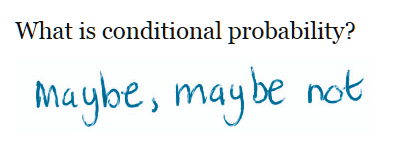
What is conditional probability

Remembering to forget is, easy.
Describe what is meant by "forgetting"

6. Young at heart, is the river.
Name the smaller rivers that run into the Nile

7. Need I say more?
In Pride and Prejudice, at what moment does Elizabeth Bennet realize her true feelings for Mr Darcy. 

Kindle Excerpt:


© 2012, Abhinav Agarwal. All rights reserved.

Sunday, August 12, 2012

Bali and the Ocean of Milk - Review

Bali and the Ocean of Milk, by Nilanjan P. Choudhury

 (FlipkartAmazon, my review on Amazon)
Hindu mythology-based fiction has been fashionable for a few years now. This book is a standout in the genre, and succeeds on many, many levels.
5 stars
This is a notable book I read and reviewed. Click to see more such books.

Having read one mythology-based fiction bestseller some time back, I had sworn off the entire genre. When I found myself reading Bali and the Ocean of Milk, I had at least one trusted recommendation to go on. I had also promised myself that I would read this book, cover-to-cover, as the trite cliche goes. The delightful surprise was that I could not stop turning the pages of this very, very good thriller.

The plot, in a nutshell, is that Indra (spelled Indrah in the book), the King of gods, is out of shape and out of form, and cannot perform, err... his duties as a king. It is the result of the dying Asura Vritra's curse, killed by Indra by deceit. Viru, or Lord Vishnu, promises to reverse the effects of the curse, and the sin of killing a brahmana, if the devas and asuras can come together to churn the ocean of milk to retrieve a jar of nectar. So far, so good. But will the asura king Bali, son of Vritra, want to have any truck with the killer of his father? Furthermore, can Indra be trusted to keep his word and share the nectar with the asuras?  Yes, yes, we all know that he did not, but even then there is a twist in this tale also. Will the Mahakali priests in Bali's kingdom of Tripura, who have seen their power cut to the bone, rise in revolt against Bali, if only to reclaim power and reimpose their puritanical way of life? And who exactly are behind the assassination attempt on Bali?

While the book does not strictly following the Puranic mythological canon, nor does it claim to, it still reveals an admirable amount of knowledge on the part of the author. To modify intelligently, you also need to know what you are changing, and from what.

The language and the style of writing are confident and assured. Yes, there are words that made me wish I remembered my GRE and CAT word-lists, but they add to the texture of the narrative, not detract or distract.

Some of the tongue-in-cheek dialog between the gods is hilarious. Whether it is Viru, as Lord Vishnu is referred to, and there is a Jai and Sambha also, in case you were wondering where some members of the other cast of Sholay were lurking (sadly, no Basanti, no Thakur, no Ramlal, and no Gabbar), or referring to Indra's not so omnipotent problem, or Indra's gloriously desperate attempts to extricate himself from the clutches of Urvashi,  the effect has the desired effect of puncturing any feeling of celestial awe the reader may have.

There are two sub-plots running in the book. They intersect at times, as when Indra and the bumbling celestial physicians visit Bali's court. More than two sub-plots and it can become a challenge for both the writer and reader to stay fully informed and engaged. Switching between the sub-plots also keeps monotony away.

The story takes a decidedly dark turn after the first half or so. The puns taper off, almost completely, and the narrative turns uncomfortably dark. There is talk of fundamentalism, and such that it can evoke memories of the Holocaust, Stasi-style civilian spying, ethnic cleansing, and of religious intolerance - and take your pick of religions and ideologies. That it does not fall into the messy morass of preachiness is achieved by not moralizing, and by weaving all this into the plot, making it an inextricable part of the plot at that, and by resisting the temptation to dive into a sermon in the middle of the book.

One quibble that I do have is with the dialogue. At times, in a few places, not many, the dialogue seems somewhat stilted and not consonant, so to say, with the emotions running in the scene.

In all, a very satisfying read.

Disclosure: Nilanjan, the author, provided me with a copy, ex-gratis, on the recommendation of Dr. Bibek Debroy, economist and author. I am grateful to both.

http://www.harpercollins.co.in/BookDetail.asp?Book_Code=3049
http://baliandtheoceanofmilk.blogspot.com/

Author: Nilanjan P. Choudhury
ISBN: 9789350291252
Cover Price: Rs. 199.00
Format: ‘B’ Paper Back
Extent: 320  pages
Category: Fiction
On Sale: December 2011


--> © 2012, Abhinav Agarwal (अभिनव अग्रवाल). All rights reserved.

Saturday, August 4, 2012

Ten Years with Guru Dutt: Abrar Alvi's Journey

Ten Years with Guru Dutt: Abrar Alvi's Journey, Sathya Saran (Amazon, Flipkart, my review on Amazon.com)
An Honest Reminisce, But Doesn't Quite Flow Well Enough
4 stars
Abrar Alvi penned most of the screenplays for Guru Dutt's productions, either by writing the screenplay, or the dialogues, or both, in movies like Aar Paar, Mr & Mrs 55, Pyaasa, Kaagaz Ke Phool, and Sahib Bibi Aur Gulam. His influence on Guru Dutt's craft however went beyond being a scriptwriter, and his 10-year collaboration with Guru Dutt ended only in 1964, with Guru Dutt's suicide.

In this book, Abrar Alvi's recollects his decade of working with Guru Dutt, from the time he was virtually locked up in a room, asked by Guru Dutt to write dialogues as a test, to the time after Guru Dutt's suicide where he persuaded Dharmendra to act in "Baharen Phir Bhi Aayengi", and also ghost-directed the movie. The movie flopped, but is still remembered today for its silky melody, "aapke haseen rukh pe aaj naya noor hai", sung by the legendary Mohd Rafi. And while on the movie, there was a song that "SD Burman had composed for Baharen ("Baharen Phir Bhi Aayengi"), which remained unused in the film, was later shot on Dev Anand in Jewel Thief. The song: 'yeh dil na hota bechara.'" [page 118]. Interspersed in the book, between Abrar Alvi's recollections, are comments by Sathya Saran, the author of this book, who also adds some background information that helps clarify Abrar Alvi's recollections. It makes for fascinating reading. Whether reading how Guru Dutt would make sure his friend Johny Walker (real name 'Badruddin') got a role in every Guru Dutt movie, or how Guru Dutt enlisted the help of his cameraman, V.K. Murthy, to play a prank on Abrar, or the poignant story of why Mehmood refused to drink any alcohol. We also get to know why SD Burman, the great composer, refused to work in any movie with Sahir after Pyaasa - no, it was not jealousy that Sahir got the greater plaudits for Pyaasa, as has been often suggested.

If there is one would thing that Abrar Alvi remained (he died in 2009) somewhat bitter about, it was the lingering doubts people have whether it was he who directed the hit "Sahib Bibi Aur Gulam" or Guru Dutt handled the baton there also.
"From his tone I knew there was trouble ahead. I went to the first floor where Guru Dutt had his office, and entered the room. He started shouting at me almost immediately: 'Who do you think you are? Is it your film? It is my film.'
...
I left the room, went back to my place and wrote a letter to him, telling him it was his film, and that I did not want to be part of it. 'Do what you want with the movie,' I wrote. 'I want no credit - I have nothing to do with the film.' I dropped the letter off at his house at about five p.m.
He wrote me a reply: 'You have directed the movie, the credit, and the discredit, if any, is yours.' I still have that precious letter with me and it is the irrefutable proof, to all those who claim that my name was merely a front for Guru Dutt, that I was indeed was the director of Sahib Bibi Aur Ghulam." [page 158]
Abrar however notes that Guru Dutt wanted to, and did indeed shoot the songs for the movie, Saibh Bibi aur Ghulam.. Abrar refused to be on the sets when Guru Dutt shot these songs, because he believed that two directors could not be on the sets at the same time. Abrar Alvi also says that Guru Dutt had a remarkable ability to use songs to advance the story, and where songs would end up becoming an integral part of the story, a narrative continuum rather than a forced contrivance.

Sahib Bibi Aur Ghulam was the only movie that Abrar Alvi directed, a Guru Dutt production, and which became one of the biggest, if not the biggest, hits of Guru Dutt Productions. That movie provides us, the readers, with a rich and fertile ground from which Abrar digs out innumerable anecdotes.
"I learnt a lot about lighting from him. It came in handy while directing Sahib Bibi Aur Ghulam. But I could never really rise to his standard of using light in a scene to make it unique and painterly." [page 103]
The most painful recollections are about the movie's heroine, Meena Kumar, however. More on that toward the end of the review.

Chaudhvi Ka Chand was perhaps the biggest hit till that time among period movies set in a Muslim milieu. The movie was also a monster hit in its own right. Abrar Alvi sheds some light on the modifications he had to make to the script, to not only improve the plot, but also to correct the stereotypical reinforcement of Muslims the story would have fortified. That Guru Dutt played a major part in the direction of the movie is also obvious, not to mention in the cinematography of the title song, "Chaudhvi Ka Chand", an incredible song with also superb music, lyrics, and singing by Mohd. Rafi.
"For six years I would not let the film, now titled Chaudhvi Ka Chand, be made. I said, 'Muslims do not really believe that their women are like a pair of shoes.' I felt it completely wrong to let a man, the hero of a film, pass on his wife to another man. I said, 'This writer has run off to Pakistan and left this third-rate story behind.'
...
Luckily for the fate of the film, Guru Dutt paid heed this time, and the script was turned around. ... Though the film's direction is officially credited to Mr Sadiq, it bears Guru Dutt's stamp all over. .. It has cinematography that once again proved that Guru Dutt was a master of lighting as well as shot composition."
Pyaasa, another Guru Dutt movie that was not only critically acclaimed but also a huge commercial success, provides us with several more anecdotes. It was also during the making of this movie that S.D. Burman decided not to work again with lyricist Sahir Ludhianvi. There are two anecdotes here worth recounting; both center around songs, one is a recitation that the movie's hero, Guru Dutt, gives at a school reunion, and the second is the movie's acclaimed song that appears in the climax, "ye duniya agar mil bhi jaye."
"It was decided that a poem by Sahir should be used for the scene. Burman Dada had to work out a tune for the poem. On the appointed date, Rafi, who was a thorough professional, came over to Guru Dutt's place for the sitting right on time. But unfortunately for us, Dada was nowhere to be seen. I told Rafi, 'You are a master at music, why don't you recite the poem in your own style?'
Rafi thought about it a bit, and then started reciting the poem in the clear, musical voice that was his signature. And we recorded it right there, on a spool of tape, on Guru Dutt's tape recorder. So clear and distinct was the voice and the recording that we could use the copy as it was without having to record it again in the studio. In fact, the somewhat rough quality of the recording gave the scene greater authenticity." [page 73]
Abrar had to make some last minute adjustments to the script to make a somewhat lapse of judgment on Sahir's part not seem incongruous to the movie.
"But somewhere along the way, he seemed to have lost track of the millieu of the story. However, the song he wrote had enough punch and pathos in it to excite the director in Guru Dutt, who filmed it immediately.
...
I was impressed by the wonderful way he had shot it, but the lyrics dismayed me. Guru Dutt could not understand why, so I had to explain. 'The era we have placed the film in is in the mid-fifties,' I said. 'and Sahir has written about the mahelon, the takhton, the tajon ki duniya... these symbols of the Raj, royalty and zamindari are defunct; that era is past in the period our movie is set in...
Of course, it was impossible to change the lyrics; the song had already been shot. I had to do some damage control at my end and bring in relevance to the lines ... I thought about it seriously and decided to give Rehman, the publisher, some rhetoric that would justify the references to royalty. Which is why Rehman talks about the dead poet and says if Vijay were alive today he would place him on a takht and place a crown (taj) on his head ... which Vijay, standing framed in a flood of light at the door of the hall, overhears and responds to with the now-famous renunciation of the world of falsehood and hypocrisy." [page 75]?
The movie's heroine, Waheeda Rehman, plays the part of a streetwalker, and the character was portrayed somewhat on a person Abrar had met some time back, and whose real-life story was much more tragic than "Gulabo's", the name of Waheeda Rehman's character in the movie.

But the most poignant and sad recollections are that from Sahib, Bibi, Aur Ghulam, and the movie's heroine, Meena Kumari. She was a virtual slave to her exploitative husband, Kamal Amrohi, as well as her sister and nephew. She was not only robbed of her money by her relatives, but also subject to physical violence. Her tale is not a happy one that Abrar recounts.
"'Today I will get a thrashing because I am so late,' she said to me, tears streaming down her face. It was well known that not only Kamal Amrohi but even Baker would beat her quite mercilessly. Kamal exploited her monetarily too, and at one point, when she came to stay with her brother-in-law, Mehmood, the actress who had ruled Hindi cinema successfully for so many years and had been the darling of millions did not even have suitable clothes to wear.
...
It is another well-known fact that one of India's biggest stars died in absolute penury, having been successfully looted by her husband and by her own relatives. She lived next door to our bungalow. Her sister and nephew moved in with her and looted her methodically. There would be days when she would drop in to ask my wife for food, as there would be nothing for her to eat at her home. She would eat the leftovers or content herself with bread dipped in tea. It was tragic to see her that way. She was steadily ruining herself with drink, turning into an alcoholic, and to me it appeared as if the story of Chhoti Bahu was being repeated in real life." [page 167]
The book also covers more commonly known topics and controversies such as Guru Dutt's dalliance with Waheeda Rehman - Guru Dutt found companionship and fulfillment with Waheeda Rehman, but could not see his wife with another man, such was the age-old conflict that he found himself in - the consequent tensions between Guru Dutt and his wife, singer Geeta Dutt, as well as the downward emotional spiral that ultimately resulted in Guru Dutt's suicide.

This is a first-rate book, and I would highly recommend it. The first-person narrative style interspersed with commentary by the author, Sathya Saran, has its advantages, the biggest one being to keep the attention and focus on Abrar Alvi. The disadvantage is that you miss the simpler, linear arc that you otherwise would get from a story written in the third-person. I liked the book's style, but remained somewhat ambivalent as to its efficacy.


© 2012, Abhinav Agarwal (अभिनव अग्रवाल). All rights reserved.

Sunday, July 29, 2012

Mummies in the Morning (Magic Tree House, No. 3)

Mummies in the Morning (Magic Tree House, No. 3), Mary Pope Osborne (Author), Sal Murdocca (Illustrator) (Amazon, Kindle)
3 stars
Magical Adventure, But This One Is a Bit Slack
The third magical adventure of Jack and Annie takes them back to the land of the Mummies, in Egypt. Here, they find themselves inside a Pyramid, and have to help a ghost-queen find her way to the otherworld. The queen, dead for over a thousand years, is stuck in this world, and needs to decipher some hieroglyphs to get to the otherworld. She can't, because of short-sightedness. Jack's glasses are of no help to a person made up of air, because she is made up of air! A real-world ailment for the departed, but without a real-world cure.
Jack and Annie are siblings, eight-and-a-half years and seven years old respectively. They find a tree house high up in a tree one day, and which has several books in it. Jack loved reading, while Annie had a sense of adventure. Looking at a book and wishing to go there took them to that place.

In both their earlier adventures, Jack and Annie got into some trouble, and received some help from unexpected quarters. In this third adventure too they get help, from a cat!

Like the earlier adventures, this book also contains eye-catching illustrations, some of which are full-paged. The style of writing is engaging, the language simple, the plot interesting, and the dialog of and between Jack and Annie brings out the personalities of the two children.

Unlike the first two adventures, however, this third adventures felt a bit contrived. I got the impression that the adventure lacked enough surprises to keep my fully engaged.


© 2012, Abhinav Agarwal (अभिनव अग्रवाल). All rights reserved.

Friday, July 27, 2012

After the Prophet, Part 3

Deeply Sympathetic, Gripping Page-Turner. Though At Times Overly Melodramatic Narrative.
(KindleAmazonFlipkartmy review on Amazon)
5 stars

Part 3 - Aisha, Muawiya, and The Night of Shrieking (See Part 1, Part 2)

Even though it had been Aisha, the Prophet's youngest widow, The Mother of the Faithful, who had instigated the crowd against Othman, the Caliph, it was Aisha who was also shocked and infuriated by Othman's assassination, and it was Aisha who marched straight to the the "great mosque", the Kaaba, at Mecca, and roused the people to rise against Ali, with words that were to be echoed by different people in different circumstances, ""Seek revenge for the blood of Othman, and you will strengthen Islam!"" Whether Aisha was more concerned about strengthening Islam or whether more concerned about Ali, her bete-noire, becoming the Calipph, is open to conjecture. However, for the people of Mecca, the argument being made against Ali was the same as what Abu Bakr had used, and the words similar - that Ali's blood was now fair-game, "haraam". Aisha was supported by her brothers-in-law, Talha and Zubayr, who had been part of the six that had voted for Othman after Omar's death, and "each wanted the caliphate for himself". Both Talha and Zubayr would perish the civil war that followed, both done to death, many alleged, by Marwan.

It is useful to include a brief description of Marwan, also known as "Ibn Tarid, the Son of the Exile". His father had been so distrusted by the Prophet that he had been "banished along with his family to the mountain city of Taif." Othman would later reverse this banishment, and recall Marwan to Medina to serve as his chief-of-staff. Furthermore, "no sooner was the battle lost than he rode across the desert to Damascus, to become a senior counselor in the court of Muawiya, the governor of Syria." Muawiya, brother-in-law of Muhammad (his sister, Umm Habiba, had been the Prophet's eighth wife) is another character that belies belief, and more on him later. If ever there was a medieval machinator par-excellence, and without compunctions of any sort, it has to be Muawiya.

Aisha marched from Mecca to Basra, and Ali marched with his army from Medina.
"So when Aisha rode out onto that battlefield outside Basra on her red camel, it was the first time a Muslim woman had led men into war. It was also to be the last."
Actually, this particular bit is not quite true, since Razia Sultan, Sultana of Delhi from 1236 to 1240 CE, led her army in battle against Malik Altunia, her childhood friend and governor of Bhatinda. http://en.wikipedia.org/wiki/Razia_Sultan)

Despite entreaties from several, including Ali, war was not avoided, and the first of what would be an endless elegy of civil wars amongst the Islamic community was fought in October 656CE, less than twenty-five years after the death of the Prophet.
"Hand-to-hand combat was utterly and horribly visceral."
...
"Hardened warriors swore the rest of their lives that they had never seen so many severed arms and legs. It lasted from early morning to midafternoon, and by the time it was done, three thousand men, most of them from Aisha’s army, lay dead and dying."
In the end, the battle was fought around Aisha's camel, with Ali's soldiers appealing to her to surrender, and Aisha sent soldier after soldier to his death. "Seventy men were cut down as they held the reins of Aisha’s camel," and Aisha's own armoured howdah was peppered with so many arrows it "bristled like a porcupine."

As I  read the pasages describing the brutal war, I was reminded again and again about the Mahabharata, and the passages describing the mayhem and severing of limbs that took place in that terrible war.

Aisha was finally defeated, and she returned to Medina, escorted for the first few miles on the journey by Ali and his two grandsons, Hasan and Hussein, as a gesture of respect for the defeated and also to the widow of the Prophet.

Muawiya

Meanwhile, Muawiya, governor of Syria, and "a clear-eyed pragmatist who delighted in the art and science of manipulation, whether by bribery, flattery, intelligence, or exquisitely calculated deception" had watched the outcome of this battle between Aisha and Ali from Damascus. power,  He had let Othman's bloodstained clothes be displayed for a year, to derive maximum mileage from that sight.
"Caliph, Muawiya had ruled Syria for close to twenty years, and the whole province - nearly all the land now known as Turkey, Lebanon, Syria, Jordan, Israel, and Palestine - had become his own personal fiefdom, a powerhouse in its own right."
While Muawiya lived in a luxurious palace, he had however escaped any resentment from the people, thanks to his exquisite cunning. He "prided himself on being exactly as generous and precisely as ruthless as he needed to be."
"“If there be but one hair binding someone to me, I do not let it break,” he once said. “If he pulls, I loosen; if he loosens, I pull.” As for any sign of dissent: “I do not apply my sword where my whip is enough, nor my whip where my tongue is enough.”
...
As one of his senior generals put it, “Whenever I saw him lean back, cross his legs, blink, and command someone ‘Speak!’ I had pity on that man.”
...
“I do not come between people and their tongues,” he said, “so long as they do not come between us and our rule.""
When Ali recalled all governors appointed by Othman, all but Muawiya complied. Ali rejected sage advice from his advisers, who asked Ali to play the same devious political games as Muawiya. Ali would have "nothing to do with such underhand schemes". His advisers assured Ali that he would not have had to do any of the dirty work required to secure allegiance from Muawiya. His aides would do that for him.
"...one of his top generals had promised. “I swear I will take him to the desert after a watering, and leave him staring at the backside of things whose front side he has no idea of."
Four months later Muawiya replied to Ali's missive with an "openly hostile" letter. Ali's inevitable response was to lead "his battle-tested army north out of Basra to Kufa, a hundred and fifty miles closer to Damascus," This would also lead to Iraq becoming the cradle of Shia Islam. Muawiya, in the meantime, set about manipulating popular opinion in his favor, and this included "a carefully staged campaign to present himself as loath to take action. He would have to be forced into it by the outraged conscience of the people."

And thus it came to war, "Early that summer of 657 the two armies, Syrian and Iraqi, met at the Plain of Siffin just west of the Euphrates, in what is today northern Syria." Ali even went to the extent of challenging Muawiya to a one-to-one duel, and to avoid the inevitable "mass bloodshed". Muawiya refused, even though it was not "fitting for him to refuse such a challenge", with the practical reply that ""Ali has killed everyone he has ever challenged to single combat.""

And so the war began. The Battle of Siffin, as it was called, continued into the second night, which came to be known as the "Night of Shrieking", so called for the "unearthly howls of men in mortal agony, a sound more fortunate people now know only as that of an animal hit by a car, dragging itself to the side of the road to die." Hasan and Hussein, Ali's sons, and the Prophet's grandsons, urged Ali to move faster on the battlefield to avoid being so exposed a target. Ali's famed response was:
""My sons," he said, "the fateful day will inevitably come for your father. Going fast will not make it come later, and going slow will not make it come sooner. It makes no difference to your father whether he comes upon death, or death comes upon him.""
As the battle progressed, it was clear that Ali's armies were gaining the upper hand, and it was a matter of perhaps only hours before the war was won. But Muawiya was not defeated. He had a masterstroke up his sleeve. Parchment copies of the Quran were distributed to the army's top cavalry, "with orders for each horseman to spear a single parchment sheet on the tip of his lance and then ride into the enemy lines."
Unbelievable. But happen it did.

What was worse, for Ali, was that his army refused to fight at the sight of the Quran, and lay down their weapons. Muawiya then proposed arbitration between the two armies, with the holy Quran as the guiding light. This again was a masterstroke. He had "couched his proposal in the most pious terms" to make it acceptable to Ali's army. Ali, on the other hand, saw the Quran being turned into a political tool, and warned his men, ""Do not forget that I forbade you this," ... "This will only demolish strength, destroy right, and bequeath lowliness. Shame on you!""

Thus outmaneuvered, as Ali's army began the march back to Kufa, the murmurs of disappointment began to arise. Rather than confront their own gullibility, some turned an accusatory finger at Ali. The leader of the disgruntled was Abdullah ibn Wahb, and they were to be the "first Islmaic fundamentalists". The name Abdullah ibn Wahb "still reverberates in the Islamic world since it calls to mind Abd al-Wahhab, the founder of the fundamentalist Wahhabi sect."

(... to be concluded)
http://www.aftertheprophet.com/
The Accidental Theologist
After the Prophet by Lesley Hazleton « Knopf Doubleday - Doubleday
@accidentaltheo

Kindle Excerpt:


-->
© 2012, Abhinav Agarwal (अभिनव अग्रवाल). All rights reserved.

About Me - Photography 2

Buying The Camera

Having decided I wanted a new camera, and hopefully a better camera than the one I had, I now needed to figure out which one to buy, where to buy it from, and what such a camera would cost me. Now remember this was 1999, and the Internet had been around, well, the Internet had been around a few decades, but the world-wide-web was only a few years old. Heck, Netscape was still a flourishing brand and browser. It would slowly self-destruct, pushed further down into a death-spiral by a ruthless Microsoft. You did had a few internet shopping sites out there. I don't think Amazon had started selling cameras yet, but CameraWorld was out there, and as a name for an e-commerce site it was pretty self-descriptive. I had not heard of B&H. I was not keen on going to a store, a brick-and-mortar store to buy one, for reasons that I can't quite recall. I suspect one reason was that I knew next to nothing about cameras. So I would like just another Indian with money in the wallet in search of a toy. The other reason was I didn't trust salespersons to have my, a customer, best interests at heart. Also, perhaps it was the belief that online stores would offer lower prices and a larger selection. In retrospect I think these reasons were pretty valid ones and if I did in fact decide on an online channel for my purchase that was a darn good decision.

A colleague at work suggested I try out CameraWorld. He knew more about photography than I did. Heck, any person picked at random would have known more about photography than I did then. So I took his advice, browsed over to the Camera World web site. Between all the different brands out there, I knew little about the lesser-known brands, so to say, and knew I would be pretty safe if I stuck with Canon or  Nikon. I checked the models and prices, and picked one. Entered my credit card information, got the confirmation, and that was it. Done. The shipment arrived less than a week later, and I was the proud owner of an "SLR" camera with a 28-80mm Canon lens. This was basically the starter kit - the camera body, a started lens, a lens cap, and a strap. The bag, the cleaning kit, the zoom lens would all come later.

Hang on a second. Didn't I do any research? Shouldn't I have done research, some research, any research? Good questions. And indeed I should have - done the research. Which should tell you I didn't. The research would indeed happen. But it would be post-purchase research. In some ways it would be meant to provide confirmation of my purchase decision. I would look for data points to confirm my purchase. In some ways, by making a strictly middle-of-the-road purchase, I knew I could not have gone wrong by much in any way. After all, I didn't really expect anyone to look at my camera and scream, "You stupid f**k!! You putz!! You went and wasted your money on a freaking Canon???!! Who buys Canon??" No, I was sure I wouldn't get that kind of a reaction. And if someone did look at my camera, smile wryly, and shake their head, as if to say, "Another one of these desis, knows squat about cameras or photography, yet wants to be seen with an SLR," that was also just fine by me. Over the next several years, I would develop a thick skin about photography. If I wanted to take photographs, I would carry my camera. If I wanted to place the camera on a tripod, I would do that. It did get me in a little spot of a bother on a couple of occasions, in the US as well as in India, but that was okay by me. "Have camera, will shoot" was what I believed in.


The next thing on my agenda was to actually use this camera.

Bangalore,
July 27, 2012


© 2012, Abhinav Agarwal. All rights reserved.

Sunday, July 22, 2012

After the Prophet, Part 2

Deeply Sympathetic, Gripping Page-Turner. Though At Times Overly Melodramatic Narrative.
(KindleAmazonFlipkartmy review on Amazon)
5 stars

The Ascent of Ali
(See part 1 of review)

Abu Bakr was the new caliph, but Ali had not acknowledged or publicly pledged allegiance to Abu Bakr. The task of making Ali fall in line fell unfortunately on Omar, unfortunate because while Omar was a courageous military commander, he was ill-suited to the task of diplomacy. The task failed, and failed miserably, as Omar crashed his entire body against the locked door of Ali’s house, slamming into the pregnant Fatima, who gave birth to a stillborn boy a few weeks later. This was followed by a social boycott of Ali and his family, to force them to fall in line. Ali soon thereafter pledged allegiance to Abu Bakr, more for the "sake of unity in the face of rebellion" by "Many of the tribes in the north and center of the vast peninsula".

At this point, pause to ponder how the justification of Muslims killing Muslims begins. Islam proscribes the killing of a fellow Muslim. "That was haram, taboo, in Islam."  However, by declaring anyone who refused to pay the taxes due to Islam an apostate, as argued by Omar, "to shed his blood was no longer taboo. It was now halal - permitted under Islamic law." Notice how political compunctions were already triumphing over the Prophet’s words.

The Wars of Apostasy (the "ridda" wars) wars - "were as ruthless as Abu Bakr had promised." However, Abu Bakr died soon thereafter, of natural causes ("He would be the only Islamic leader to die of natural causes for close on fifty years"), but not before he had "appointed Omar the second Caliph." Yet again, Ali, cheated as some would say of his rightful place as successor, pledged allegiance to Omar, and, as "Omar’s rule began, Ali married Abu Bakr’s youngest widow, Asma."
"every time Omar left Medina on one of his many military campaigns, Ali stood in as his deputy. It was a clear sign, understood by all to mean that when the time came, Ali would succeed Omar as Caliph."
Omar as the caliph actually "discouraged conversion. He wanted to keep Islam pure - that is, Arab". This would be seen as an affront by the Persians, and who "would convert in large numbers after his death." This reluctance on Omar’s part to discourage conversions also had an economic angle.
"Omar had set up the diwan, a system by which every Muslim received an annual stipend, much as citizens of the oil-rich Gulf state of Dubai do today." 
More the number of Muslims, lower would be the share of the stipend in each Muslim’s hands. Ergo the policy towards conversions.

Omar was assassinated by a "Christian slave from Persia" who would "stab the Caliph six times as he bent down for morning prayer in the mosque, then drive the dagger deep into his own chest".
However, on his deathbed, Omar threw a googly on the topic of succession. He "named Ali"and "five others"! These six would be the candidates as well as selectors. One of the six would be elected the new, the third, Caliph.

As fate would have it, two of the people shortlisted from among the six were Ali and Othman.
"On the one hand was Ali, now in his mid-forties, the famed philosopher-warrior who had been the first man to accept Islam and who had served as deputy to both Muhammad and Omar. On the other was Othman, the pious and wealthy Umayyad who had converted early to Islam but had never actually fought in any battle and, at seventy, had already survived far beyond the average life span of the time." 
The other men in the room announced, rather pre-empted Ali by announcing, Othman as the third Caliph, and Ali "pledged allegiance to yet another man as Caliph."

Omar had been assassinated by a Christian slave. Othman too would be assassinated, but by a Muslim, and who, "many would argue that he had excellent cause." The reason? Money. Money corrupts. And Money corrupted.
"Muhammad had wrested control of Mecca from Othman’s Umayyad clan, but with one of their own now in the leadership of Islam, the Umayyads seized the chance to reassert themselves as the aristocracy, men of title and entitlement, and Othman seemed unable - or unwilling - to resist them."
The loudest voice to protest Othman came from Aisha, who called the Caliph a "dotard". She was to do more, but before that, Walid, one of Othman’s half-brothers harboured a not unfamiliar aristocratic disdain for the "residents under his control", and dismissed them as "worth "no more than a goat’s fart in the desert plains of Edom."

When Othman dismissed a delegation of Kufans who had come demanding the recall and public flogging, they went to Aisha for justice. Othman’s "sneer", "Can the rebels and scoundrels of Iraq find no other refuge than the home of Aisha?" was like throwing a gauntlet to the Mother of the Faithful, who, took that up. And take it up she did in style. She stood "brandishing a sandal that had belonged to Muhammad" and shouted at "Othman in that high, piercing voice of hers. .. ‘See how this, the Prophet’s own sandal, has not yet even fallen apart?’ ‘This is how quickly you have forgotten the sunna, his practice!’"
"As the whole mosque erupted in condemnation of the Caliph, people took off their own sandals and brandished them in Aisha’s support." 
History had been created. George Bush, US President, would be at the receiving end of this fourteen hundred years later.

Despite a military standoff between the town of Medina and thee armed columns that had come in response to letters asking for strong action, Othman refused to either resign or sanction strong action against Walid. Othman was stoned unconscious at the mosque at the Friday prayers, an ominous prelude to what lay in store. A secret letter, planted perhaps without the knowledge of the Caliph, ignited the attack on Medina. Othman was killed, by devout Muslims.
"Abu Bakr was the first to strike, the son of the first Caliph leading the assassins of the third. His dagger slashed across the old man’s forehead, and that first blood was the sign that released the others. As Othman fell back, they piled in on him, knives striking again and again. Blood splashed onto the walls, onto the carpet, even onto the open pages of the Quran—an indelible image of defilement that still haunts the Muslim faithful, both Sunni and Shia."
Thus, on June 16th, 656 CE, Ali was crowned "Commander of the Faithful", since he refused to take the title of Caliph.
"Ali was destined to be the only man aside from Muhammad himself whom both Sunnis and Shia would acknowledge as a rightful leader of Islam."
However, the bloodsoaked shirt of Othman and the severed fingers of his wife Naila were "on their way to Damascus", while Aisha remained in Mecca.

http://www.aftertheprophet.com/
The Accidental Theologist
After the Prophet by Lesley Hazleton « Knopf Doubleday - Doubleday
@accidentaltheo

Kindle Excerpt:


-->
© 2012, Abhinav Agarwal (अभिनव अग्रवाल). All rights reserved.

After the Prophet: The Epic Story of the Shia-Sunni Split in Islam

After the Prophet: The Epic Story of the Shia-Sunni Split in Islam, by Lesley Hazleton


Deeply Sympathetic, Gripping Page-Turner. Though At Times Overly Melodramatic Narrative.
(Kindle, Amazon, Flipkartmy review on Amazon)
5 stars
This is a notable book I read and reviewed. Click to see more such books.

Part 1: The death of the Prophet and the first Caliph (Part 2)
A remarkably lucid, gripping, and evocative account of the origins of the Shia-Sunni split in Islam. The narrative gets overly melodramatic at times, but can be overlooked.

The history of Islam is much more nuanced, and more full of timeless human emotions and failings, and that much more riveting than has been typically caricatured in Western media. Perhaps the need to indulge in simplistic reductionisms has fuelled this black-and-white depictions of entire religions and people. The loss is more than just abstract - the terrible price paid for by the people in the Middle-East and the ghastly costs of Western interventions have been there for all to see.

Among several aspects of Islam, a fundamental one when trying to explain and understand the schisms in the religion, and also the historical underpinnings of a lot of the conflict amongst the nations in the Middle-East, is perhaps the Shia-Sunni divide. This book, short though it is, does a remarkable job of narrating document the origins of the Shia-Sunni split in Islam. It does so in the short space of 250 pages, and is written with much empathy. It seeks to explain, without judging. And that is perhaps a good thing, because there will be ample opportunities for forming opinions; this book should be used to inform.

"What happened at Karbala in the seventh century is the foundation story of the Sunni-Shia split."

But before we can get to Karbala, we have to travel to the place where Muhammad would breathe his last, at the age of sixty-three, most likely from bacterial meningitis. As he lay dying, the question of who would succeed the Prophet was foremost amongst his followers. The closest among Muhammad’s followers was Ali. Ali, not only was "close enough by virtue of being Muhammad’s paternal first cousin and his adoptive son, Muhammad handpicked him to marry Fatima, his eldest daughter" where "the Prophet not only performed the wedding ceremony himself but laid down one condition: the new couple would follow the example of his own marriage to Khadija and be monogamous." Ali and Fatima would give the Prophet "two adored grandsons, Hasan and Hussein." It would Ali "whose name the Shia were to take as their own. They were, and are, the followers of Ali, or in Arabic, Shiat Ali - Shia, for short."

The fact that Muhammad had never clearly and unambiguously designated his successor made things that much more difficult for his followers. That there was a deep-rooted animosity, the result of perhaps a trifling misunderstanding, between his youngest wife, Aisha, and Ali, didn't help either.
"Aisha and Ali, the two people closest of all to Muhammad on a daily basis, had barely been able to speak a civil word to each other for years, even in his presence." 
That the Prophet left behind no son, who could have been seen and accepted by all as his legitimate successor also complicated matters.  "though Muhammad’s first wife, Khadija, had given birth to two sons alongside four daughters, both had died in infancy, and though Muhammad had married nine more wives after her death, not one had become pregnant." As the author writes, "Or as Sunni theologians would argue in centuries to come, perhaps this late-life childlessness was the price of revelation." The closest the Prophet had come to designating Ali his successor was when, in 632 CE, he had raised Ali’s "hand high in his own" and said, "of whom I am the master, of him Ali is also the master," ". But never did Muhammad clearly designate Ali, or anyone else, as his formal successor. Maybe he knew the fate that awaited his successors, for on his deathbed, the Prophet,
"with his dying breath, repeat his chilling last words three times: "Oh God, have pity on those who will succeed me.""
Apart from Ali, then, there were Abu Bakr and Omar, who were the Prophet’s in-laws, who were claimants to the Prophet’s legacy, his "khalifa"

The origins of the standoff between Aisha and Ali could be traced to a scandal referred to as "The Affair of the Necklace". Aisha, the Prophet’s youngest wife, had lost a necklace near Medina when returning from an expedition with the Prophet and hundreds of his followes. The necklace had been a gift from the Prophet. In her haste to search and retrieve the necklace, she had not informed the caravan, nor had the caravan noticed her absence, and had proceeded to Medina without her. No one from the caravan came to fetch her, and it was a Medinan named Safwan who "helped her up onto his camel, then led the animal on foot the whole twenty miles to Medina." Unfortunately, unsurprisingly, tongues started wagging in the valley of Medina, and when Muhammad turned to Ali for advice, he got a "peculiarly curt" response,
""There are many women like her," he said. "God has freed you from constraints. She is easily replaced.""
 Now, can you blame Aisha for harbouring a lifelong animosity against Ali? Anyway, to complete the story, Muhammad went into a "prophetic trance" while at Abu Bakr, Aisha’s father’s, house, and uttered words that are "now part of Sura 24 of the Quran", where it was ordained that people slandering a woman would need to produce four witnesses for corroboration.
"Unless there were four witnesses to an illegal sexual act, it said, the accused was blameless, and the false accusers were the ones to be punished. For a wronged woman, there could have been no better outcome, yet the form of it would be cruelly turned around and used by conservative clerics in centuries to come to do the opposite of what Muhammad had originally intended: not to exonerate a woman but to blame her. The wording of his revelation would apply not only when adultery was suspected but also when there had been an accusation of rape. Unless a woman could produce four witnesses to her rape—a virtual impossibility—she would be considered guilty of slander and adultery, and punished accordingly."
There was one more chapter in this particular episode, the twisted consequences of which Islamic women wear to this day.
"The sight of her riding into Medina on Safwan’s camel had branded itself into the collective memory of the oasis, and that was the last thing Muhammad needed. In due course, another Quranic revelation dictated that from now on, his wives were to be protected by a thin muslin curtain from the prying eyes of any men not their kin. And since curtains could work only indoors, they would soon shrink into a kind of minicurtain for outdoors: the veil.

The Revelation of the Curtain clearly applied only to the Prophet’s wives, but this in itself gave the veil high status. Over the next few decades it would be adopted by women of the new Islamic aristocracy—and would eventually be enforced by Islamic fundamentalists convinced that it should apply to all women."
Upon the Prophet’s death, by "noon of that Monday, June 8 in the year 632", started the task of selecting, perhaps electing, his successor. Whether he would come from the Hashimis or the Ummayads in the Quraysh tribe was a thorny one. A "shura", "a traditional intertribal forum", was called for, which was gate-crashed by Abu Bakr and Omar. After more than twenty-four of debates and speeches, when all were at the point of exhaustion, Abu Bakr and Omar made their "closing move", with Abu Bakr proposing Omar as the "new leader of Islam", Omar in turn proposing Othman’s name (an aristocrat from the Umayyad tribe), and Omar, after there had been a fist-fight in which Ibn Obada, the convener of the shura, was beaten unconscious, Omar proposed Abu Bakr as the caliphate. Abu Bakr, the father of the Prophet’s youngest wife, Aisha, a strong-willed and headstrong woman.

Ali was not present at this shura. His "years of dust and thorns" were about to begin.


http://www.aftertheprophet.com/
The Accidental Theologist
After the Prophet by Lesley Hazleton « Knopf Doubleday - Doubleday
@accidentaltheo


Kindle Excerpt:

-->
© 2012, Abhinav Agarwal (अभिनव अग्रवाल). All rights reserved.
Sunday, July 15, 2012

The Knight at Dawn by Mary Pope Osborne


Magic Tree House #2: The Knight at Dawn (AmazonKindle, Flipkart)
Mary Pope Osborne (Author), Sal Murdocca (Illustrator)
4 stars
This is the second adventure in the Magic Tree House series, and also the second book in the series that I read. The series revolves around the Jack and Annie, siblings, aged eight-and-a-half and seven years respectively, and their magical adventures that begin when they find a tree house full of books, books that take them on a magical adventure.

After their very first adventure the previous day, that takes them back to an adventure in the times of dinosaurs, Jack and Annie cannot wait to get back to the tree house. It is not even daylight, but Jack and Annie sneak out of the house to the tree house. The time they find a book on the state of Pennsylvania, about knights and castles, make a wish, and lo behold, they are transported in their tree house to the times of knights and castles! Jack and Annie explore the castle, escaping detection from people, and observe what would seem to be strange sights indeed. A drawbridge, a moat, a hawkhouse, and a large dining room where dogs fight for scraps thrown on the floor, and where peacocks may actually be part of the meal.

Unlike the first adventure, this time they are actually caught and may find themselves locked in a dungeon. Annie's ingenuity and a torchlight gets them out of trouble, and with the help of an anonymous knight, manage to escape back to their own time.

We are still not told the secret behind the secret "M", and we may have to wait a few more episodes before it is finally revealed. Annie is as impetuous as ever, but manages to keep her wits and courage about her. Jack loves books, and cannot stop taking notes wherever he goes.


Kindle Excerpt:


© 2012, Abhinav Agarwal (अभिनव अग्रवाल). All rights reserved.

Jaggery Making at Pandavapura

On the way from Bangalore to Mysore, a two-hour detour can yield a rich harvest of sightseeing. On the Bangalore-Mysore SH 17 state highway, less than a kilometer after exiting the town of Mandya, there is a road that leads to the temple town of Melkote. After you have completed your darshan of the two main temples in Melkote, the Cheluvarayaswamy Temple and the Yoga-Narasimha Swamy Temple, you can take the road down towards Srirangapatna, pass through the small town of Pandavapura, and rejoin the Bangalore-Mysore highway near Srirangapatna.

Pandavapura, as the name suggests, has a connection with the Mahabharata epic. Legend says the five Pandava brothers, along with their mother Kunti, had stayed at this place for some time after their escape from the house of Lac at Varnavata. Wikipedia mentions the word "exile", but that cannot be quite right, because Queen Kunti had not accompanied the the Pandava brothers on their 13 year exile. The only time when the Pandava brothers and their mother Kunti spent any time in the jungle was after the Varnavata episode. Kunti liked this place, and it came to be known as Pandavapura.

Today, the town is mostly an agricultural town, and the surrounding fields are used to grow paddy (rice) and sugarcane. Mile after mile of roads are dotted on both sides by paddy fields or sugarcane plantations. The district headquarter and town of Mandya is also known for being the sugar capital of the state of Karnataka. The other claim to fame that the town has are its jaggery ('gur' गुड़) manufacturing units. These are are typically small-scale units that are run by a handful of people, and can be found dotting the roads. The tell-tale sign of such a unit is the dark yellow smoke billowing from its chimney.

We took a chance and stopped by the first such unit we saw. Not sure whether they would allow or welcome uninvited guests, we nonetheless parked our car and ventured inside. The unit, and to use the word manufacturing plant seems overly over-ambitious in this context, is basically no more than a few rooms with a tin roof. Crushed sugarcane stalks are littered all over the place, laid out to dry. These have a use, as we will see shortly.

At one end of the unit is a single contraption that is used to crush the sugarcane stalks. The juice flows through  a channel and into the vats used for the actual jaggery making.

The sugarcane juice is brought to the first of the three vats shown below. The juice is collected in the vat on the left. From there it is filtered and passed to the second vat. Here it is boiled. How long I don't know, but boiled it is. After the appropriate duration of time, that the juice needs to be boiled for, it is then passed to the third vat. Here some more boiling takes place. In this third vat, the final one, some color additives are also added, to give the jaggery its distinctive yellow color. Boiled sugarcane juice tends to be more white than yellow, while jaggery is yellow in color. The color is the result of these additives.

After the juice has been boiled and is thick enough, and it is really jaggery at this point, it is poured out of the third vat and into the flat and shallow receptacle. See the closeup of the channel through which the molten jaggery flows.

As you can see below, the pan into which the molten jaggery flows is quite broad and shallow. This is to get the jaggery to cool down fast. No air-conditioning or air-blowers here. Just good old physics here - large surface area means accelerated cooling down of the jaggery. At this point the jaggery is quite gooey. Yes, that's the exact word that came to my mind.


After some time, perhaps as little as 15 minutes to half-an-hour, the jaggery has cooled down sufficiently and is now in what I would describe as a semi-solid state. Shovels are used to scrape the jaggery off the pan and pour it into small buckets. Each bucket can hold about 10kgs of jaggery. The thin cotton cloth that lines the buckets ensures that it is easy to take out the jaggery from the buckets. The pails otherwise would become one sticky mess with bits and pieces of jaggery sticking to different corners and crevices.

Since the jaggery is now cooling down at a fast rate, several pails are lined up and three or more people can be seen at work simultaneously, grabbing pails and scraping and pouring the jaggery into the pails.


This particular photo should give you an idea as to how fluid the jaggery is even at this point. Of course, you can also taste some if you so want. And it is the one of the most heavenly tasting jaggery I had ever eaten. It would be incorrect to say it melted in my mouth since it was already in a semi-solid state, but if it could have, it would have.

Here is all the jaggery from one lot, collected and poured into pails, and ready to be sealed and sent to wholesalers and retailers, who then take it out of these pails and break them into cubes or pieces to package and sell.

Remember the crushed sugarcane stalks I was talking about earlier in the post. And promising to talk about them later on? Well, it turns out that the furnace underneath the big, giant vats of sugarcane juice are fed with these sugarcane stalks. Neat, smart, green, eh? Gobsmacked, to use a miserable phrase I detest. Who feeds these crushed stalks into the furnace? A machine? No. A channel, a sluice of sorts? No.

The distinguished gentleman at the bottom is the one who makes sure the furnace is kept fed with crushed sugarcane stalks. He sits near the opening. All day long. He has a stick in his hand that he uses to push the stalk through the opening. All day long. He does that for as long as the furnace needs to be burning. All day long. His is an exciting job. All day long. As my brother said, "his eyes are dead."

And yes, I had to include this photo as a parting shot. The gentlemen at work in this jaggery unit wear slippers. Barefoot would be cruel since the floor and the jaggery can be very hot and scald the skin. I leave it to your imagination to work out the details of the flavors that mingle with your jaggery. A sort of a geographic indicator into the origin of each chunk of jaggery I should say.
Enough said.


© 2012, Abhinav Agarwal (अभिनव अग्रवाल). All rights reserved.