Showing posts with label management. Show all posts

Wednesday, June 6, 2018

The Fourteen Faults of a Leader

The 14 Faults of a Leader - Do They Still Hold in the 21st Century?

I
 will confess straight off the bat - this post is from the Ramayana, but its learnings apply uncannily enough to modern day leadership too.

With that minor matter of a confession out, let's get started. While one may not associate the Ramayana with expositions on statecraft, the fact is that the Ayodhya kanda itself has one such example. In sarga 94 (of the Critical Edition, sarga 100 in other versions) of the Ayodhya Kanda, when Bharata comes to meet Rama and to persuade him to return to Ayodhya as the rightful king, Rama, of course, refuses, but first asks Bharata about the state of the kingdom and whether Bharata, as the presumed king of Ayodhya, is following the duties of a king. This is one of the longest sargas in Ayodhya kanda, and is worth reading repeatedly. More pertinently, Rama exhorts Bharata to abandon the sins associated with kings. How many? Fourteen. Let's look at them all:

Wednesday, February 28, 2018

Attention Merchants, by Tim Wu - Review

The Attention Merchants - The Epic Scramble to Get Inside Our Heads, by Tim Wu

T
he business of selling requires that the target consumer pay - attention at the very least, for without attention, there is no interest, no sale, and no market. Even, and especially so, with services that are sold and advertised as free, there is still a valuable personal resource that is sold in exchange - your time.

Tim Wu's book is an engrossing, well-researched, and fascinating look into the evolution of the advertising business - the attention merchants, as he calls them. It helps put into perspective many of the advertising practices we see today.

Each one of Brahma's days may well be more than four billion years long, but for humans the time available to each one of us is far limited in comparison. What we do with the time available to us is decided by what we choose to pay attention to. The job of those looking to sell us their wares is to take a bite out of that span of attention and to broker it to the other party in the transaction.

Friday, November 17, 2017

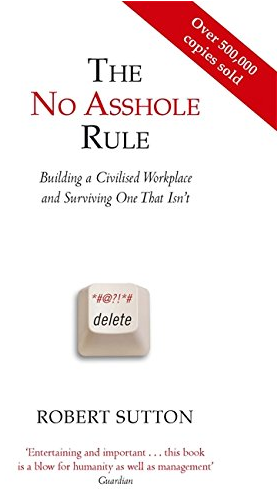
The No Asshole Rule, by Robert Sutton

The No Asshole Rule: Building a Civilized Workplace and Surviving One That Isn't, by Robert Sutton

I
n preparation for a review of Robert Sutton's latest book, "The Asshole Survival Guide", I went back to his bestseller, "The No Asshole Rule."

Prof. Robert Sutton is Professor of Management Science and Engineering and Professor of Organizational Behavior at Stanford University. In 2007 he wrote "The No Asshole Rule", which turned out to be a blockbuster bestseller, selling close to a million copies. The book itself was the result of an article he wrote in 2004, "More Trouble Than They’re Worth", and which became a Harvard Business Review's "Business Breakthrough Ideas for 2004".

Dealing with, interacting with, being at the receiving end of, and sometimes even acting like one are an inescapable fact of the workplace. What is? Who are? Being what? An "asshole", is what the author writes.

Friday, September 8, 2017

Infosys, NRN, Sikka - No one is smelling of roses here


C
orporate sagas seem to come in twos. The mega-fracas that erupted in 2016 between Cyrus Mistry, then Chairman of Tata Sons, and the iconic Ratan Tata, Chairman Emeritus at Tata Sons,  was starting to come to a close by the second half of 2017 (though I fear the last words have yet to be written). Ratan Tata had annointed N Chandrasekaran, CEO of TCS, as thew Chairman of Tata Sons, and re-asserted his complete control over the sprawling Tata empire. Now comes the rather unexpected news that Vishal Sikka (@vsikka), CEO and MD of Indian IT behemoth Infosys, had tendered in his resignation, apparently unable to tolerate any longer the constant "drumbeat of distractions" from co-founder Mr. NRN Murthy, and, some speculated, a lack of support from some members of the Infosys Board itself.
In particular, this is what Vishal Sikka wrote in his letter to the Board:
"Over the last many months and quarters, we have all been besieged by false, baseless, malicious and increasingly personal attacks. Allegations that have been repeatedly proven false and baseless by multiple, independent investigations. But despite this, the attacks continue, and worse still, amplified by the very people from whom we all expected the most steadfast support in this great transformation." [link]
In this perhaps altogether avoidable saga, no one has come out smelling of roses - not the Infosys board, not Vishal Sikka, and not Mr Murthy.

A Retrospect for Vishal Sikka

image credit: pexels.com
Let me start off by revisiting what I had written in 2014 - "A 'Vishal' opportunity awaits Infosys" - at the time of Mr Sikka's appointment as CEO and MD of Infosys.To summarize, I had made the following points:

Was Sikka a "trophy CEO"? I had written, "There will be more than one voice heard whispering that Sikka's appointment is more of a publicity gimmick meant to save face for its iconic co-founder, Narayan Murthy, who has been unable to right the floundering ship of the software services giant." This is still a pertinent question. Once the excitement of the "trophy CEO" wore out, did Mr Murthy's interest in Vishal Sikka also wane? Conversely, once the excitement of the CEO's crown wore off for Mr Sikka, did the thorns of leading and growing a company, with close to two-hundred thousand employees, in a difficult business environment, start to prick?

Tuesday, August 29, 2017

Between Strategy and Success Lies Execution


Why Do We Undervalue Competent Management?

T
his one comes from the Sep-Oct, 2017 issue of Harvard Business Review.

Between strategy and success lies the minor matter of execution. Execution in turn is dependent on the managers tasked with implementing the strategy.  After all, if a firm can’t get the operational basics right, it doesn’t matter how brilliant its strategy is. Execution is about figuring out the right way to do things, and then doing those things right, time after time.

Therein lies the rub. "Managerial competence takes effort, though: It requires sizable investments in people and processes throughout good times and bad. These investments, we argue, represent a major barrier to imitation."

Sep-Oct 2017 issue of
Harvard Business Review
The authors of the article use their research of "management practices across more than 12,000 firms and 34 countries." They rated companies' "18 practices in four areas: operations management,
performance monitoring, target setting, and talent management." These four areas, they believe are good-enough "proxies for general operational excellence."

The authors found clear laggards and clear "superstars" in their rankings. Not surprising, given the number of companies and the geographic spread of their survey. The laggards, for example, tended to have "promotions and rewards based on tenure or family connections." This begs the question, do companies where senior management has strong family connections are also more likely to be laggards? In either case, the authors found that family-run businesses had the weakest governance structures and lowest management scores on the survey. Lower scores translated to poorer financial outcomes.

Since this was also a longitudinal study in some ways, lasting several years, it also highlights the fact that changing management practices is not easy. The costs are high, and which may therefore also explain why so many companies pay only lip-service to improving management practices.

This is a useful and informative article. Leaders at companies, small and large, would do well to pay attention to the basics of management. The successful ones will be the ones who get these right. The ones who do not will die.

© 2017, Abhinav Agarwal (अभिनव अग्रवाल). All rights reserved.

Monday, August 21, 2017

Inside Chanakya’s Mind: Aanvikshiki and the Art of Thinking - Review

Inside Chanakya’s Mind: Aanvikshiki and the Art of Thinking, by Radhakrishnan Pillai

T
he relevance of Chanakya to today's world has only recently received the kind of attention it deserves. The author's 2014 book, "Chanakya's 7 Secrets of Leadership", co-authored with D Sivanandhan, was perhaps the first mainstream bestseller in this genre. The author's latest book in the series, "Inside Chanakya's Mind", provides many more insights into the mind and thinking of the greatest strategist in the last two thousand years and more.

First off, let's get the meaning of this word - Aanvikshiki - out of the way. I say "out of the way" because beyond the word is the book itself. It is therefore important to understand what it means. This will allow the reader to understand the book better.

Aanvikshiki is the combination of two words - "anu" and "ikshiki". "Anu" means atom, while "ikshiki" means "a person who wants to know."

Tuesday, August 8, 2017

The Jobs Trilogy - 2 - Six and One Types of Interviewers

R
emember Chuck Noland? The character in the movie Castaway, who has to use the blade of an ice-skate to extract his abscessed tooth, without anesthesia? The scene is painful to watch, yet you can't look away.

Interviews have this habit of turning up a Chuck Noland - in the interviewee or the interviewer. You willingly agree to subject yourself to the wanton abuse by random strangers who you may have to end up working for or with. Apart from the talented few whom companies are more eager to hire than they are to get hired, most are in less enviable positions.

What about interviewers? Not all are cut from the same cloth. But there are at least six types that I think we have all met in our lives, and a seventh one.

1. The Interview As an End In Itself - Hyper-excited newbie

You know this guy. You have been this person, most likely. You have a team now. You expect your team to grow. You have to build a team. You believe that you, and you alone, know what it takes to hire the absolutely best person for the opening you have. You sit down and explain to the harried hiring HR person what the role is, what qualifications you are looking for, why the job is special, why just ordinary programming skills in ordinary programming languages will simply not cut it, why you as the hiring manager are special, and how you will, with the new hire, change the product, the company, and eventually the whole wide world. The HR executive therefore needs to spend every waking minute of her time in the pursuance of this nobler than noble objective. You badger your hiring rep incessantly, by phone, by IM, by email, in person, several times a day, asking for better resumes if you are getting many, and more if you aren't getting enough. You read every single resume you get, several times over. You redline the points you don't like. You redline the points you like. You make notes on the resumes. You still talk to every single candidate. You continue interviewing, never selecting, till the economic climate changes and the vacancy is no longer available. Yes, we all know this person.

Monday, July 31, 2017

Management Mantras for Startups - Waste Not, Vacate Not

Image credit: pexels.com
Waste Not, Vacate Not.

W
hen Jeff Bezos, founder and CEO of Amazon, started out Amazon, he, along with Shel Kaphan, programmer and a founding employee, used sixty-dollar doors from Home Depot as desks. It was the demand of frugality. More than a decade later, when Amazon was a multi-billion dollar behemoth, conference-room tables were still made of door-desks. It reflected its CEO's adamant belief in "frugality." A leadership principle at Amazon states that "Frugality breeds resourcefulness, self-sufficiency and invention." In case you have been living in a world without news, you would know that Amazon's market capitalization, as of July 23rd, was a shade under US$500 billion, its trailing twelve-month revenues in excess of US$140 billion, and has been growing at an annual rate of more than 20%.

All this about Amazon's culture of frugality are captured in Brad Stone's brilliant book on the company, "The Everything Store: Jeff Bezos and the Age of Amazon."
"Bezos met me in an eighth-floor conference room and we sat down at a large table made of half a dozen door-desks, the same kind of blond wood that Bezos used twenty years ago when he was building Amazon from scratch in his garage. The door-desks are often held up as a symbol of the company’s enduring frugality."
...
They set up shop in the converted garage of Bezos’s house, an enclosed space without insulation and with a large, black potbellied stove at its center. Bezos built the first two desks out of sixty-dollar blond-wood doors from Home Depot, an endeavor that later carried almost biblical significance at Amazon, like Noah building the ark.
...
"Door-Desk award, given to an employee who came up with “a well-built idea that helps us to deliver lower prices to customers”—the prize was a door-desk ornament. Bezos was once again looking for ways to reinforce his values within the company."
...
"Conference-room tables are a collection of blond-wood door-desks shoved together side by side. The vending machines take credit cards, and food in the company cafeterias is not subsidized. When a new hire joins the company, he gets a backpack with a power adapter, a laptop dock, and some orientation materials. When someone resigns, he is asked to hand in all that equipment—including the backpack." [The Everything Store, by Brad Stone]

So what does this have to do with Flipkart?

Flipkart has been in business for (almost) ten years now (it was founded in October 2007). It has raised more than $4 billion dollars from investors, the most recent round of funding closing in early 2017. The Indian e-commerce pioneer however has yet to make a single new paisa in profit. In its fiscal year ending March 31st, 2016, its losses doubled to ₹2,306 crores (approximately US$350 million). Keep that in mind as you go through this post.

Tuesday, July 18, 2017

Flipkart and the Art of Advertising Mishaps - 1


I
n the age of startups, especially in the e-commerce space, where money is plentiful - or till a a year or so back, used to be - the only metric that seems to matter for the marketing function is "spend". Not ROI, CPA, CLV, etc... Splurging money on advertising became an end in itself. Where the mantra to success is growth, unencumbered by thoughts of the bottom line, any kind of growth will do. Therefore, growth in "eyeballs", "page-views", "app downloads", and other metrics of "engagement" - any and all numbers will do. Into this heady mix of unaccountability, if you then throw in lack of experience, lack of competence, and rank immaturity, you get a series of marketing disasters of the kind that headlined Flipkart's slow descent into what seems like inevitable irrelevance. One still hopes it will recover to give a creditable account of itself in its existential battle against Amazon. Then there is Alibaba and WalMart waiting in the wings. One hopes.

In this series of short posts, I will look at just a few marketing and advertising fiascoes at the company.

Monday, February 20, 2017

Flipkart and the Revolving Door

T
he contrast could not have been more striking, or poignant.
2017 began on a sombre note for Flipkart, when it announced on the 9th of Jan that Kalyan Krishnamurthy had been named CEO, and its current CEO Binny Bansal would become group CEO. It was the Indian e-commerce startup's third CEO in less than one year.
Three days later, on the 12th, Amazon let it be known via a press release that it intended "to grow its full-time U.S.-based workforce from 180,000 in 2016 to over 280,000 by mid-2018." To let that sink in, Amazon, already a company with a 180,000 employees in the US, would add another hundred-thousand full-time employees in eighteen months. Media was all over the news.

The battle for dominance of the Indian e-commerce market continues well into its third year. For all practical purposes this battle began in earnest only after Amazon entered India in 2013, and since then it has transformed into a brutal, no-holds barred, fifteen-round slugfest between Flipkart and Amazon. Yes, there is SnapDeal that is entering its end-game (there are talks of a merger between Paytm's marketplace and SnapDeal and of senior-level exits amidst rumours of a cash-crunch), there is ShopClues that has had to defer its IPO plans, and an e-commerce tragedy by the name of IndiaPlaza that was among the earliest e-commerce entities, which survived the dot-com bust of 2001, and yet folded up in a most ignominious manner. Ever since Amazon entered India in 2013, it notched up one success after another against the Indian behemoth, Flipkart. Flipkart went from strength to strength when it came to valuations even as it reeled from one blow to another in the market. Flipkart's party finally entered its long-expected yet still-painful endgame in 2016. For Amazon the costs have been equally staggering - billions of dollars sunk into its Indian operations, promises of billions more to be spent, break-even years and years away, and almost every last penny of profits from its parent company being shoveled into its Indian outpost.

Friday, February 17, 2017

Aamir Khan's Games and a Management Lesson on Celebrity Brand Endorsements

Movie poster of Dangal
[image credit: Disney]
N
ow that it is becoming clear that Aamir Khan's latest movie, "Dangal", is going to be a blockbuster hit (it's already recorded the second-highest opening of any movie in 2016), and with significant financial contributions in the form of ticket sales from the so-called right-wing brigade, it is time to go back in time a little bit and look at lessons learned and not learned. Lessons on brand management, lessons on social boycotts and boycott-fatigue, and lessons on adaptability.

Friday, September 6, 2013

Make Time for the Work That Matters

Make Time for the Work That Matters

"Make Time for the Work That Matters" is an article from the Sep 2013 issue of the Harvard Business Review, written by Julian Birkinshaw and Jordan Cohen. For the time being, the full article is available on the HBR site, and not behind a subscriber paywall.
The article promises to shed light on a problem that has defied a workable and lasting solution - how to spend more time on the really useful things. While the article does a good job of articulating the pressing need for to save time in the workplace, the proposed solutions however fall short of what would qualify as meaningful or workable.

Friday, July 5, 2013

HBR - Uses and Abuses of Influence


The Uses (and Abuses) of Influence

From the July-August 2013 issue of the Harvard Business Review comes an "interview with Robert Cialdini by Sarah Cliffe". At least for the time being, the full article is available on the HBR site here, and not behind a subscriber paywall.

Friday, June 28, 2013

HBR - Change for Change's Sake

Change for Change’s Sake

by Freek Vermeulen, Phanish Puranam, and Ranjay Gulati

Change for Change’s Sake - Harvard Business Review, from the June 2010 issue of HBR, is a good article on how to decide it is time for organizational change in a company, and how to ask whether the persistence of any one organizational structure is fostering the growth of silos and entrenched networks, stifling of innovation, and adaptability.

A short series of questions, grouped into three sets can help companies get started on assessing the need for change.

Friday, June 21, 2013

HBR - The Unmanageable Star Performer


The Unmanageable Star Performer

The Unmanageable Star Performer - Harvard Business Review, from the May 2013 issue of the Harvard Business Review

This is a fictionalized case-study, "based on the case study "Superstar Leaders," by Abhishek Goel and Neharika Vohra (Indian Institute of Management, 2007)."

Tuesday, October 25, 2011

Power by Jeffrey Pfeffer: Why Some People Have It and Others Don't

Power: Why Some People Have It and Others Don't, by Jeffrey Pfeffer (Kindle Edition, Flipkart, my user review on Amazon)
4 stars
Do as the world does; not as you think it should.
This book is an urgent wake-up call to the nice, smart, but otherwise powerless people in the workplace. Secondly, it is a guide to understanding how mediocre people rise to and stay in power. Thirdly, well... aren't the first two enough? A riff though; the book almost drowns out its message in anecdotes. Stay focused through the innumerable accounts, and you will see the considerable merits in the book.

The premise of this book is simple. The world is not as nice a place as you think it should be. In fact, the world may actually be run mostly by psychopaths (The Psychopath Test). If bad people do bad things to good people, it is not because the good people deserve it. That's a fallacy. That's the "just-world hypothesis." If you buy into this hypothesis it hurts you in two ways. More on that in a bit. The acquisition of power in the business world does not necessarily flow to the good people. By good people I mean the people that good people would call good people. People who acquire power do so by understanding how the world works, and understand they need to work as the world does, and not force the world to work they way they want it to, notable exceptions notwithstanding.

By knowing these rules, and understanding how they work, and reading about them in the context of examples from the real world, the author hopes to level the playing field.
The belief in a just world has two big negative effects on the ability to acquire power. First, it hinders people’s ability to learn from all situations and all people, even those whom they don’t like or respect.
Second, this belief that the world is a just place anesthetizes people to the need to be proactive in building a power base.
Books on leadership, and books on leadership by leaders are your worst enemy. Because they have been written to fool people into thinking that good, kind-hearted, do-gooders are what leaders are. Leaders writing about themselves seldom write about what it really took for them to get to the top. Churchill called Stalin trustworthy in 1945. You won't read about that in Churchill's writings. Jack Welch did not talk about the accounting jugglery that GE indulged in to make its earnings look more predictable than they were. Why leaders, even rank-and-file people lie about themselves. They lie about verifiable facts. They exaggerate achievements. And this has been documented in studies over and over again.
People distort reality. One study found that out of 1,000 resumés, there were substantial misstatements on more than 40 percent.18 If people make up educational qualifications and previous job experience—stuff that can actually be verified—do you think everyone is completely honest when they describe aspects of their behavior and character that are more difficult to discover?
If that were not good enough, know that performance does not matter. Good performance is not likely to get you promoted. Bad performance will not get you fired, if you are a leader. Being nice may make your neighborhood kids like you, but it won't make your coworkers respect you. Unless there are consequences to disagreeing with you, people will not fear you. Between love and fear, always choose fear. Because fear gets you results. Love gets you, well, a big wet kiss from a puppy. Maybe.

So enough with the cynicism. What does it take to get to the top? Well, like any good book, there is a list. There is a list of attributes.
The three three personal qualities embodied in will are ambition, energy, and focus. The four skills useful in acquiring power are self-knowledge and a reflective mind-set, confidence and the ability to project self-assurance, the ability to read others and empathize with their point of view, and a capacity to tolerate conflict.

The fact that status hierarchies are stable means not only that it is difficult to move up but also that it is difficult to move down. Once you have achieved power and status through the network of your relationships, you will be able to maintain your influence without expending as much time and effort.

This is a very engaging book that is well-organized and takes the reader through the topic of power. However, the anecdotes accounts of people tend to drown out the substantive stuff at times. The author, you realize, is making the point that the real world exists, despite our denials. The accounts reinforce the reality of power in the world. However, you wish they were a little less in-your-face and in-every-paragraph.

University of California–Berkeley professor Morten Hansen has studied what types of social networks are most useful given different types of product development efforts. When you need to access tacit knowledge, a smaller network of close ties is important because it takes close relationships to get people to spend the time to explain their tacit expertise. When the project requires locating explicit knowledge that can be readily transferred once you find it, a large network of weak ties provides greater benefit.
This is a list of the chapters in the book. This will help you understand the lay of the land, so to say, in the book.
  1. It Takes More Than Performance 
  2. The Personal Qualities That Bring Influence 
  3. Choosing Where to Start 
  4. Getting In: Standing Out and Breaking Some Rules 
  5. Making Something out of Nothing: Creating Resources 
  6. Building Efficient and Effective Social Networks 
  7. Acting and Speaking with 
  8. Building a Reputation: Perception Is Reality 
  9. Overcoming Opposition and 
  10. The Price of Power 
  11. How-and Why--People Lose Power 
  12. Dynamics: Good for Organizations, Good for You? 
  13. It's Easier Than You Think


Kindle Excerpt:


© 2011, Abhinav Agarwal. All rights reserved.

Saturday, June 11, 2011

HBR - Can You Handle Failure

 Managing Yourself: Can You Handle Failure? - Harvard Business Review, by Ben Dattner and Robert Hogan, comes from the April 2011 issue of the Harvard Business Review. The issue itself is a special on failure - the "F" word.

To prevent failures, inevitable at some point in everyone's career, from derailing or even destroying your career, you have to recognize whether your reaction to failure is "dysfunctional", and if so, which of the 11 types does it fall under. These types "represent roughly 70% of the U.S. population". These 11 types can be divided into three categories - "Denies Blame", "Blames Others", and "Blames Oneself" - proposed by the psychologist Saul Rosenzweig in the 1930s.. The cynic in us would like to be in the first two camps - to deny blame and then to blame others.

The 11 types listed are:
Blames Others
(Extrapunitive)
1. Excitable: “Volatile Guardian”
2. Cautious: “Sensitive Retirer”
3. Skeptical: “Wary Watcher”
4. Leisurely: “Rationalizing Blamer”

Denies Blame
(Impunitive)
5. Bold: “Big Person On Campus”
6. Mischievous: “High-Wire Walker”
7. Reserved: “Indifferent Daydreamer”
8. Colorful: “Thespian”
9. Imaginative: “Assertive Daydreamer”

Blames Oneself
(Intropunitive)
10. Diligent: “Micromanager”
11. Dutiful: “Martyr”


 HP's former CEO and one-time gubernatorial candidate for the state of California, Carly Fiorina, is singled out for being a blame-denier:
One well-known executive who has been accused of this sort of behavior is Carly Fiorina, a past CEO of Hewlett-Packard. Disgruntled former subordinates have described her as a self-promoting attention seeker who ignored integration challenges and day-to-day operations
following HP’s 2002 merger with Compaq and took no responsibility when the combined company failed to live up to its potential. When the HP board suggested that she delegate greater authority to her team and more power to the heads of key business units, she refused and was  subsequently dismissed. (When HBR contacted Fiorina’s chief of staff about this article, she declined to comment.)
Carly may be an atypical example, since the author says that "Because of their socialization and other
cultural influences, women are more likely than men to be intropunitive.
"
The key to learning and changing your response to failure is to be "self-aware". A personality test can help you assess what your personality type is. Myers-Briggs Type Indicator and Big Five are two such models. You also have to be "politically aware", which "involves finding the right way to approach failure within
your specifi c organization, department, and role
". It is possible that different types of people may be successful at different companies - big or small, private or public sector.
An obituary published on the Washington University in St Louis web site had this to say:
Saul Rosenzweig, Ph.D., professor emeritus of psychology in Arts & Sciences and an internationally recognized expert on psychoanalysis, died Monday, Aug. 9, 2004, in St. Louis. He was 97.

He made his mark on the field in the 1930s with a publication outlining common factors underlying a range of popular and competing approaches to psychotherapy. He dismissed the contentious contemporary arguments about which approach was most effective, arguing that all methods of therapy — when competently used — could be equally successful.

His premise became known as the "Dodo Bird Hypothesis" — a reference to Lewis Carroll's 1865 book, Alice in Wonderland, in which a dodo bird declares: "Everybody has won and all must have prizes."

Rosenzweig's study of aggression led to the Rosenzweig Picture-Frustration Study, a test of latent hostility.


© 2011, Abhinav Agarwal. All rights reserved.

Saturday, May 28, 2011

Talent Is Overrated

Talent Is Overrated: What Really Separates World-Class Performers from Everybody Else
Talent Is Overrated: What Really Separates World-Class Performers from Everybody Else (Kindle edition, Flipkart.com, my review on Amazon.com)
No prodigal, inborn talent. No silver bullet. No shortcuts. Hard work, focused, deliberate practice, a good teacher, and perseverance.

This is an outstanding book on excellence. Myth-busting yet liberating in the opportunities it lays open to the reader. Deserves to be read by one and all - and should be mandatory reading especially for parents I may suggest.
There are several books that talk about performance and the secrets, so to say, behind success and developing world-class skills. Amazon itself lists 119,049 books on the subject. There is even a magazine named "Success" on the topic. Outliers by Malcolm Gladwell is one recent book on the subject. This book, Talent Is Overrated: What Really Separates World-Class Performers from Everybody Else, however is perhaps the best and most comprehensive look at what it takes to deliver world-class performance. Not deep, because the book does not delve into the neurological, psychological or other factors in depth that affect success. It does mention myelin, but only as a possible contributor to efficacy in performance, but something that has not been proven beyond doubt in its ability to affect performance in adults But comprehensive because it looks at almost all aspects of building world-class competencies, thinks of alternative explanations of genius, examines popular conceptions and misconceptions of genius, personalities through the ages thought to be endowed with some sort of a "genius" gene, medical explanations, and more.

The Cambridge Handbook of Expertise and Expert Performance (Cambridge Handbooks in Psychology)The history of outstanding skills is not new. The thinking however has changed dramatically. From believing that everyone was born with an inborn, innate, fixed capacity for a certain level of performance to more modern thinking that believes outstanding skills are the composite result of several factors, all of which are within the grasp of most humans - there has been a significant change in mindsets. What however still persists is the popular belief that some people are "just born with talent", perpetuated by fatuous journalists looking for a story that is more exotic than the rather mundane "hard work" theory. You never got a successful headline that read "Long hours, hard work, focused practice - the secret of success." It is much easier for us to believe, and rather, very important for the preservation of our self-esteem, that success that attends the outstanding performers is not within the reach of us, "average" humans. If we had to believe that success is in our hands, then we would also have to believe that we did not work towards achieving it. Much more comforting to the ego to believe that outstanding talent is "inborn", that some people are "simply born with it", or that some are "just good with numbers", or that some "have a photographic memory".

What about the quaint but oft-repeated accusation against formal schooling? The one where people claim that schooling actually makes you less likely to "create" something? That schooling actually ends up making you no different from the others, a replica of each other, stamped from the assembly-line output of education factories? This is a oft-repeated accusation against schools, most often heard being spouted by armchair experts from the comfortable confines of headline seeking news outlets. The author begs to differ.
And what about evidence for the related notion that excessive schooling is correlated with lower creative achievement? ... Indeed, in many creative fields the person who pursues an advanced degree has consciously chosen a path that leads to a professorship, not to a life of innovating in that domain; it makes perfect sense that in these fields, those with the most years of formal schooling would be less eminent as innovators.
...
Innovation doesn't reject the past; on the contrary, it relies heavily on the past and comes most readily to those who've mastered the domain as it exists. [pages 155-157]

There does seem to be some scientific truth behind the assertion that it is easier to learn things when you are young.
A separate effect involves myelin, the substance that wraps slowly around neurons with practice, insulating and strengthening key connections in the brain. ... Starting early holds advantages that become less available later in life. [page 171]
Outliers: The Story of SuccessThis is something that the book, What's Going on in There? : How the Brain and Mind Develop in the First Five Years of Life, also describes. That myelin could play a vital role in helping strengthen these key connections, especially in the first few years of life. BUT, and the big but is that there is no evidence that the same holds true for people later on in life.
In the research, the poorest performers don't set goals at all; they just slog through their work. Mediocre performers set goals that are general and are often focused on simply achieving a good outcome... best performers make the most specific, technique-oriented plans.
...
The best performers observe themselves closely. They are in effect able to step outside themselves, monitor what is happening in their own minds, and ask how it's going. Researchers call this metacognition ...
Average performers believe their errors were caused by factors outside their control... Top performers, by contrast, believe they are responsible for their errors.
[pages 116-119]


There may well be a so-called "talent gene" that determines success and expertise in some particular area of activity, but "...All we can say for the moment is that no specific genes identifying particular talents have been found." [page 24]

Talent skeptics are careful to say that the evidence, taken together, doesn't prove that talent is a myth. They allow that further research could eventually show that individual genetic differences are what make the greatest performers so accomplished. But hundreds of studies conducted over decades have failed to show this. On the contrary, the preponderance of them have suggested very powerfully that genetic differences of this particular type - that is, differences that determine the highest levels of performance - don't exist. [page 25]

Bounce: Mozart, Federer, Picasso, Beckham, and the Science of SuccessThere you go - as closely and as clearly as one can say in the language of science, that there is no evidence of a "talent gene". On the other hand, there is ample evidence, backed by rigorous scientific studies, that hard work pays.
On factor, and only one factor, predicted how musically accomplished the students were and that was how much they practiced. [page 18]


"The Role of Deliberate Practice in the Acquisition of Expert Performance (PDF)", by Anders Ericsson, Ralf Th. Krampe, and Clemens Tesch-Romer proposed "a new theoretical framework for understanding why some people are so remarkably good at what they do."
...
In a study of chess players, Nobel Prize winner Herbert Simon and William Chase (Ericsson's coauthor on the memory study) proposed the "ten-year rule," ...
Subsequent research in a wide range of fields has substantiated the ten-year rule everywhere the researchers have looked. In math, science, musical composition, swimming, X-ray diagnosis, tennis, literature ...
... Many researchers and authors produce their greatest work only after twenty or more years of devoted effort
It could be put very simply: What the authors called "deliberate practice" makes all the difference. .. "the differences between expert performers and normal adults reflects a life-long period of deliberate effort to improve performance in a specific domain." [pages 61 - 63]

Deliberate practice is characterized by several elements.
It's designed specifically to improve performance. ... Decades or centuries of study have produced a body of knowledge about how performance in developed and improved ... At least in the early going, therefore, and sometimes long after, it's almost always necessary for a teacher to design the activity best suited to improve an individual's performance.

In general, well-designed practice, pursued for enough time, enables a person to circumvent the limitations that would otherwise hold back his or her performance, and circumventing limitations is the key to high performance at an advanced age. In a study of chess players, the older ones chose moves just as well as the younger ones, but they did it in a different way. They didn't consider as many possible moves because they couldn't; but they compensated through greater knowledge of positions. [pages 181-182]

The Talent Code: Greatness Isn't Born. It's Grown. Here's How.Praise at a young age can often be the single biggest motivator for a child to latch on to a particular skill at a task and hone it over the next ten or fifteen years into world-class expertise.
... as people start learning skills in virtually any field, they're typically compared not against the world's greatest performers in that field but against others their own age. ... Standing out at any given age is an excellent way to attract attention and praise, fueling the multiplier, and it can be done without relying on any innate ability. [page 202]

In closing:
But if you believe that your performance is forever limited by your lack of a specific innate gift, or by a lack of general abilities at a level that you think must be necessary, then there's no chance at all that you will do that work.
That's why this belief is tragically constraining. Everyone who has achieved exceptional performance has encountered terrible difficulties along the way. There are no exceptions. If you believe that doing the right kind of work can overcome the problems, then you have at least a chance of moving on to ever better performance. But those who see the setbacks as evidence that they lack the necessary gift will give up - quite logically, in light of their beliefs. [pages 205-206]

http://en.wikipedia.org/wiki/Herbert_Simon
Talent Is Overrated: What Really Separates World-Class Performers from Everybody Else (Kindle)


© 2011, Abhinav Agarwal. All rights reserved.

Monday, March 28, 2011

Medium Maximization

From Dan Ariely's blog, comes this interesting post on the theory of "medium maximization"Behavioral finance lesson – frequent flyer points?: "

In response to a reader's email on his clients tending to select a financial retail custodian on the basis of which offered more frequent flyer miles, which is an odd way to be sure of making such critical decisions, Dan Ariely offers this interesting concept to explain how people make decisions...
This phenomenon is what we call “medium maximization.”
The basic idea is that often people focus on near term concrete goals (such as frequent flyer miles), and while trying to maximize these immediate and clear goals they forget or discount the real reason for their actions — which in your case is maximizing their financial outcome. (For a great paper on medium maximization see this paper by Chris Hsee)
Why do people engage is such medium maximizations? Because it is easy. It gives people a clear direction for behavior — and just having something measurable within reach can redirect our motivation. Another reason for the efficacy of medium maximization is that such immediate and concrete goals by which to measure ourselves against give us a sense of progression ….

Abstract: A medium--for example, points or money--is a token people receive as the immediate reward of their effort. It has no value in and of itself, but it can be traded for a desired outcome. Experiments demonstrate that, when people are faced with options entailing different outcomes, the presence of a medium can alter what option they choose. This effect occurs because the medium presents an illusion of advantage to an otherwise not so advantageous option, an illusion of certainty to an otherwise uncertain option, or an illusion of linearity to an otherwise concave effort-outcome return relationship. This work has implications for how points influence consumer choice and how money influences human behavior. Copyright 2003 by the University of Chicago.
When applying such a concept to the area of employment, do people sometimes decide to join a company based on the company providing free soft-drinks. Sure it is a perquisite, a convenience, but certainly not one on which an employment decision should be made.