Showing posts with label animals. Show all posts

Monday, March 5, 2012

Sasan Gir National Park and Wildlife Sanctuary


The truly majestic Asiatic lion now lives in the wild in only one place in Asia; in the western Indian state of Gujarat, within the protected confines of the Gir Forest National Park and Wildlife Sanctuary (Gujarat Tourism page on Gir, Wikipedia page on Gir). Where at one point in time the Asiatic lion could be found even in Northern Africa, today there are less than 500 Asiatic lions left in the wild, all of them in the 1400 sq kms that forms the sanctuary, of which about 250 sq km is fully protected.

This is the entrance to the park boundary when approaching the park from the eastern side. Basically this is where you would enter the park if you came from the Union Territory of Diu.

Friday, October 14, 2011

Monkeys in Kodaikanal

As you approach the hills or jungles, you get to see lots and lots of monkeys. On trees, by the roadside, and just about everywhere. More so along the roads because of highway drivers that sometimes stop to throw food for the monkeys.
No different when in Kodaikanal (see my earlier post, On the road to Kodaikanal and all posts labeled kodaikanal). These are photos of some of the hundreds of monkeys we passed during our drive to Kodaikanal and while there.

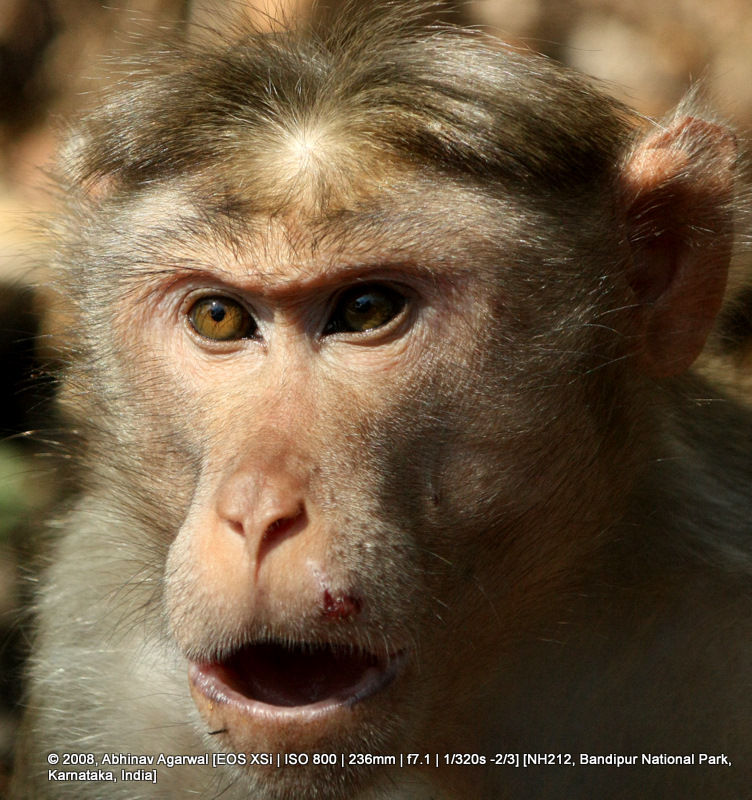
Some of the monkeys have hairdos you would be proud to get from a salon.


Monkeys are social animals. When they live in groups they also fight for territorial rights. A sign of aggression is to bare their teeth. Look at the canines and you will realize why monkeys can be so dangerous. These canines are long enough and attached to jaws strong enough to inflict mortal wounds on even full-grown adults. Hence it is a good idea to steer clear of monkeys, not to throw food at them because that will attract their attention even more towards you, not to tease them, not to throw stones at them, and lastly, to stay away from groups of monkeys where there are small monkeys.


This monkey below could appear on the cover of GQ and look dapper-er than most of the models that grace its cover I suspect. A most distinguished looking specimen of its species. Hats off.


© 2011, Abhinav Agarwal. All rights reserved.

Monday, June 20, 2011

NH 212 through Bandipur National Park

If you want to go to the Kerala district of Wayanad (see all posts on Wayanad), set on the Western Ghats, one way is to do so via Gundalpet. This is of course assuming that you are driving from Bangalore or Mysore.

View Larger Map

If you are driving from Bangalore that would indeed be the shortest path I believe. From Bangalore to Mysore via the four-laned SH17, then on to NH 212, to Gundalpet via Nanjangud. After you cross Gundalpet you need to make a right to continue on to NH 212. If you go straight, that will lead you to Bandipur (see posts), but via NH 67, and on to Tamil Nadu, the Mudumalai National Park, and the hill stations of Ooty and Coonoor.

View Larger Map

One thing you notice as soon as you get on this stretch of the highway is that the road is excellent. Parts of the highway did not have lane markings when we drove, but that could be because the asphalt looked recently laid. No speed-breakers either! Lovely. Till you hit the outer periphery of the Bandipur National Park, traffic and conditions permitting, you can do 100kmph on the highway.


As you enter the outer sections of the Bandipur National Park, the vegetation gets decidedly thicker, the habitation decidedly sparser, and the correct thing to do is to slow down and take in the serene drive at a more leisurely pace.


The thick vegetation and the tree cover makes for quite a picturesque view. If you like photography, or even if you do not, it makes for an ideal spot to pull over by the kerb and take in the scenery. I did so, and as I was shooting, I was very glad indeed to find someone as eager into highway photography that I had to snap this photo! By the way, it goes without saying that standing in the middle of a highway to photograph the highway is not a wise thing to do. No sir. Traffic was thin, so one could take the chance, unlike the Bangalore-Mysore highway that is decidedly busier, and with traffic moving much faster.

What is a forest drive without monkeys? It's not a forest drive.What is a forest drive without stopping to feed the monkeys? Not a forest drive.


One of the more enterprising things done by the Karnataka state government(s) over the years has been to put up these very distinctive signs for Karnataka Tourism that provide travelers with useful information at a glance. Like the prominent tourist attractions along the highway and the distance. The icons on the left also give you an indication of the type of tourist attraction. The temple icon next to Nanjangud for example tells you there is a historic temple there.


Search Amazon.com for karnataka tourism
Amazon.com Books on Karnataka Tourism
Search Amazon.com for karnataka tourism

 
© 2011, Abhinav Agarwal. All rights reserved.

Saturday, April 9, 2011

Nagarhole National Park

The Nagarhole National Park, also known as the Rajiv Gandhi National Park, in memory of the late Prime Minister of India, is one of four contiguous national parks (posts on national parks) in south India. These four parks are Nagarhole, Bandipur, Mudumalai, and Wayanad Wildlife Sanctuary. Per Wikipedia, the park forms an area of over 2000 sq kms.It is a part of the Nilgiris Biosphere Reserve (posts)

Nagarhole and adjacent National Parks on Google Maps.

View Larger Map

Kabini is perhaps an ideal place to stay at if you want to visit this national park. There are several mid to high-end resorts in Kabini, including Jungle Lodges, Cicada, Orange County, The Serai, and more. The National Park takes about 4 hours to get to from Bangalore, and is a relaxing, calm, soothing, refreshing weekend getaway.

The tattered condition of the board does no justice to either the national park or the memory of Rajiv Gandhi. Our national parks deserve better.


Inside the national park, along a "kuccha" (dirt) road.

Deer and sambhar can be found in abundance. Predators are more difficult to spot.


A wizened "crocodile-skin" bark of a tree.

A machaan for wildlife observers to park themselves at and observe wildlife.

There is an elephant, a wild elephant in this photo below. If you look closely you can spot it. This is not a forest department elephant, but the real deal - a true forest tusker (or maybe not a tusker, since it is difficult to tell from afar). The elephant had come for a drink on the other side of the pond while we were in a Jungle Lodges vehicle on the other side, prohibited from getting down from the vehicle - park rules.

This Swaraj truck is from another resort neaby. Probably Orange County or Cicada. Not sure.

Here is a closeup of an elephant succumbing to the itch to scratch.


© 2011, Abhinav Agarwal. All rights reserved.

Saturday, July 25, 2009

Mysore Zoo - 1


View Larger Map
The Mysore Zoo is one of the oldest and best kept zoos in India.

These crocs are definitely not shedding tears. Though you may if you got any closer. Say what you will about these cold blooded creatures, you cannot help but admire the pearly white set of teeth they have.


This giraffe had the most expressive eyes I have seen on a giraffe.


I don't know what this dude was thinking, but I am sure the global financial crisis is not it. Even though he would not be much mistaken in thinking the crisis has been caused by the doings of people not dissimilar to him.


Now isn't this an aww-gee moment?


The weather was hot, and hippo seemed intent on staying put where he was.


And this pachyderm, the Asian elephant and its calf, cooled off by drinking some water and spraying some on him.


© 2009, Abhinav Agarwal. All rights reserved.

Sunday, May 3, 2009

Bandipur National Park

The Bandipur National Park is one of nine forests in India that were designated a Tiger Reserve in 1973-74 as part of the Project Tiger initiative of the Government of India.

This park is contiguous with the Nagarhole National Park in Karnataka, the Mudumalai National Park in Tamil Nadu, Muthanga Reserve in Kerala, and the Mukurthi and Silent Valley National Parks. I had previously blogged (Bandipur and Mudumalai National Parks) on the Bandipur and Mudumali parks in March, with lots of photos.


View Larger Map


Map of the Bandipur National Park (available on http://projecttiger.nic.in/bandipurmap.htm)

The Bandipur Safari Lodge of Jungle Lodges and Resorts is a good place to stay at. It is on the outskirts of the Bandipur National Park, and some 17 kms from the Gundalpet town limits. As of April 2009, a room cost Rs 2750 per person per night, and the charges include "Stay, Lunch, Dinner & Breakfast, Jeep safari into Bandipur Tiger Reserve, Guided Nature Walk, Forest Entry Fees, Camera Fees & Taxes"

http://www.cicadaresorts.com/ is another highly recommended though (very) expensive place to stay.
Bandipur Tusker Trail Resort also crops up often enough when you do a search for hotels in and around the park.


JLR guide at the Golghar giving a talk before the tour into the national park.


Without knowing the precise lat-long coordinates of the place, it is awfully difficult to pinpoint precisely on a map where the lodge is, but if memory serves me right, this map below from Google Maps is where the Bandipur Safari Lodge is located. The distinctive golghar is visible in this satellite imagery, hence my confidence that this indeed is the JLR lodge. I may be wrong, but I think I have nailed the location...

View Larger Map


The Golghar at the Bandipur Safari Lodge. (Canon XSi|@30mm|1/4s|f3.5|ISO200|-2ev)


(Canon XSi|@30mm|1/50s|f5.0|ISO100|-1ev)
Almost the same camera angle, but this time at ISO 100, spot metering but with the focus on the light, 1/50 sec, and -1 step exposure compensation


Inside the park, in 2002

The Indian 'gaur' is mistaken for the bison, which it is not. However, the word 'bison' seems to have stuck, which is wrong, and wrong. This is the first thing that the safari guide at the Bandipur National Park took pains to make us aware of - the term Indian bison is the result of safari tourism. Anglicized names are better than Indian names like 'gaur', or it seems that the guides finally tired of repeating the word 'gaur' for the foreign tourists, and found it convenient to refer to the giant beasts as 'Indian bison'.

In case you are wondering what this gaur is doing, it is licking the wet mud on the ground. Why? No, not because it is thirsty and this is the only place that has any amount of water. But because the mud is rich in salt, and by licking this mud the gaur ensures that it gets whatever sodium its body needs.


The gaurs are massive beasts, reaching upto six or even seven feet and more in height at the shoulders. The females weigh in at 800 kgs, while the males can top a ton. Yes - a ton. 1000 kilograms. 2200 pounds. That is equal to 14 adults. Or the weight of a Maruti 800 car, with weight remaining for a driver, a passenger in each seat, with weight left for the luggage, and a full tank of fuel. You get the picture - these are massive beasts. Only the elephant weighs more among land animals in India. The rhino doesn't weigh as much. Nor the hippo. The elephant weighs at 3,000 to 5,000 kgs. That is almost equal to the wight of a large Detroit built SUV. And the elephant can swim. And is prettier to look at. And is environmentally very friendly, not ruinous like an SUV.

Other animals to spot are sambhar, deers, langurs, peahens, peacocks, eagles.


The tiger is very, very difficult to spot, and requires a good degree of luck and a good dose of perseverance. Firstly there are not that many tigers left in the wild. Even the latest tiger census figures seem to indicate that poaching is steadily but surely driving the tiger to extinction in India. In some reserves like Dudhwa and Sariska there is not a single tiger left; all have been poached, and for several years the forest officials were parading out fake numbers. A physical count, based on actual sightings, revealed there were no tigers left. These tiger reserves, which had upwards of 50 tigers each a decade ago, have probably less than a dozen each now. Some environmentalists argue that the tiger population in the wild has dipped below the point from where the tiger can be expected to survive in the wild. A tragedy, and not likely to be reversed.

The other reason behind the tiger's elusiveness is the season. During the post-monsoon months when the vegetation is lush and there are lots of small water holes and ponds all over the jungle that have water, the tiger does not need to venture much to get to water. The lush vegetation also makes it difficult to spot the tiger from the trails where the jeep travels on. Unlike humans, the tiger does not have any curiosity to watch urban slickers in the wild.


(Canon XSi|@83mm|1/30s|f/9.0|ISO200|0.0 ev)
Unless the tiger sees the need to venture out into the open you are most likely not going to spot the tiger. As someone once remarked, it is the tiger who decides if he wants to be seen. It remains a near-mythical beast, its presence felt more than seen. It is the tiger that makes a jungle a living entity.

Perseverance and patience is not something that you can expect when you are bundled in a jeep with half a dozen other people. Of course, all of them are there in the jeep, in the jungle, for the same purpose - to sight animals, and the tiger above all. The collective might of the expectations of a dozen humans is still not enough to stir the king of the jungle to come out and bless us with a sighting. Getting out of the vehicle is a no-no, and is anyway not something that city slickers are likely to do. Alcohol is prohibited, so that precludes any alcohol aggravated act of attempted self-annihilation.

The other thing to notice, and you notice it more by its absence, is the complete absence of plastic or other man made waste. It feels blessed to be in the jungle, and one is thankful for these few remaining tracts of land that have not yet been destroyed by the inexorable march of civilization.