. It seems that the surest and quickest way of getting page hits is to mention Google in an article (heck! even I am doing the same, amn't I???). It has an accompanying photo essay titled
. It lists examples of Exodus, Excite@Home, SGI, Novell, Siebel, and Oracle - all very well known companies at some point in time or other, that ran into troubles, in some cases terminal trouble, after moving into swanky new office premises. Oracle is a surprising inclusion, till you read that the reference is to its financial problems in the early 1990s when it had to restate earnings and lay off many employees. As for Excite and Exodus, these two companies fell to the dot-com bust that came in 2001.
Oracle's office in Redwood Shores: building 100 is now not visible. One of the problems of not having a wide enough lens. So the next best alternative to me is to use 'photo-stitching'.
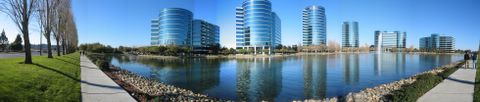
This photo is a combination of four separate photographs. Can't really tell where one photo has merged with the other. Technology is wonderful!
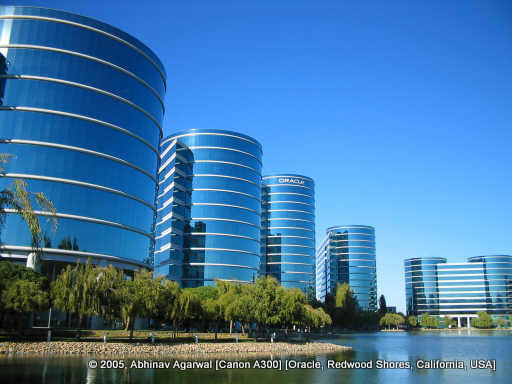
Everytime I visit Oracle's HQ at Redwood Shores, I cannot help gaze at the buildings. Very distinctive, and very different from many of the other cookie cutter hi-tech companys' buildings that you see in Silicon Valley and elsewhere. A clear day always makes for some lovely photographs, and this particular angle happens to be the one shot the most frequently. The buildings themselves have a cylindrical front and a cuboid back. The building with the words 'Oracle' is building 300, and the building you see furthest to the right is building 500, which is also Oracle's address: 500 Oracle Parkway. Building 600 is further to the right, and not in the photo.
Building 600 is now visible in this photo. But, building 100 is not.
More on Oracle's campus at Redwood Shores. This photo illustrates why I guess the buildings, especially the first three - 100, 200, and 300 - are in ascending order of height. 100 is the shortest one, 200 is taller, and 300 is taller than 200. If you approach the Oracle Parkway signal, this is how the buildings looks like: stacked on top of another almost.
And this is the shot from the intersection itself. If you travel up the same road a mile or so you will meet up with Oracle Parkway again, as it loops behind the Oracle campus and meets with this road up ahead.
 |
| Oracle's Redwood Shores Campus ((c) 2005, Abhinav Agarwal) |
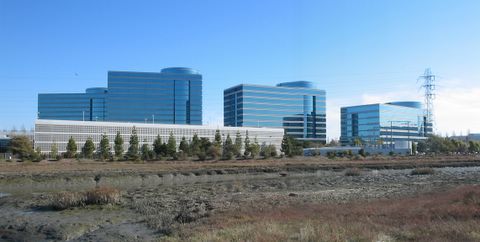
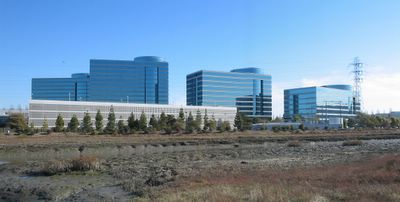
At first sight these buildings may appear to be small. But small they certainly aren't. Each building seats on average more than a thousand people, and this shot from the back brings out the size quite nicely. The white grilled structure in the foreground is one of the many parking garages.
A long line of cars, all making their way to the different Oracle offices. You would suspect that the 'nicer' cars, the Audis, BMWs, Lexuses, Mercs... were bought when Oracle's stock was trading at a price that had sent its market cap to over $200 billion and Larry Ellison richer than Bill Gates :-)
This is building 400 from behind.
This is the long path in front of the five cylindrical buildings. A favourite track for people who take a short walk after lunch.
December meant that most of the trees had shed their leaves, leaving behind a very stark looking picture.
Not only humans, but birds also frequent the campus.
Particularly pensive looking egret (let's call it a white-bird-with-a-long neck in case it's not an egret)
If you walk down the path, and towards building 600, you would see that the buildings are not so closely spaced as may appear at first glance.
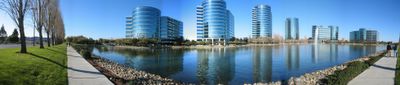
This shot didn't come through as nicely as I thought it could. This is basically a very very wide photo, taken by stitching together five or six different photos. I think I should moved a bit more to the right before taking these shots. Well... maybe next time.
© 2005, Abhinav Agarwal (अभिनव अग्रवाल). All rights reserved. Reposted to this blog, 2012
 Companies on the sands of Silicon Valley: Webex

 Companies in the sands of Silicon Valley - Macromedia.