Wednesday, December 8, 2010

Strand Book Stall Annual Sale 2010

Every year the Strand Book Stall holds an annual sale in the month of December. For the past few years they have tended to start the sale in the last week of November, on a Friday, and continue for three weekends (see my post on last year's sale -Strand Book Stall's 2009 sale).

For one year, in 2005 or 2006 I think, they had the sale inside the Chinnaswamy Cricket Stadium, in the rooms of the cricket association. You got to see ornate portraits of famous Karnataka state cricketers like Gundappa Viswanath, Erapalli Prasanna, Anil Kumble, Rahul Dravid, and others, and from the windows you got to see the lush green carpet-like field of the cricket stadium. Unfortunately, that sale was not repeated at the venue the next year, because the powers-that-be did not like the mass of book lovers thronging the exclusive domain of the cricket association's members. So, for the next two years the sale did happen at the stadium, but in one of the narrow rooms at the periphery of the stadium. Over the year-end break I will try and post photos from those sales.

For the last year or two the sale has been happening at Basava Bhavan, near the Chalukya Hotel. This year is no different, and the sale continues till Sunday Dec 12.


View Larger Map Map showing Basava Bhavan. It is triangulated by Palace Road, Sankey's Road, and Millers Road

Coming from Raj Bhavan Road, you need to make a right on to Sankey Road, then an immediate right at Sankey's Road, and then again an immediate right on to Miller's Road. The entrance to Basava Bhavan as well as parking can be found on this road.

The sale is split across two levels of the hall. This is the photo of the top level. As you can see they have made arrangements for extra tubelights to light up the place, because, you do need light if you are going to browse through tens of thousands of books and flip through them. Thoughtful.

This is the lower level, with books on cookery, design, and three full rows of books on children and for children.


Classics can be had for Rs 150.


This stacked arrangement of books makes it very hard to read the titles of the books on display. Given the shortage of space it is understandable, but nonetheless, to go over the titles you need to crane your neck sideways and then start shifting in one direction. And then hope that the books have all been stacked in the same direction, else you have to crane your neck the other way to read the title, and then crane it back, and so on. Not good.

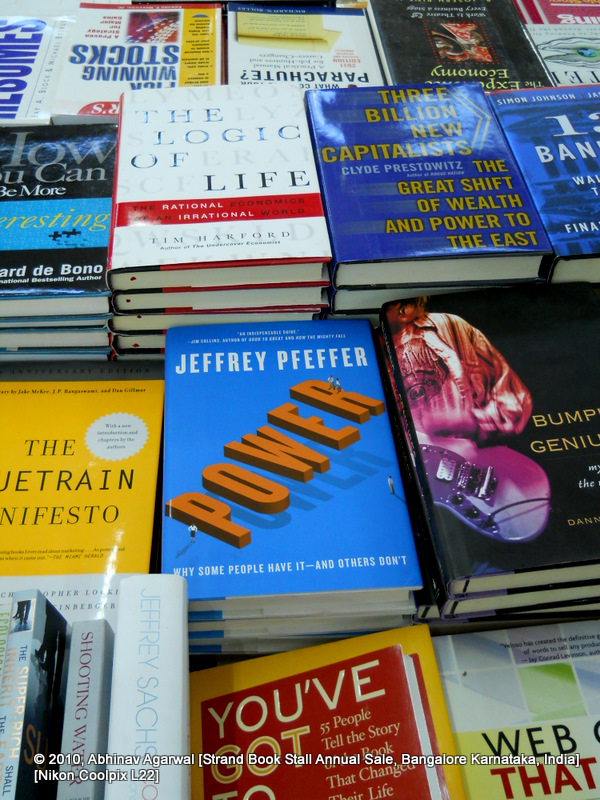
 Power: Why Some People Have It and Others Don't
 The Cluetrain Manifesto: 10th Anniversary Edition
 The Logic of Life: The Rational Economics of an Irrational World
 Three Billion New Capitalists: The Great Shift of Wealth and Power to the East

The books themselves do not seem to be arranged in any particular theme, beyond the very broad themes of fiction and non-fiction. Within non-fiction there is a wide assortment to be had, sometimes right next to each other. A book on the psychology and science of shopping is right below one on microfinancing, which is adjacent to a book on Six Sigma.
 Why We Buy: The Science of Shopping--Updated and Revised for the Internet, the Global Consumer, and Beyond
The Faber Report: How Wall Street Really Works-And How You Can Make It Work For You
Creating a World Without Poverty Social Business and the Future of Capitalism
What is Design for Six Sigma

Case in point below. A book on "Pricing Derivatives" has books on "Bourgeois Hinduism", "An End To Suffering", and "Proust" for company. Go figure.
 Bourgeois Hinduism, or Faith of the Modern Vedantists: Rare Discourses from Early Colonial Bengal
 How Proust Can Change Your Life
An End to Suffering: The Buddha in the World


 Cinema India: The Art of Bollywood
 Eminent Historians: Their Technology, Their Line, Their Fraud


Among others, I picked up these three books:
 Leading Change
Best of Sherlock Holmes (Wordsworth Classics) (Google Books link)
A Rasika's Journey Through Hindustani Music (A Rasika's Journey Through Hindustani Music by Rajeev Nair | Flipkart Books from Flipkart.com)


And other books from this post...


.

© 2010, Abhinav Agarwal. All rights  reserved

Tuesday, December 7, 2010

The Best of Sherlock Holmes

Best of Sherlock Holmes (Wordsworth Classics)

A hard-to-fault selection of Sherlock Holmes mysteries. 12 of the stories were selected by Sir Arthur Conan Doyle as the best from the 44 Sherlock Holmes stories that had appeared by then. David Stuart Davies adds a further 8 to the mix, which include such classics as The Man With the Twisted Lip, The Blue Carbuncle, and Charles Augustus Milverton. The mysteries seem to lose little of their charm and appeal more than a century after their writing. Short introduction by Davies is a useful bonus that reveals interesting tidbits.


"In the March 1927 issue of The Strand Magazine, a competition was held to choose the twelve best Sherlock Holmes stories from the forty-four already published in book form. Sir Arthur Conan Doyle had made his choice and placed the titles in a sealed envelope and readers were invited to match the great man's selection. ... It is fascinating to note that not one entrant chose the exact same titles. The winner, a Mr R.T. Norman, managed ten." [Introduction, pgs xiii, xv)
These are the twelve stories selected by Sir Arthur Conan Doyle
  1. The Speckled Band - a personal favorite of mine
  2. The Red-Headed League
  3. The Dancing Men - fascinating
  4. The Final Problem - a must-read for every Sherlock Holmes, where the detective meets his end, almost, at the hands of his nemesis, Prof Moriarty.
  5. A Scandal in Bohemia
  6. The Empty House - aka the Return of Sherlock Holmes.
  7. The Five Orange Pips
  8. The Second Stain
  9. The Devil's Foot
  10. The Priory School
  11. The Musgrave Ritual
  12. The Reigate Squires
and the 8 additional stories selected for this collection are:
  1. The Man With the Twisted Lip
  2. The Blue Carbuncle
  3. The Copper Beeches
  4. Silver Blaze
  5. The Greek Interpreter
  6. The Solitary Cyclist
  7. Charles Augustus Milverton
  8. The Illustrious Client

David Stuart Davies was born in 1946. He was a teacher of English before becoming a full-time editor, writer, and playwright. Davies has written extensively about Sherlock Holmes, both fiction and non-fiction.[1] [David Stuart Davies - Wikipedia, the free encyclopedia]

Sherlock Holmes (pronounced /ˈʃɜrlɒk ˈhoʊmz/)[1] is a fictional detective created by Scottish author and physician Sir Arthur Conan Doyle. A brilliant London-based "consulting detective", Holmes is famous for his astute logical reasoning, his ability to take almost any disguise, and his forensic science skills to solve difficult cases. [Sherlock Holmes - Wikipedia, the free encyclopedia

Sir Arthur Ignatius Conan Doyle, DL (22 May 1859 – 7 July 1930[1]) was a Scottish[2] physician and writer, most noted for his stories about the detective Sherlock Holmes, which are generally considered a major innovation in the field of crime fiction, and for the adventures of Professor Challenger. He was a prolific writer whose other works include science fiction stories, historical novels, plays and romances, poetry, and non-fiction. [Arthur Conan Doyle - Wikipedia, the free encyclopedia]


© 2010, Abhinav Agarwal. All rights reserved.

Monday, December 6, 2010

At Home

At Home: A Short History of Private Life

At Home: A Short History of Private Life
(my Amazon.com review, all my Amazon.com reviews)

Every house has a story. Every room has a story. And this is the almost perfect book to tell it. Quite an amazing feat.

Starting with the house, you go into almost every nook and cranny of the house that you can think of, including the bathroom, kitchen, dining room, living room, the hall, and the things that make up the house, like electricity, the spices in the kitchen, and those two, no three, tumblers of salt and pepper. Why only salt and pepper? No one knows. Really. No one knows.

Or how did corn and potatoes become so staple a feature of our diets?
"Potatoes are from the nightshade family, which is of course notoriously toxic, and in their wild state they are full of poisonous glycoalkaloids." [pg 28]
or
"Had people not been tending it continuously for these thousands of years, corn would be extinct." ... "Corn kernels do not spontaneously disengage from their cobs, so unless they are deliberately stripped and planted, no corn will grow." [pg 37]

That people in olden times had little time for anything except work, which brought them money for food, which took up an enormous proportion of their incomes, is documented in stark detail in the chapter "The Kitchen"
"Up to 80 per cent of all household expenditure, according to the bread historian Christian Petersen, was spent on food, and upto 80 percent of that went on bread." [pg 63]
Which brings us to the provenance of the phrase, "baker's dozen"
"Because bread was so important, the laws governing its purity were strict and the punishment severe. ... This was a matter of real concern for bakers because every loaf of bread loses weight in baking through evaporation, so it is easy to blunder accidentally. For that reason, bakers sometimes provided a little extra - the famous baker's dozen." [pg 63]

The history of ice is equally fascinating. Or that of electricity. Or the rise of New York city in the United States. And so on.

The weakest chapter may well be the one on "The Drawing Room", where there are more than a few digressions and detours that don't seem to take the reader back to the starting point in quite the same way as the other chapters do.

Such an exercise can quickly turn into a literary drudgery of sorts. What keeps this book a page-turner are three things: the logical collection of facts into chapters, each of which serves to take the reader into a part of the house.
Secondly, the skillful weaving of a ton of facts, nuggets, trivia, history, and more into a seamless narrative.
Thirdly, the use of humour in writing, without overpowering the reader. Sample this, "If it was his goal to make as little an impression as possible upon history, he achieved it gloriously."

It can become a bit overwhelming if you were to attempt to read this book in one sitting. A more rewarding option would be to read it one chapter at a time, and finish the entire book in a week or two. You can keep coming back to this book again and again, and can literally open it to any page at random, start reading from that point onwards, and expect to be rewarded by pearls of discovery.


Read a sample from the book (via Amazon Kindle on the Web)


The Colbert ReportMon - Thurs 11:30pm / 10:30c
Bill Bryson
www.colbertnation.com
Colbert Report Full Episodes2010 ElectionMarch to Keep Fear Alive

http://www.colbertnation.com/full-episodes/thu-october-14-2010-bill-bryson


Bill Bryson - Wikipedia, the free encyclopedia
Bill Bryson - Official Books Website
Bill Bryson: Home (Random House)
Excerpts from At Home

Search Amazon.com Books for bill bryson
Search Amazon.com Kindle Store for bill bryson
A Short History of Nearly Everything: Special Illustrated Edition
In a Sunburned Country
A Walk in the Woods: Rediscovering America on the Appalachian Trail
I'm a Stranger Here Myself: Notes on Returning to America After 20 Years Away
Bryson's Dictionary of Troublesome Words: A Writer's Guide to Getting It Right
The Lost Continent: Travels in Small-Town America
Neither Here nor There: Travels in Europe


© 2010, Abhinav Agarwal. All rights reserved.

Bangalore Metro, MG Road

The first stretch of Bangalore Metro is now almost ready for rollout. Sometime later this month, in December, or January, the first stretch is expected to start between Byappanahalli and MG Road. The photos below are from MG Road (see route map).


This is the Metro stretch as seen from the Anil Kumble circle. You can see the route snake northwards as it proceeds towards Cubbon Park, circling around the Chinnaswamy cricket stadium.

A closeup of the same stretch above.

Immediately after the Anil Kumble traffic signal, on the left-hand side of the road there is a coach kept for public display.


This below is the MG Road station, still under completion as you can see. Hectic construction activity can be seen all around. Between now and a month from now it will all be complete, with shiny new trains running on shiny new tracks, and stopping at shiny new stations.


View Larger Map


© 2010, Abhinav Agarwal. All rights reserved.
